Testing & Chemistry
Cyanuric Acid: Stabilizer, and Its Limit
It protects your chlorine from sunlight, and past a point it protects your algae from your chlorine too.
We have not handled these products and we do not pretend to have. Here is what we did instead. Links to Amazon earn us a commission at no extra cost to you, and commission never decides a pick — disclosure.
| # | Product | Best for | The spec it turns on | Price |
|---|---|---|---|---|
| 1 | 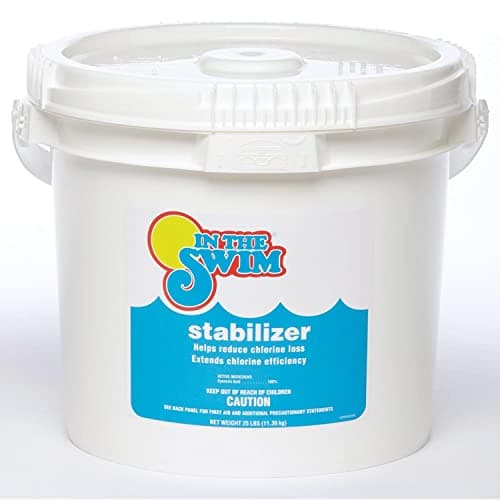 In The Swim Pool Stabilizer, 100% Cyanuric Acid, 25 lbTop pick100% cyanuric acid at a purity that lets you compute the dose, for pools whose chlorine source does not supply its own. | Stabilizing a liquid-chlorine or salt pool | 100% cyanuric acid, granular | |
| 2 | 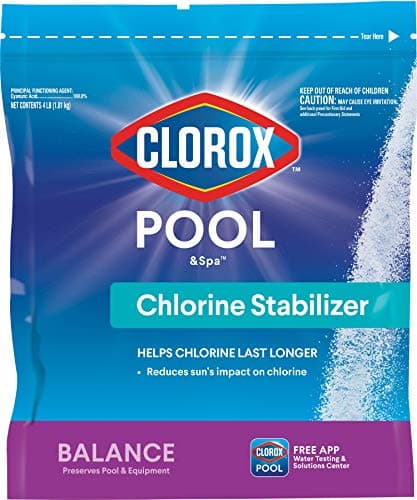 Clorox Pool&Spa Swimming Pool Chlorine StabilizerSaltwater pools burn through chlorine in sunlight faster than anything, and this is the correction, in a size that suits one. | Saltwater pools | Cyanuric acid stabilizer, stated as saltwater compatible | |
| 3 | 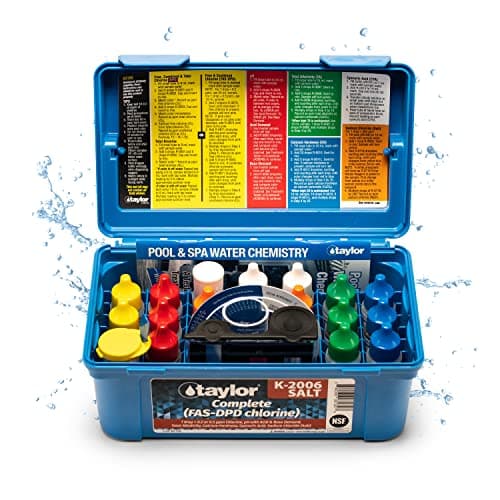 Taylor Technologies K-2006-SALT FAS-DPD 9-in-1 Test KitFAS-DPD is a drop-count titration, so the chlorine reading is a number you counted rather than a color you matched. | Knowing the number rather than the color | FAS-DPD titration; tests free and combined chlorine, salt, pH, alkalinity, hardness, cyanuric acid |
What it does, and why every outdoor pool needs some
Ultraviolet light destroys free chlorine quickly. HTH's chlorine stabilizer page states that cyanuric acid prevents up to 90% of chlorine loss from sunlight, which is the difference between a pool that holds a residual through a summer day and one that does not.
Cyanuric acid binds loosely to chlorine, holding a reserve that releases as free chlorine is consumed. It is genuinely essential outdoors, and it is why an unstabilized outdoor pool is an expensive way to make chlorine disappear.
The targets, and where they come from
| Pool type | Target CYA | Why |
|---|---|---|
| Trichlor or dichlor sanitized | 30-50 ppm | The tablets add their own; this is the working band |
| Saltwater | 60-80 ppm | A generator produces continuously, so more reserve helps |
| Indoor pool | None needed | No UV to protect against |
The limit, which is the part nobody mentions
The same binding that protects chlorine from sunlight also holds it back from doing its job. Past roughly 50 ppm, an increasing share of your measured free chlorine is bound rather than available, so the number on your test overstates what the chlorine is actually doing.
This is the single most common explanation for the most confusing situation in pool care: a green pool with a chlorine reading that looks fine. The chlorine is there. It is just not working.
It only leaves by dilution
Cyanuric acid is not consumed, does not evaporate, is not filtered out and is not broken down by chlorine. It accumulates, and the only way to reduce it is to remove some of the water and replace it.
How pools get there
- **Trichlor tablets, every week, all season.** The commonest route by far. Each tablet adds stabilizer as it dissolves.
- **Dichlor shock, used routinely.** Roughly 0.6 ppm of CYA rides along with every 1 ppm of chlorine added.
- **Deliberate over-dosing at opening**, usually because stabilizer dissolves slowly, the first retest reads low, and a second dose gets added before the first has finished.
- **Topping up rather than diluting.** A pool that only ever loses water to evaporation concentrates everything dissolved in it, including CYA.
Staying out of trouble
- **Test cyanuric acid a few times a season**, not once a year. It only moves in one direction.
- **Under-dose when correcting it.** Too little is easy to fix; too much needs a drain.
- **Wait 24 to 48 hours before retesting** after adding it, since it dissolves slowly and an early reading tempts an unnecessary second dose.
- **If you sanitize with tablets, shock with cal-hypo or liquid chlorine**, both of which add none. See cal-hypo vs dichlor vs trichlor.
- **If CYA is climbing every season, change the sanitizer** rather than fighting it. Liquid chlorine and salt systems add none at all.
The picks
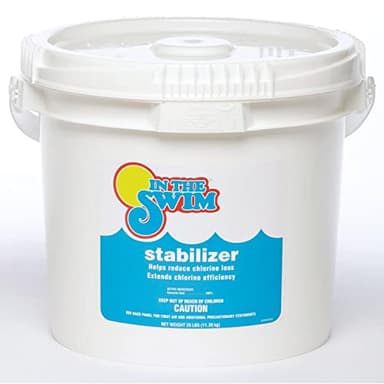
Top pick - Stabilizing a liquid-chlorine or salt pool
In The Swim Pool Stabilizer, 100% Cyanuric Acid, 25 lb
100% cyanuric acid at a purity that lets you compute the dose, for pools whose chlorine source does not supply its own.
The published figure
100% cyanuric acid, granular
Trichlor tablets and dichlor shock both add cyanuric acid as they dissolve. Liquid chlorine, cal-hypo and salt systems do not, so those pools need it added deliberately.
At 100% purity, 1 lb raises 10,000 gallons by 12 ppm. HTH's own stabilizer page states the useful targets: 30-50 ppm for trichlor and dichlor pools, 60-80 ppm for saltwater.
Cyanuric acid does not leave except by dilution. Adding too much is a mistake you fix by draining water, so under-dose and retest.
What it does well
- 100% purity means the arithmetic is exact
- Protects chlorine from UV loss, which HTH puts at up to 90%
- One correction lasts until you dilute the water
What it costs you
- Dissolves very slowly — 24 to 48 hours before a retest means anything
- Cannot be removed except by draining and refilling
Skip it if you sanitize with trichlor tablets. Those already add stabilizer, and your problem is more likely too much of it.
#ad · how this is funded · price as of October 18, 2026
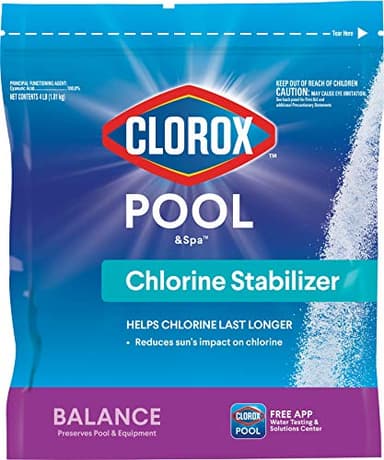
Pick 2 - Saltwater pools
Clorox Pool&Spa Swimming Pool Chlorine Stabilizer
Saltwater pools burn through chlorine in sunlight faster than anything, and this is the correction, in a size that suits one.
The published figure
Cyanuric acid stabilizer, stated as saltwater compatible
A salt chlorinator generates chlorine continuously and adds no stabilizer, so a salt pool without cyanuric acid loses most of what it makes to UV.
HTH's stabilizer page puts the saltwater target at 60-80 ppm, higher than the 30-50 ppm for tablet pools, because the generation rate is steady rather than dosed.
Add it through the skimmer with the pump running and give it two days before retesting.
What it does well
- Explicitly stated as saltwater compatible
- Directly reduces the chlorine your generator has to make
What it costs you
- Very slow to dissolve
- Cannot be reduced except by draining
Skip it if you already read above 80 ppm — more will start suppressing the chlorine you generate.
#ad · how this is funded · price as of October 18, 2026
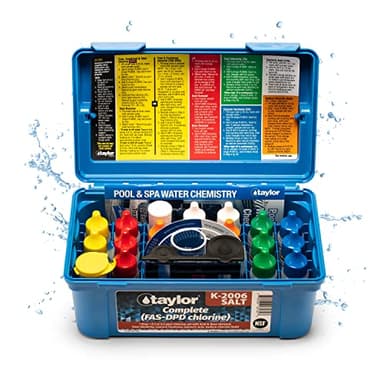
Pick 3 - Knowing the number rather than the color
Taylor Technologies K-2006-SALT FAS-DPD 9-in-1 Test Kit
FAS-DPD is a drop-count titration, so the chlorine reading is a number you counted rather than a color you matched.
The published figure
FAS-DPD titration; tests free and combined chlorine, salt, pH, alkalinity, hardness, cyanuric acid
Every strip and every DPD color-match kit asks you to judge a shade. FAS-DPD asks you to count drops until a color disappears, which removes the judgment entirely.
That matters most exactly where the cheap methods fail: above about 5 ppm free chlorine, color-match scales saturate and read 'high' for anything from 6 ppm to 30 ppm. When you are shocking, that is the range you are in.
It also measures combined chlorine separately, which is the reading that tells you whether the shock worked or the pool needs another round.
What it does well
- Titration rather than color matching, so chlorine is a counted number
- Reads accurately at shock-level chlorine where strips saturate
- Measures combined chlorine, cyanuric acid and salt in one kit
What it costs you
- Slowest kit here to use — several minutes per full test
- Reagents expire and need replacing each season
- The most expensive way to test
Skip it if you will not actually run it. A kit used monthly is worse than strips used weekly.
Questions people actually ask
What should cyanuric acid be in a pool?
How do I lower cyanuric acid in a pool?
Why is my pool green when the chlorine level is fine?
Is cyanuric acid the same as pool stabilizer?
Do chlorine tablets add cyanuric acid?
Sources
Every figure on this page traces to one of these. Where a number could not be sourced, the page says so rather than estimating.
- HTH Pool Care Chlorine Stabilizer - product page, states up to 90% chlorine loss from UV and CYA targets of 30-50 ppm for trichlor and dichlor pools, 60-80 ppm for saltwater
- HTH Pool Care 3" Chlorine Tabs Advanced - product page, states one tablet per 10,000 gallons lasts up to 7 days and holds free chlorine at 1-4 ppm
- Michigan EGLE, Maximum Disinfectant Residuals and Operational Ranges: Guidance for Michigan Licensed Pools (December 2025) - quotes CDC MAHC 5.7.3.1.1.5.0, the EPA FIFRA label rule and the NSF 10 ppm application ceiling
- Skim & Soak methodology - the constants, formulas and worked examples behind every dose on this site
- In The Swim Pool Stabilizer, 100% Cyanuric Acid, 25 lb - Amazon listing, read 2026-09-02
Read next
Best for routine sanitizing
Best Pool Chlorine Tablets
Four trichlor tablets compared, with the cyanuric acid and pH arithmetic that decides whether they suit your pool.
Top pick
In The Swim 3 Inch Stabilized Chlorine Tablets, 50 lb
Season-long sanitizing
#ad · how this is funded · price as of October 18, 2026
Cal-Hypo vs Dichlor vs Trichlor
Calcium, cyanuric acid or acid - every chlorine product adds something besides chlorine, and knowing which decides your season.
Top pick
In The Swim Pool Shock, 68% Cal-Hypo Granular, 25 lb
Clearing an algae bloom
#ad · how this is funded · price as of October 18, 2026
How to Clear a Green Pool Fast
The ordered fix: test, brush, shock by weight, filter continuously, clear the dead algae, then prevent the next one.
Best test kit
Best Pool Test Kits
Titration kits, color comparators, strips and a photometer compared on precision, speed and what each one cannot see.
Top pick
AquaChek Select Connect 7-Way Test Strips, complete kit
Weekly testing you will actually do
#ad · how this is funded · price as of October 18, 2026