Green Water & Algae
Best Pool Shock for a Green Pool
Ranked on the one figure that decides how much you need, and honest about what each chemistry adds besides chlorine.
We have not handled these products and we do not pretend to have. Here is what we did instead. Links to Amazon earn us a commission at no extra cost to you, and commission never decides a pick — disclosure.
| # | Product | Best for | The spec it turns on | Price |
|---|---|---|---|---|
| 1 | 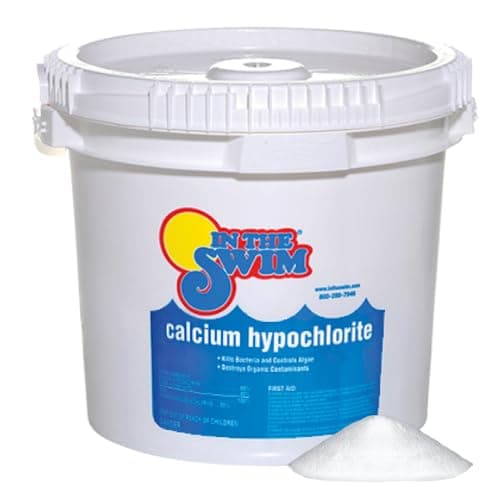 In The Swim Pool Shock, 68% Cal-Hypo Granular, 25 lbTop pickThe highest available-chlorine percentage in common retail cal-hypo, sold loose so you dose by weight instead of by packet. | Clearing an algae bloom | 68% available chlorine, calcium hypochlorite, sold loose by the pound | |
| 2 | 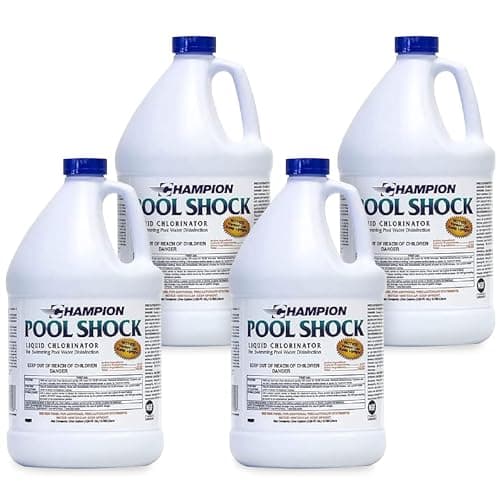 Champion Pool Shock Liquid Chlorine 12.5%, 1 gal, 4-packAdds nothing but chlorine and salt, which on a big bloom or a saltwater pool is exactly the point. | Large blooms and saltwater pools | 12.5% trade sodium hypochlorite, ready to use, no residue | |
| 3 | 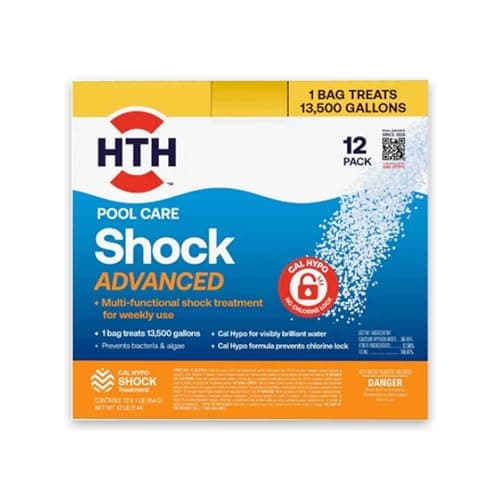 HTH Pool Care Shock Advanced, cal hypo, 12 packPre-measured bags sized to the weekly dose, from the only maker in this list that publishes its target ranges on the product page. | Weekly maintenance shocking | Calcium hypochlorite in pre-measured 1 lb bags; adds no cyanuric acid | |
| 4 | 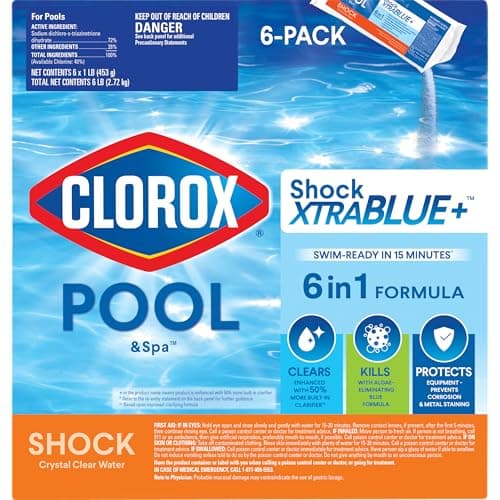 Clorox Pool&Spa Shock XtraBlue PlusDichlor, which dissolves fast and is pH neutral, at the cost of adding cyanuric acid with every dose. | Swimming again the same afternoon | Stabilized dichlor shock; label states swim-ready in 15 minutes | |
| 5 | 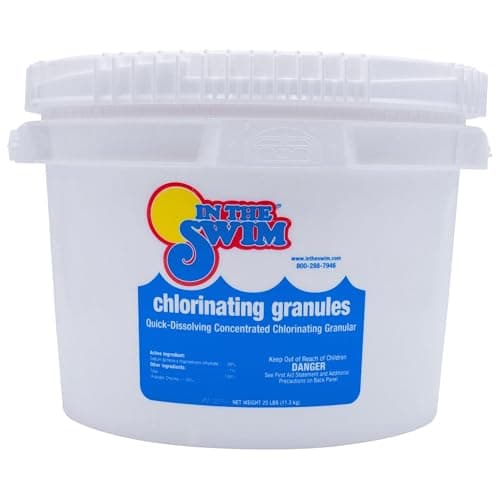 In The Swim Sodium Dichlor Chlorine Shock Granules, 25 lbThe liner-safe shock in a format you can actually weigh, if you are prepared to watch cyanuric acid climb. | Vinyl liners and fiberglass | Sodium dichloroisocyanurate, fast dissolving, sold loose |
How we picked
We have not used any of these products. What we have done is read the available-chlorine percentage each one publishes, work out what that means per gallon of your pool, and set out what each chemistry adds to your water besides chlorine - because that second thing is what decides whether you can use it again next month.
There are exactly three decisions in this category, and everything else is packaging:
- **Available chlorine percentage** decides how much product a given ppm costs you. It is printed on every bag and it ranges from 47% to 73% across products all sold as 'pool shock'.
- **What else it adds.** Cal-hypo adds calcium hardness. Dichlor and trichlor add cyanuric acid. Liquid chlorine adds salt and nothing else. Over a season, this is the decision that matters most.
- **Format.** Loose granular lets you weigh a dose; pre-measured packets force you to round to the nearest pound, which on a 7,000-gallon pool is a 30% error.
What each chemistry actually adds
| Chemistry | Typical available chlorine | Adds | pH effect | Best for |
|---|---|---|---|---|
| Calcium hypochlorite (cal-hypo) | 47-73% | Calcium hardness | Raises pH | Clearing blooms; any pool that already has enough stabilizer |
| Sodium dichlor | 56% | Cyanuric acid (~0.6 ppm per 1 ppm chlorine) | Roughly neutral | Vinyl liners; pools that need stabilizer anyway |
| Liquid chlorine (sodium hypochlorite) | 10-12.5% trade | Salt only | Raises pH | Hard water, saltwater pools, large volumes |
| Trichlor tablets | ~90% | Cyanuric acid; strongly acidic | Lowers pH | Slow-release sanitizing, never shocking |
How much you need, computed
Everything below is the same calculation with a different percentage substituted. That is the entire trick, and it is why the generic 'one pound per 10,000 gallons' advice is wrong for most pools and most products.
| Pool volume | How much |
|---|---|
| 5,000 gal | 10 oz |
| 10,000 gal | 1.2 lb |
| 15,000 gal | 1.8 lb |
| 20,000 gal | 2.5 lb |
| 25,000 gal | 3.1 lb |
| 30,000 gal | 3.7 lb |
| Pool volume | How much |
|---|---|
| 5,000 gal | 12 oz |
| 10,000 gal | 1.5 lb |
| 15,000 gal | 2.2 lb |
| 20,000 gal | 3 lb |
| 25,000 gal | 3.7 lb |
| 30,000 gal | 4.5 lb |
| Pool volume | How much |
|---|---|
| 5,000 gal | 51 fl oz |
| 10,000 gal | 102 fl oz |
| 15,000 gal | 1.2 gal |
| 20,000 gal | 1.6 gal |
| 25,000 gal | 2 gal |
| 30,000 gal | 2.4 gal |
The picks
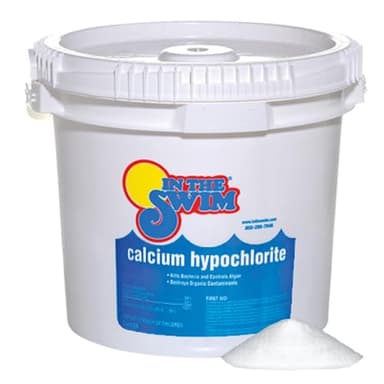
Top pick - Clearing an algae bloom
In The Swim Pool Shock, 68% Cal-Hypo Granular, 25 lb
The highest available-chlorine percentage in common retail cal-hypo, sold loose so you dose by weight instead of by packet.
The published figure
68% available chlorine, calcium hypochlorite, sold loose by the pound
68% available chlorine means 1 lb raises 10,000 gallons by about 8 ppm. A green pool typically needs 10 to 30 ppm depending on how far the bloom has gone, which is 1.2 to 3.7 lb per 10,000 gallons.
Loose granular is the format that lets you weigh a dose. Pre-measured 1 lb packets are convenient and fine for weekly maintenance, but they force you to round a shock dose to the nearest pound, which on a small pool is a 30% error.
Cal-hypo adds calcium hardness and no cyanuric acid. That is the right trade for a bloom and the wrong one for a pool that already sits above 400 ppm calcium.
What it does well
- 68% is the top of the common retail range, so you carry and store less product per ppm
- Loose granular lets you weigh an exact dose rather than round to a packet
- Adds no cyanuric acid, so shocking repeatedly does not drive you into chlorine lock
What it costs you
- Adds calcium hardness with every dose
- Must be pre-dissolved in a bucket for vinyl liners, which the label states
- A 25 lb bucket is more than a small pool will use in a season
Skip it if your fill water is already hard, or you own a small above-ground pool that will never work through 25 lb before the bucket cakes.
#ad · how this is funded · price as of October 19, 2026
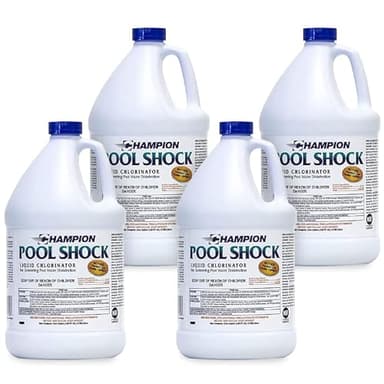
Pick 2 - Large blooms and saltwater pools
Champion Pool Shock Liquid Chlorine 12.5%, 1 gal, 4-pack
Adds nothing but chlorine and salt, which on a big bloom or a saltwater pool is exactly the point.
The published figure
12.5% trade sodium hypochlorite, ready to use, no residue
12.5% trade means one gallon raises 10,000 gallons by 12.5 ppm. That identity makes it the easiest chemistry on this page to dose in your head, and it stops being easy the moment your pool is not 10,000 gallons — see the calculator below.
Liquid chlorine adds no calcium and no cyanuric acid. For a pool that is already hard, already stabilized, or salt-chlorinated, that is the whole argument.
It also degrades. Sodium hypochlorite loses strength in storage, faster when warm, so a jug that has sat in a hot garage since last summer is not 12.5% any more.
What it does well
- Adds no calcium and no cyanuric acid
- Dissolves instantly, no pre-mixing, no granules on the liner
- Cheapest route to a large ppm swing on a big pool
What it costs you
- Loses strength in storage, particularly in heat
- Heavy and awkward to handle at four gallons
- Raises pH, so expect to follow with acid
Skip it if you cannot store it cool and use it within a couple of months — you will be dosing an unknown percentage.
Pick 3 - Weekly maintenance shocking
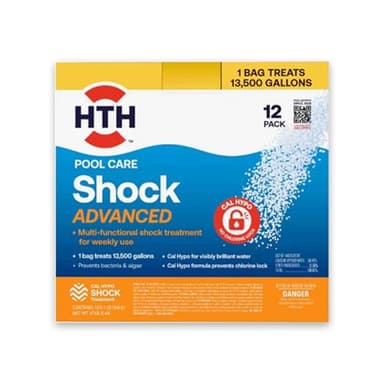
HTH Pool Care Shock Advanced, cal hypo, 12 pack
Pre-measured bags sized to the weekly dose, from the only maker in this list that publishes its target ranges on the product page.
The published figure
Calcium hypochlorite in pre-measured 1 lb bags; adds no cyanuric acid
HTH sells this in 1 lb sachets designed around a 10,000-gallon weekly dose, which is exactly the case where a packet is more convenient than a scale.
HTH's own product page states the Shock Advanced line is cal hypo and adds no cyanuric acid, which is what makes weekly shocking sustainable — dichlor at the same cadence walks CYA up until chlorine stops working.
Packets are the wrong format for an emergency. A bloom in a 15,000-gallon pool wants a weighed dose, not four bags and a guess.
What it does well
- Pre-measured for a weekly maintenance dose, no scale needed
- Cal hypo, so weekly use does not accumulate cyanuric acid
- HTH publishes its target chemistry ranges, which most brands do not
What it costs you
- Packet sizing forces rounding on any pool that is not near 10,000 gallons
- Costs more per pound of available chlorine than a loose bucket
Skip it if you are clearing a bloom rather than maintaining — buy loose granular and weigh it.
#ad · how this is funded · price as of October 19, 2026
Pick 4 - Swimming again the same afternoon
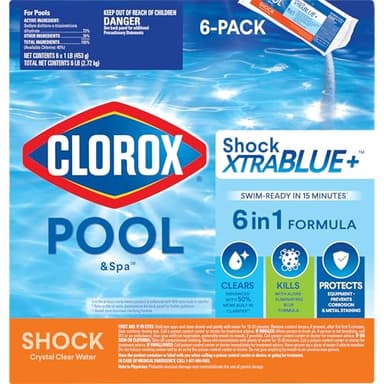
Clorox Pool&Spa Shock XtraBlue Plus
Dichlor, which dissolves fast and is pH neutral, at the cost of adding cyanuric acid with every dose.
The published figure
Stabilized dichlor shock; label states swim-ready in 15 minutes
Sodium dichlor is roughly 56% available chlorine and dissolves without pre-mixing, which is why the label can promise a 15-minute swim window.
The catch is structural, not a flaw in this product: dichlor is stabilized, so every dose adds cyanuric acid. Roughly 0.6 ppm of CYA rides along with each 1 ppm of chlorine. Shock a pool ten times in a season and you have added enough stabilizer to blunt the chlorine you are adding.
That makes dichlor a genuinely good occasional shock and a bad weekly habit.
What it does well
- Dissolves without pre-dissolving, so it is liner-safe straight from the bag
- pH neutral, so it does not drag pH up the way cal-hypo does
- Short swim-wait window stated on the label
What it costs you
- Every dose adds cyanuric acid, which accumulates and cannot be filtered out
- Lower available chlorine than cal-hypo, so you carry more product per ppm
Skip it if your cyanuric acid is already at or above 50 ppm — you would be making the next problem while solving this one.
#ad · how this is funded · price as of October 19, 2026
Pick 5 - Vinyl liners and fiberglass
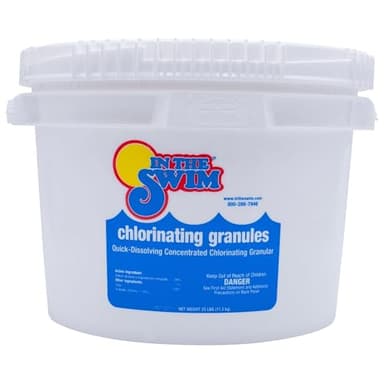
In The Swim Sodium Dichlor Chlorine Shock Granules, 25 lb
The liner-safe shock in a format you can actually weigh, if you are prepared to watch cyanuric acid climb.
The published figure
Sodium dichloroisocyanurate, fast dissolving, sold loose
Dichlor dissolves fast enough to broadcast directly, which is the practical argument for it on a vinyl liner where undissolved cal-hypo granules bleach the pattern.
Buying it loose rather than in packets is the same argument as the cal-hypo above: an exact dose beats a rounded one.
Keep a cyanuric acid test to hand if this is your regular shock. The stabilizer it adds is the reason it needs watching.
What it does well
- Safe to broadcast on vinyl and fiberglass without pre-dissolving
- Loose format allows a weighed dose
- pH neutral
What it costs you
- Adds cyanuric acid on every dose
- 56% available chlorine means more product per ppm than cal-hypo
Skip it if you shock weekly. At that cadence stabilizer accumulation is not a footnote, it is the outcome.
Which one for your pool
- **Plaster or gunite pool, ordinary tap water:** 68% cal-hypo, bought loose. Strongest per pound, no stabilizer accumulation.
- **Vinyl liner:** dichlor, or cal-hypo pre-dissolved in a bucket. Undissolved cal-hypo granules bleach a liner where they land.
- **Hard fill water, or calcium already above 400 ppm:** liquid chlorine. Cal-hypo would make an existing problem worse.
- **Saltwater pool:** liquid chlorine. It is chemically what your generator already makes, so it adds nothing new.
- **Cyanuric acid already above 50 ppm:** cal-hypo or liquid chlorine, never dichlor. Adding more stabilizer to a stabilized pool is how people end up draining water.
Storage, which matters more than people expect
Cal-hypo cakes if it takes on moisture and loses strength slowly once opened. Liquid chlorine degrades measurably in weeks at summer temperatures - a jug stored in a hot garage since last season is a genuinely unknown strength, and dosing it as though it were 12.5% is how people end up under-shocking twice. Dichlor is the most storage-stable of the three. Buy the quantity you will actually use, not the biggest tub on the shelf.
Questions people actually ask
What is the best pool shock for green algae?
How much pool shock do I need for a green pool?
Is liquid chlorine better than granular shock?
Can I use household bleach instead of pool shock?
Why did shocking not clear my pool?
Sources
Every figure on this page traces to one of these. Where a number could not be sourced, the page says so rather than estimating.
- HTH Pool Care Shock Advanced - product page, cal hypo formulation, adds no cyanuric acid
- HTH Pool Care 3" Chlorine Tabs Advanced - product page, states one tablet per 10,000 gallons lasts up to 7 days and holds free chlorine at 1-4 ppm
- HTH Pool Care Chlorine Stabilizer - product page, states up to 90% chlorine loss from UV and CYA targets of 30-50 ppm for trichlor and dichlor pools, 60-80 ppm for saltwater
- Michigan EGLE, Maximum Disinfectant Residuals and Operational Ranges: Guidance for Michigan Licensed Pools (December 2025) - quotes CDC MAHC 5.7.3.1.1.5.0, the EPA FIFRA label rule and the NSF 10 ppm application ceiling
- Skim & Soak methodology - the constants, formulas and worked examples behind every dose on this site
- In The Swim 68% Cal-Hypo Pool Shock, 25 lb - Amazon listing, read 2026-09-02
- Champion Liquid Chlorine 12.5% - Amazon listing, read 2026-09-02
Read next
How to Clear a Green Pool Fast
The ordered fix: test, brush, shock by weight, filter continuously, clear the dead algae, then prevent the next one.
Cal-Hypo vs Dichlor vs Trichlor
Calcium, cyanuric acid or acid - every chlorine product adds something besides chlorine, and knowing which decides your season.
Top pick
In The Swim Pool Shock, 68% Cal-Hypo Granular, 25 lb
Clearing an algae bloom
#ad · how this is funded · price as of October 19, 2026
Liquid Chlorine vs Granular Shock
Liquid adds only salt; granular cal-hypo adds calcium; dichlor adds stabilizer. Which matters depends on your water, not your budget.
Top pick
Champion Pool Shock Liquid Chlorine 12.5%, 1 gal, 4-pack
Large blooms and saltwater pools
Best for prevention
Best Pool Algaecide
Polyquat 60 for prevention without staining, copper for black algae, and one combination product we would not buy.
Top pick
In The Swim Algaecide 60 Plus, 1 quart
Prevention without staining