Testing & Chemistry
Testing & Chemistry
Every dose on this site starts here, because every dose starts with a number you measured rather than one you assumed.
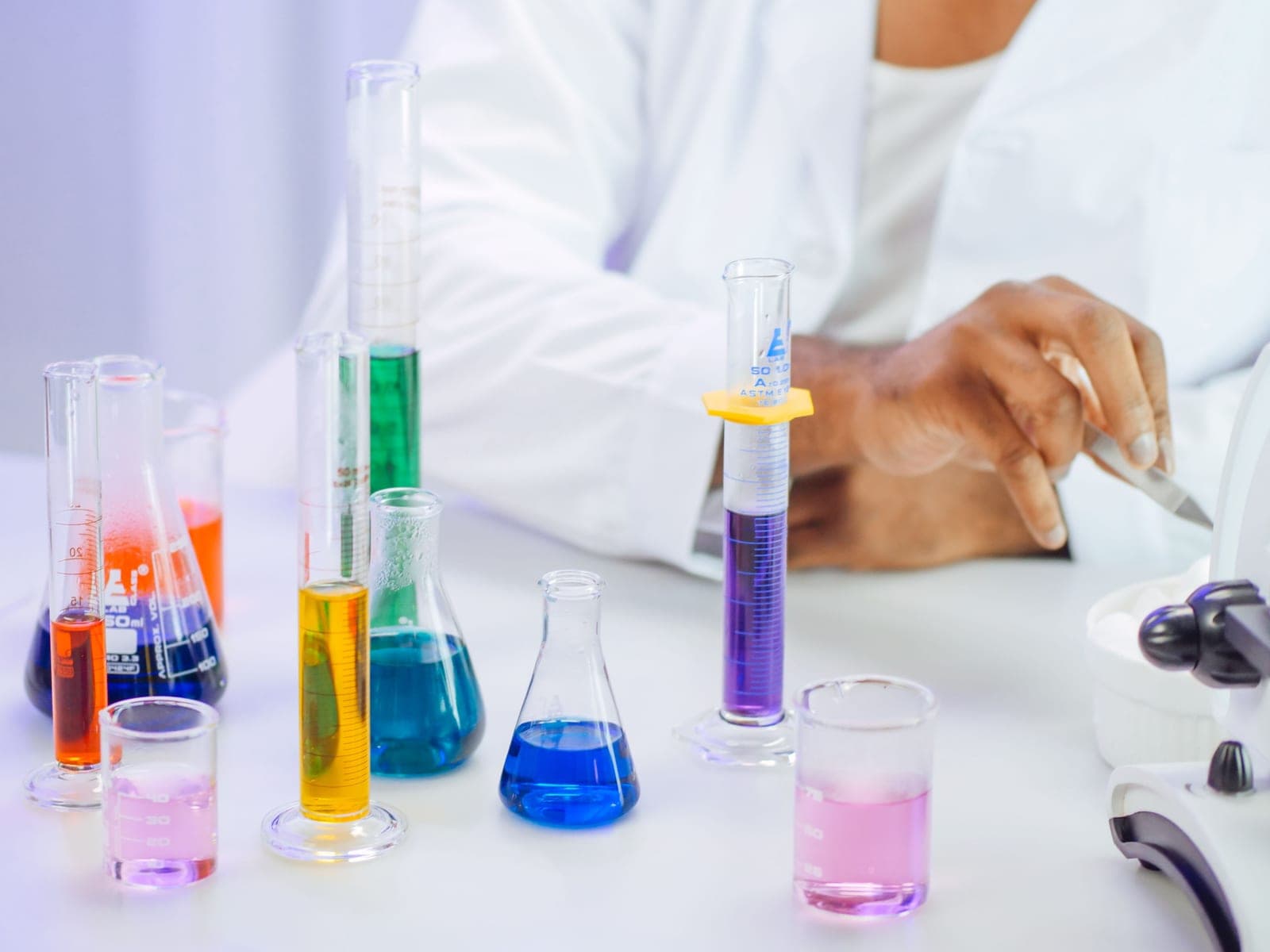
The six numbers
| Reading | Target | Source of the target | What goes wrong outside it |
|---|---|---|---|
| Free chlorine | 1-4 ppm for routine sanitizing | HTH states 1-4 ppm for its 3 inch tabs; the label is the binding authority under EPA FIFRA | Below: algae. Above the label limit: not permitted, and irritating |
| pH | 7.2-7.6 | HTH pH Down product page | High blunts chlorine and clouds water. Low corrodes surfaces and metal |
| Total alkalinity | 80-120 ppm | HTH Alkalinity Up product page | Low means pH bounces. High means pH will not move |
| Cyanuric acid | 30-50 ppm on tablet pools, 60-80 ppm saltwater | HTH Chlorine Stabilizer product page | Low: chlorine burns off in sunlight. High: chlorine stops working at any reading |
| Calcium hardness | Roughly 200-400 ppm | General industry practice; we could not source a manufacturer figure | Low is corrosive. High scales and clouds |
| Phosphate | Below 200-500 ppb | HTH Phosphate Remover product page | Above it, algae becomes harder to control |
Correct them in this order
- **Total alkalinity first.** It is the buffer that holds pH steady. Correcting pH on a pool with low alkalinity means correcting it again next week.
- **pH second.** Into the 7.2 to 7.6 range. HTH's own guidance is to wait four to six hours after shocking before adding acid. If it climbs straight back every time, read pool pH too high.
- **Cyanuric acid third**, if it needs it. It dissolves slowly, so wait 24 to 48 hours before a retest means anything.
- **Chlorine last.** Because how much chlorine you need depends on all three of the readings above.
- **Calcium hardness and phosphate** as periodic checks rather than weekly ones. Neither changes quickly.
Why we show the arithmetic
Because the shorthand everyone repeats is only true for one pool and one product. 'One pound per 10,000 gallons' assumes a specific available-chlorine percentage; '1.4 lb of bicarb raises alkalinity 10 ppm' assumes 10,000 gallons. Change either assumption and the number is wrong.
Every dose table on this site is computed from the percentage printed on your product and the weight of water, and every one shows its formula. You can redo any of them for your own pool - see our methodology for the constants and the full working.
Everything in this section
- Best pool test kits - strips, drops and photometers compared
- How to balance pool water - the order, and the dose tables
- Best chlorine tablets - trichlor and what it costs you over a season
- Chlorine vs bromine - and why bromine belongs in a spa
- How to raise alkalinity - sodium bicarbonate, the dose, and the soda ash mix-up
- How to lower alkalinity - the one correction with no clean formula
- Cyanuric acid - the reading that explains most chlorine mysteries
- Salt water vs chlorine - the same chemistry, generated differently
- Chlorine alternatives - minerals, ionizers, and what the asterisks admit
- Test strips vs liquid kits - precision against the kit you will use
- Are phosphates bad for your pool - the reading nobody takes
- Pool pH too high - six causes, and the one that makes it recur
- Pool pH too low - soda ash, bicarbonate or borax, and which your alkalinity calls for
- Best pool salt - purity is the only spec that matters
- Pool closing chemicals - the sequence, the dose, and the kits that list their contents
- Best salt water chlorinator - compared on pounds of chlorine per day
- Pool opening chemicals - the sequence, and the step people reverse
- How to raise calcium hardness - the one reading with no way back
- Best salt cell cleaner - soak times, and why acid is the expensive method
- Taylor K-2006 review - why counting drops beats matching pink
Every page in this section
Best test kit
Best Pool Test Kits
Titration kits, color comparators, strips and a photometer compared on precision, speed and what each one cannot see.
Top pick
AquaChek Select Connect 7-Way Test Strips, complete kit
Weekly testing you will actually do
#ad · how this is funded · price as of October 18, 2026
How to Balance Pool Water
The correction order that stops you doing the same job twice, with computed dose tables and the formulas behind them.
Top pick
Pool Mate Premium Alkalinity Increaser, 10 lb
Raising total alkalinity
#ad · how this is funded · price as of October 18, 2026
Best for routine sanitizing
Best Pool Chlorine Tablets
Four trichlor tablets compared, with the cyanuric acid and pH arithmetic that decides whether they suit your pool.
Top pick
In The Swim 3 Inch Stabilized Chlorine Tablets, 50 lb
Season-long sanitizing
#ad · how this is funded · price as of October 18, 2026
Chlorine vs Bromine for a Pool
Bromine tolerates heat and holds up at higher pH, but no stabilizer protects it from UV - which settles it for outdoor pools.
Top pick
In The Swim 3 Inch Stabilized Chlorine Tablets, 50 lb
Season-long sanitizing
#ad · how this is funded · price as of October 18, 2026
How to Lower Your Pool's Alkalinity
Acid lowers both alkalinity and pH; aeration raises pH alone. Alternating the two is how you separate them.
Top pick
HTH Pool Care pH Down, 5 lb
Lowering pH
Cyanuric Acid: Stabilizer, and Its Limit
How stabilizer works, the targets HTH publishes, and why the only way down is dilution.
Top pick
In The Swim Pool Stabilizer, 100% Cyanuric Acid, 25 lb
Stabilizing a liquid-chlorine or salt pool
#ad · how this is funded · price as of October 18, 2026
Salt Water Pool vs Chlorine Pool
Same sanitizer, different delivery. What genuinely changes, and the cell replacement cost that decides the economics.
Top pick
Morton Pool Salt, 40 lb
Salt chlorinators
#ad · how this is funded · price as of October 18, 2026
Test Strips vs Liquid Test Kits
Strips for monitoring a trend, titration for diagnosing a problem - and why owning both is the sensible answer.
Top pick
AquaChek Select Connect 7-Way Test Strips, complete kit
Weekly testing you will actually do
#ad · how this is funded · price as of October 18, 2026
Are Phosphates Bad for Your Pool?
Phosphate is algae food. The threshold that matters, where it comes from, and why a test comes before a remover.
Top pick
HTH Pool Care Phosphate Remover, 1 quart
A published dose rate
#ad · how this is funded · price as of October 18, 2026
Pool pH Too High
High pH blunts chlorine and clouds water. Correct it with acid, then find the cause - usually alkalinity or aeration.
Top pick
HTH Pool Care pH Down, 5 lb
Lowering pH
Best pool salt
Best Pool Salt
Pool-grade purity, grain size, and the salinity test that stops you over-salting a pool you then have to drain.
Top pick
Morton Pool Salt, 40 lb
Salt chlorinators
#ad · how this is funded · price as of October 18, 2026
Best pool closing kit
Pool Closing Chemicals: What to Buy
The closing sequence step by step, with the shock dose computed for your volume and the closing kits ranked on whether they tell you what is in the box.
Top pick
Doheny's Master Pool Closing Kit, up to 35,000 gallons
A large-pool kit that lists its contents
#ad · how this is funded · price as of October 18, 2026
Best salt water chlorinator
Best Salt Water Chlorinator
Inline and drop-in salt chlorine generators compared on published daily output, pool rating, warranty and install - with the arithmetic that turns your pool's demand into a cell size.
Top pick
CircuPool RJ45+ Salt Chlorine Generator System, 45,000 gallons
Large pools and hot climates
#ad · how this is funded · price as of October 18, 2026
Taylor K-2006 Review
Taylor's FAS-DPD kit explained from the method up: why counting drops reads chlorine above 5 ppm when color matching cannot, and which of the four versions to buy.
Top pick
Taylor K-2006 Complete FAS-DPD Pool Test Kit
The reference residential kit
How to Raise Your Pool's Alkalinity
Sodium bicarbonate raises total alkalinity; soda ash raises pH. Which one your reading calls for, how much of it, and why three labels give three different doses.
Top pick
Pool Mate Premium Alkalinity Increaser, 10 lb
Raising total alkalinity
#ad · how this is funded · price as of October 18, 2026
Pool Opening Chemicals
What to add when a pool comes off its winter cover, which opening kits publish their contents, and the sequestrant-before-shock rule that protects your plaster.
Top pick
Doheny's Ultimate Pool Opening Start-Up Kit
One box that covers the whole opening
#ad · how this is funded · price as of October 18, 2026

How to Raise Calcium Hardness
Why low calcium hardness attacks surfaces, the 200-400 ppm target the labels agree on, and the calcium chloride dose worked out in full.
Top pick
Pool Mate Premium Calcium Hardness Increaser, 25 lb
A real correction on a full-size pool
Best salt cell cleaner
Best Salt Cell Cleaner
Salt cell cleaners compared on published dilution, soak time and which scales they remove - plus why the acid method is the expensive one.
Top pick
BioGuard Mineral Springs Cell Cleaner, 1 quart
A fast, stated soak time
#ad · how this is funded · price as of October 18, 2026
Pool pH Too Low
Why acidic water is the expensive direction to drift, how alkalinity decides whether you need soda ash or bicarbonate, and what each label actually publishes.
Top pick
Pool Mate Premium pH Up, 10 lb
Low pH when alkalinity is already fine

Best chlorine reducer
Chlorine Alternatives for Pools
Mineral systems, copper ionizers, UV and ozone compared on what each maker actually claims, including the asterisks, plus the copper staining risk nobody advertises.
Top pick
Nature2 Express Mineral Sanitization System
An in-line mineral system on an existing pool
#ad · how this is funded · price as of October 18, 2026
Questions people actually ask
What order should I balance pool water in?
What are the correct pool chemistry levels?
How often should I test my pool water?
Why does my chlorine reading look fine when the pool is green?
Sources
Every figure on this page traces to one of these. Where a number could not be sourced, the page says so rather than estimating.
- Michigan EGLE, Maximum Disinfectant Residuals and Operational Ranges: Guidance for Michigan Licensed Pools (December 2025) - quotes CDC MAHC 5.7.3.1.1.5.0, the EPA FIFRA label rule and the NSF 10 ppm application ceiling
- HTH Pool Care pH Down - product page, sodium bisulfate, states a 7.2-7.6 target and a 4-6 hour wait after shocking
- HTH Pool Care Alkalinity Up - product page, states the 80-120 ppm total alkalinity target and a 6-8 hour circulation wait
- HTH Pool Care Chlorine Stabilizer - product page, states up to 90% chlorine loss from UV and CYA targets of 30-50 ppm for trichlor and dichlor pools, 60-80 ppm for saltwater
- HTH Pool Care 3" Chlorine Tabs Advanced - product page, states one tablet per 10,000 gallons lasts up to 7 days and holds free chlorine at 1-4 ppm
- HTH Pool Care Phosphate Remover - product page, states 2 fl oz per 10,000 gallons weekly and that levels above 200-500 ppb make algae harder to control
- Pool & Hot Tub Alliance - PHTA standards program, the ANSI-accredited consensus standards for residential and public pools
- Skim & Soak methodology - the constants, formulas and worked examples behind every dose on this site
Why there is nothing to buy here: This is the section's front door. The kits and chemicals sit on the roundups below, each with its top pick priced and linked, because a hub of bare text links is a hub with nothing to buy.