Testing & Chemistry
Best Salt Cell Cleaner
The part that makes your chlorine is also the part that scales first, and replacing it costs more than every chemical on this page combined.
We have not handled these products and we do not pretend to have. Here is what we did instead. Links to Amazon earn us a commission at no extra cost to you, and commission never decides a pick — disclosure.
| # | Product | Best for | The spec it turns on | Price |
|---|---|---|---|---|
| 1 | 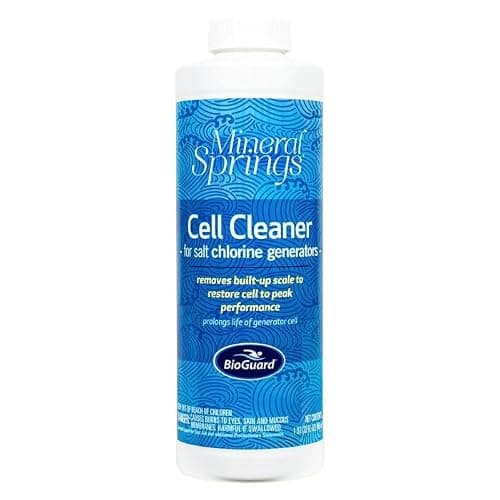 BioGuard Mineral Springs Cell Cleaner, 1 quartTop pickThe clearest instructions of any cell cleaner here: which scales it removes, and how long it takes. | A fast, stated soak time | Listing states removal of calcium carbonate, phosphate and sulfate scale in 15-30 minutes, easier to handle than acid cleaners | |
| 2 | 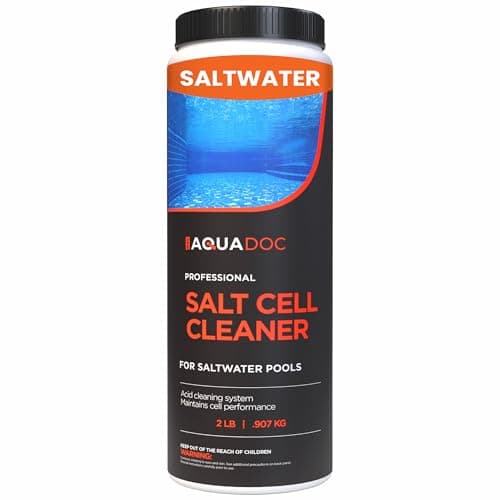 MAV AquaDoc Salt Cell Cleaner, 2 lbThe only cleaner here that prints its dilution: 1 lb to 3 gallons, soak 15 to 30 minutes. That is the instruction people actually need. | A published mixing ratio | Listing states mixing 1 lb with 3 gallons of fresh water and soaking the plates for 15-30 minutes | |
| 3 | 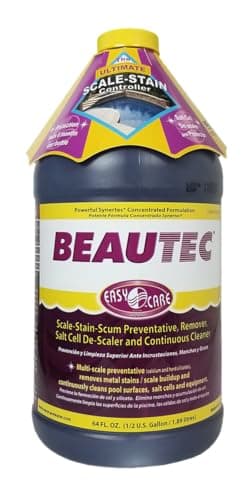 EasyCare BeauTec Salt Cell and Tile Cleaner, 64 ozThe crossover product: a descaler the maker sells for both the salt cell and the waterline, which is sensible because the deposit is the same calcium either way. | One bottle for the cell and the tile | Listing states it removes existing scale, stain and scum buildup and descales salt cells | |
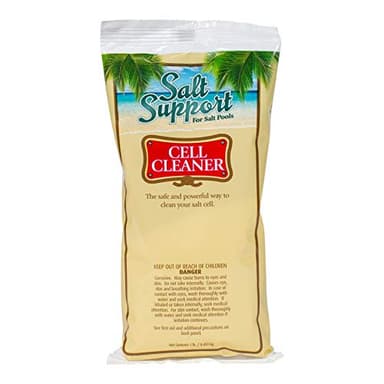
| 4 | 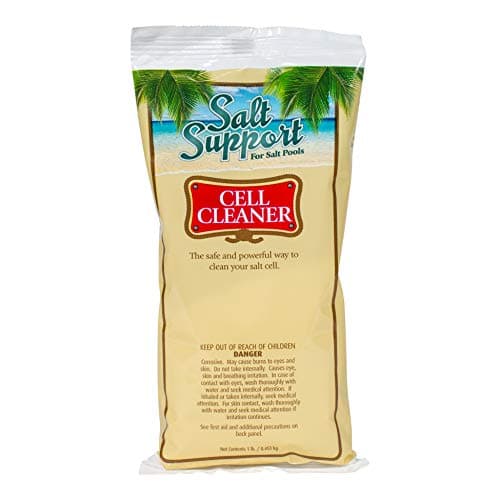 Salt Support Salt Cell Cleaner, 1 lbA one-bag, one-clean product. It publishes the least of the three, and it costs the least. | One cleaning, cheaply | Listing states a single-use bag for removing buildup from salt cell generator plates |
Why the cell scales in the first place
A salt chlorine generator passes current through the water between coated plates, splitting dissolved salt into chlorine. The reaction is alkaline at the plate surface, which means the water touching the plates has a locally high pH - and high pH is exactly what makes calcium come out of solution.
So the cell deposits scale on itself as a byproduct of doing its job. Harder fill water scales faster, and a pool running high on pH or calcium hardness scales faster again.
This is the same deposit that forms at the waterline, for the same reason - which is why one product here is sold for both jobs.
How to tell a cell needs cleaning
- Chlorine output drops while the salt reading stays normal. The generator is running; the plates cannot do the work.
- The system reports low salt when a test says the salt level is fine. Scale interferes with how the cell reads conductivity.
- Visible white crust between the plates, seen by removing the cell and looking through it against the light. This is the check that settles it.
- The pool needs supplementary chlorine to hold a residual it used to hold on its own.
Acid, and why it is the expensive method
The traditional method is a dilute muriatic acid soak - typically one part acid to several parts water. It works, it is cheap, and it is the method most cell warranties have opinions about.
The problem is the margin for error. Too strong a mix, or too long a soak, strips coating along with scale. Acid also demands the usual handling: eye protection, ventilation, acid into water and never the reverse. BioGuard's listing makes the comparison directly, stating its cleaner is easier to handle than acid cell cleaners and works in 15 to 30 minutes.
A purpose-made cleaner costs more per clean than acid does, and less than one replacement cell by a wide margin. That is the whole economic case for buying one.
How we compared them
- Does it publish a dilution? Without a ratio you are guessing, and guessing is what damages plates.
- Does it publish a soak time? A cleaner that states 15 to 30 minutes tells you when to stop.
- Does it name the scale types? Calcium carbonate is the common one, but phosphate and sulfate scale also form.
- Is it ready to use or does it need mixing? Both are fine; knowing which before it arrives is the point.
What each cleaner states
| Cleaner | Form | Dilution | Soak time | Scales named |
|---|---|---|---|---|
| BioGuard Mineral Springs | Liquid, 1 qt | Not stated | 15-30 minutes | Calcium carbonate, phosphate, sulfate |
| AquaDoc | Powder, 2 lb | 1 lb to 3 gallons | 15-30 minutes | Mineral and calcium buildup |
| EasyCare BeauTec | Liquid, 64 oz | Not stated | Not stated | Scale, stain and scum |
| Salt Support | Powder, 1 lb bag | Not stated | Not stated | Not stated |
Only AquaDoc publishes both numbers, and only BioGuard names the three scale types. Between them they cover what the category should print and mostly does not.
Cleaning a cell without damaging it
- Switch the generator and pump off at the breaker, and close the isolation valves either side of the cell if the plumbing has them.
- Remove the cell and look through it. If the plates are clear, reinstall it - the job is done.
- Mix the cleaner exactly as the label states, in a bucket or the cleaning stand the cell maker sells. Never mix acid into a cell still plumbed into the line.
- Stand the cell in the solution for the stated time, no longer. AquaDoc and BioGuard both state 15 to 30 minutes.
- Rinse thoroughly with fresh water before refitting, and check the unions are sealed before restoring power.
- Fix the chemistry that caused it. A cell that scales every few weeks is telling you pH or calcium hardness is running high.
The last step is the one that stops this being a recurring purchase. If the cell scales fast, the pH is probably sitting high - which on a salt pool is structural, because chlorine generation drives it upward. Pool pH too high covers the correction, and salt water vs chlorine explains why salt pools live there.
The picks
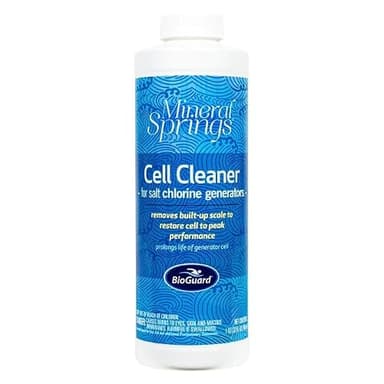
Top pick - A fast, stated soak time
BioGuard Mineral Springs Cell Cleaner, 1 quart
The clearest instructions of any cell cleaner here: which scales it removes, and how long it takes.
The published figure
Listing states removal of calcium carbonate, phosphate and sulfate scale in 15-30 minutes, easier to handle than acid cleaners
BioGuard states it removes calcium carbonate, calcium phosphate and calcium sulfate scale from generator cells, and that the job takes 15 to 30 minutes.
The listing states it is easier to handle than acid cell cleaners. Diluted muriatic acid is the traditional method and it is also the method that ruins cells when the dilution is wrong.
Scale on the plates is what makes a cell report low output or stop generating. Cleaning it is maintenance; replacing the cell is several hundred dollars.
What it does well
- Names the three scale types it removes
- States a 15-30 minute working time
- Safer to handle than acid, per the listing
What it costs you
- No dilution ratio published on the listing
- One quart is a few soaks, not a season
- Third-party seller, so delivery varies
Skip it if your cell is not scaled. Over-cleaning a clean cell wears the coating for nothing.
#ad · how this is funded · price as of October 9, 2026
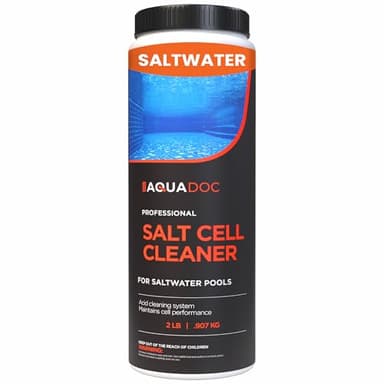
Pick 2 - A published mixing ratio
MAV AquaDoc Salt Cell Cleaner, 2 lb
The only cleaner here that prints its dilution: 1 lb to 3 gallons, soak 15 to 30 minutes. That is the instruction people actually need.
The published figure
Listing states mixing 1 lb with 3 gallons of fresh water and soaking the plates for 15-30 minutes
AquaDoc states the method plainly - mix 1 lb of cleaner with 3 gallons of fresh water and soak the cell plates for 15 to 30 minutes - and says to follow your equipment maker's instructions as well.
It states the formula reduces mineral and calcium buildup on the plates as part of seasonal maintenance.
A dry powder is easier to store between seasons than a part-used bottle of liquid, and 2 lb is two full mixes.
What it does well
- Publishes the dilution and the soak time
- Dry powder stores well between seasons
- 2 lb covers two full soaks
What it costs you
- Needs mixing, unlike a ready-to-use liquid
- Three gallons of mix is more than a small cell needs
- No statement of which scale types it targets
Skip it if you would rather pour something straight in. The BioGuard quart is ready to use.
#ad · how this is funded · price as of October 9, 2026
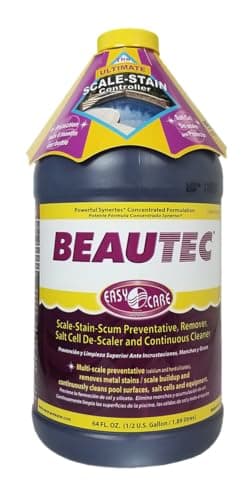
Pick 3 - One bottle for the cell and the tile
EasyCare BeauTec Salt Cell and Tile Cleaner, 64 oz
The crossover product: a descaler the maker sells for both the salt cell and the waterline, which is sensible because the deposit is the same calcium either way.
The published figure
Listing states it removes existing scale, stain and scum buildup and descales salt cells
EasyCare states it aggressively prevents scale, stain and scum buildup, removes existing buildup on surfaces and equipment, and acts as a salt cell descaler that prolongs cell lifespan.
A salt pool builds scale in both places for the same reason: chlorine generation drives pH up at the cell plates, and hard water leaves calcium behind wherever the water line sits.
The listing publishes no dilution ratio or soak time, so follow your cell maker's cleaning instructions rather than improvising one.
What it does well
- Stated for both salt cell descaling and tile cleaning
- 64 oz covers repeated cell soaks
- Prevention as well as removal, per the listing
What it costs you
- No dilution ratio or soak time published
- Costs more than a single-purpose cell cleaner
- Third-party seller, so delivery varies
Skip it if you only need one job done. A dedicated cell cleaner or a tile spray will be cheaper.
Pick 4 - One cleaning, cheaply
Salt Support Salt Cell Cleaner, 1 lb
A one-bag, one-clean product. It publishes the least of the three, and it costs the least.
The published figure
Listing states a single-use bag for removing buildup from salt cell generator plates
Salt Support states a convenient bag for easy application that removes buildup on the plates of salt cell generators and helps prevent the unit malfunctioning.
Beyond that the listing publishes nothing - no dilution, no soak time, no scale types. You are following the bag.
For a cell cleaned once a season, one bag per clean is a reasonable way to buy it and there is nothing left over to store.
What it does well
- Cheapest cell clean here
- Pre-portioned, so nothing is left to store
- Simple to use, per the listing
What it costs you
- No dilution, soak time or scale detail published
- One bag is one cleaning
- Third-party seller, so delivery varies
Skip it if you want the instructions printed before you buy. AquaDoc states its ratio.
What cleaning will not fix
Cells wear out. The coating on the plates is consumed over thousands of hours, and a cell at the end of its life reports low output with clean plates and clean water chemistry.
If a cell is scaling repeatedly despite balanced water, or if output stays low after a clean, the cell itself is the answer rather than another bottle. The chlorinators and what they publish about cell life are on best salt water chlorinator.
Questions people actually ask
How often should you clean a salt cell?
Can you use muriatic acid to clean a salt cell?
How long do you soak a salt cell?
Why is my salt cell scaling so quickly?
Does a scaled salt cell stop making chlorine?
Sources
Every figure on this page traces to one of these. Where a number could not be sourced, the page says so rather than estimating.
- Pool & Hot Tub Alliance - PHTA standards program, the ANSI-accredited consensus standards for residential and public pools
- Skim & Soak methodology - the constants, formulas and worked examples behind every dose on this site
- BioGuard Mineral Springs Cell Cleaner, 1 quart, 15-30 minute soak - Amazon listing, read 2026-09-20
- MAV AquaDoc Salt Cell Cleaner, 2 lb, 1 lb per 3 gallons - Amazon listing, read 2026-09-20
- EasyCare BeauTec Salt Cell and Tile Cleaner, 64 oz - Amazon listing, read 2026-09-20
- Salt Support Salt Cell Cleaner, 1 lb - Amazon listing, read 2026-09-20
Read next
Best salt water chlorinator
Best Salt Water Chlorinator
Inline and drop-in salt chlorine generators compared on published daily output, pool rating, warranty and install - with the arithmetic that turns your pool's demand into a cell size.
Top pick
CircuPool RJ45+ Salt Chlorine Generator System, 45,000 gallons
Large pools and hot climates
#ad · how this is funded · price as of October 9, 2026
Salt Water Pool vs Chlorine Pool
Same sanitizer, different delivery. What genuinely changes, and the cell replacement cost that decides the economics.
Top pick
Morton Pool Salt, 40 lb
Salt chlorinators
#ad · how this is funded · price as of October 9, 2026
Best pool salt
Best Pool Salt
Pool-grade purity, grain size, and the salinity test that stops you over-salting a pool you then have to drain.
Top pick
Morton Pool Salt, 40 lb
Salt chlorinators
#ad · how this is funded · price as of October 9, 2026
Best pool tile cleaner
Best Pool Tile Cleaner
Calcium scale against oily scum at the waterline, the non-acid sprays and the pumice route, and the surfaces each listing rules out.
Top pick
Guardian Pool & Tile Cleaner, 1 quart
Scale above the waterline without scrubbing
#ad · how this is funded · price as of October 9, 2026
Pool pH Too High
High pH blunts chlorine and clouds water. Correct it with acid, then find the cause - usually alkalinity or aeration.
Top pick
HTH Pool Care pH Down, 5 lb
Lowering pH