Testing & Chemistry
Pool pH Too High
Bringing pH down is a single dose. Keeping it down means finding what keeps pushing it up, and there are only six candidates.
We have not handled these products and we do not pretend to have. Here is what we did instead. Links to Amazon earn us a commission at no extra cost to you, and commission never decides a pick — disclosure.
| # | Product | Best for | The spec it turns on | Price |
|---|---|---|---|---|
| 1 | 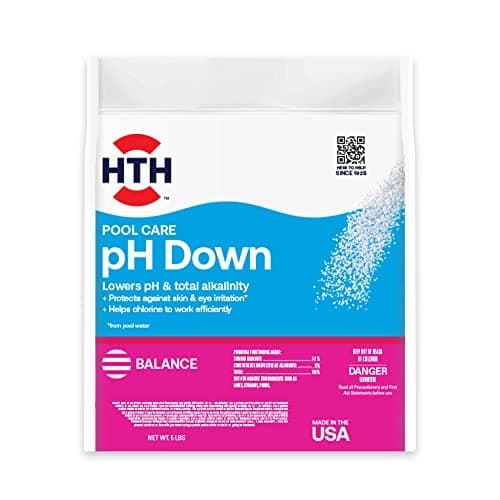 HTH Pool Care pH Down, 5 lbTop pickSodium bisulfate with the maker's own target range and timing published, which is more guidance than most balancers give. | Lowering pH | Sodium bisulfate; HTH states a 7.2-7.6 target and a 4-6 hour wait after shocking | |
| 2 | 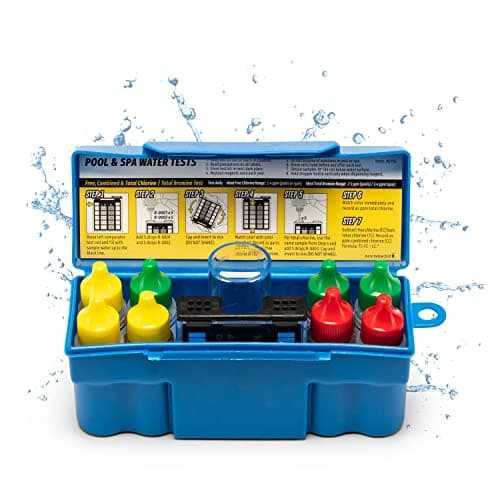 Taylor Technologies K-1004 DPD 6-in-1 Pool Test KitIncludes an acid demand test, which is the only honest way to know how much pH reducer your pool needs. | The acid demand test | DPD kit including acid and base demand titrations | |
| 3 | 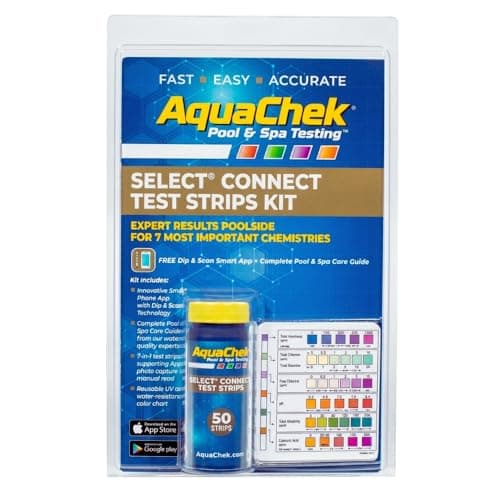 AquaChek Select Connect 7-Way Test Strips, complete kitThe kit that gets used. Seven readings in fifteen seconds beats a laboratory-grade kit that stays in the shed. | Weekly testing you will actually do | Seven parameters per strip: pH, total and free chlorine, bromine, alkalinity, hardness, cyanuric acid | |
| 4 | 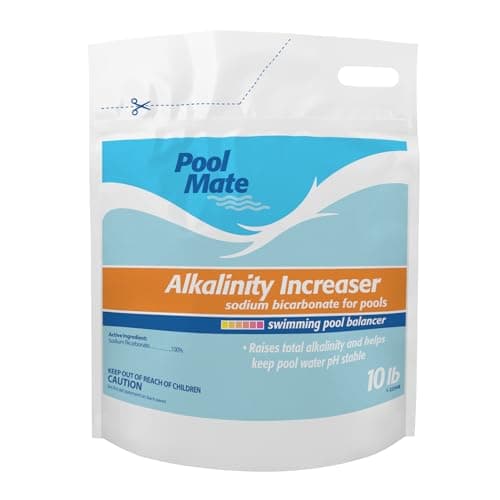 Pool Mate Premium Alkalinity Increaser, 10 lb100% sodium bicarbonate and it says so, which is the only claim that lets you compute the dose yourself. | Raising total alkalinity | Listing states 100% sodium bicarbonate |
What high pH actually costs you
pH is not a comfort setting. It changes what your chlorine is capable of, which is why it sits second in the correction order on how to balance pool water.
- **Your chlorine stops working as well.** Chlorine exists in water as two forms, and the proportion is set by pH. As pH rises, more of it becomes the weaker one - so your test reads the same number while the chlorine does progressively less.
- **The water clouds.** High pH pushes dissolved calcium out of solution as fine white particulate, which is one of the six causes on why is my pool cloudy.
- **Scale forms.** At the waterline first, then in the heater and on the salt cell, where it is expensive - the waterline and the cell each have their own page.
- **Eyes sting.** The common belief is that this means too much chlorine. It is far more often pH out of range in either direction.
The six things that push pH up
| Cause | How to recognize it | What actually fixes it |
|---|---|---|
| High total alkalinity | Alkalinity above 120 ppm; pH returns within days of every correction | Lower alkalinity, using acid and aeration in cycles |
| Aeration | A fountain, waterfall, spa jets or aimed-up returns running regularly | Nothing is broken - expect to dose acid routinely |
| A salt chlorinator | Salt pool; pH drifts up continuously and predictably | Structural to how generation works - budget for acid |
| Cal-hypo shock | pH jumps right after shocking | Wait 4-6 hours, then correct; or switch to dichlor |
| Liquid chlorine | pH creeps up with routine dosing | Normal - sodium hypochlorite is alkaline |
| New plaster | A pool resurfaced within the last year | Curing plaster raises pH for months; correct as needed |
Three of those six are not faults at all. A salt pool, a waterfall and liquid chlorine all raise pH by design, and the correct response is a routine rather than a repair.
Correcting it
Sodium bisulfate - dry acid - is the sensible choice for a residential pool. It is far safer to store and handle than muriatic acid, at the cost of adding sulfate that accumulates over many seasons.
HTH's own pH Down page states three things worth following exactly: the target is 7.2 to 7.6, you broadcast it over the deep end with the pump running, and you wait four to six hours after shocking before adding it.
- Test pH **and** total alkalinity. You cannot interpret one without the other.
- If alkalinity is above about 120 ppm, that is your real problem - go to how to lower alkalinity, because correcting pH alone will not hold.
- Run an acid demand test if your kit has one. If not, dose conservatively - roughly half what you think - and retest.
- Broadcast over the deep end with the pump running. Do not pre-dissolve dry acid.
- Wait several hours and retest before adding more. Acid acts faster than most people wait.
- Never mix acid with chlorine products, in the water or in a bucket.
When it keeps coming back
This is the situation people actually search for, and it has one dominant answer.
Total alkalinity is the buffer that resists pH change. Set it too high and it resists your correction just as firmly as it resists everything else - so pH climbs back within days and you dose again, which is a treadmill rather than a fix.
Get alkalinity into the 80 to 120 ppm range HTH gives on its own Alkalinity Up page and pH becomes far easier to hold. Doing that is genuinely fiddly, because the acid that lowers alkalinity lowers pH too - the aerate-and-repeat method is on how to lower alkalinity.
Do not overshoot
Low pH is a worse problem than high pH, and it is a more expensive one - raising it back is its own correction, and which product you need depends on your alkalinity. Acidic water is corrosive: it attacks plaster and grout, etches surfaces, and dissolves metal out of heater elements - which is one of the routes to the green water that is not algae problem, and the reason a metal sequestrant belongs on the shopping list for any pool with a heater.
If you do overshoot, sodium bicarbonate brings both alkalinity and pH back up - about 1.4 lb per 10 ppm of alkalinity per 10,000 gallons, computed in full on how to balance pool water and dosed step by step on how to raise alkalinity.
The picks
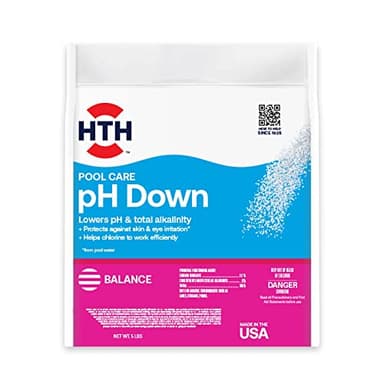
Top pick - Lowering pH
HTH Pool Care pH Down, 5 lb
Sodium bisulfate with the maker's own target range and timing published, which is more guidance than most balancers give.
The published figure
Sodium bisulfate; HTH states a 7.2-7.6 target and a 4-6 hour wait after shocking
HTH's page states the target range as 7.2 to 7.6 and tells you to wait four to six hours after shocking before adding it. Both are the kind of instruction people get wrong and no label usually gives.
How much you need depends on your total alkalinity, not on a chart. That is what an acid demand test measures, and why we recommend a kit that includes one.
Broadcast over the deep end with the pump running, and do not pre-dissolve — that instruction is on the label for a reason.
What it does well
- Maker publishes the target range and the post-shock wait
- Dry acid is far safer to store and handle than muriatic
- Stated safe for vinyl, fiberglass, concrete and saltwater
What it costs you
- Adds sulfate, which accumulates over many seasons
- Dose depends on your alkalinity, so it needs an acid demand test
Skip it if your pH is high because your alkalinity is high. Fix the alkalinity and the pH usually follows.
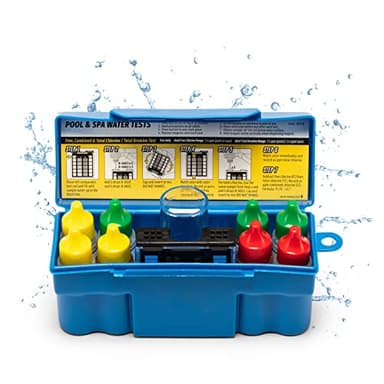
Pick 2 - The acid demand test
Taylor Technologies K-1004 DPD 6-in-1 Pool Test Kit
Includes an acid demand test, which is the only honest way to know how much pH reducer your pool needs.
The published figure
DPD kit including acid and base demand titrations
How much acid a pool needs to move pH from 8.0 to 7.5 depends on its total alkalinity, and no chart can tell you without knowing it. An acid demand test measures it directly.
That is why this site does not print a pH-down dose table: the number is a property of your water, not of the product, and the test costs a few dollars.
Six parameters rather than nine, so it does not cover cyanuric acid or salt.
What it does well
- Acid and base demand titrations, which most kits omit
- Cheaper than the nine-parameter kits
What it costs you
- No cyanuric acid test
- No salt test
Skip it if you need a cyanuric acid reading — that is a common problem this kit cannot see.
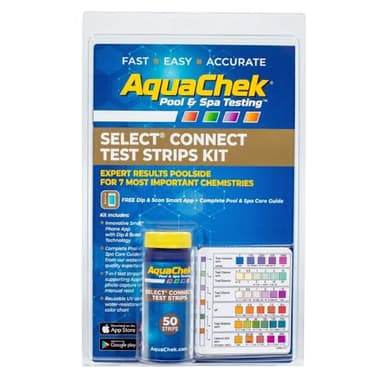
Pick 3 - Weekly testing you will actually do
AquaChek Select Connect 7-Way Test Strips, complete kit
The kit that gets used. Seven readings in fifteen seconds beats a laboratory-grade kit that stays in the shed.
The published figure
Seven parameters per strip: pH, total and free chlorine, bromine, alkalinity, hardness, cyanuric acid
The best test kit is the one you run. A strip takes fifteen seconds, which is the difference between testing weekly and testing when something looks wrong.
Seven parameters on one strip includes cyanuric acid, which most cheaper strips omit and which is the reading that explains chlorine that will not hold.
Strips are less precise than either Taylor kit and they degrade once the bottle has been opened. Note the date you opened it on the lid.
What it does well
- Fast enough that weekly testing actually happens
- Includes cyanuric acid, unlike most cheap strips
- No reagents to mix or spill
What it costs you
- Less precise than a drop kit, particularly on alkalinity
- Degrades after the bottle is opened, especially in humidity
Skip it if you are diagnosing a problem rather than monitoring. Precision matters when you are about to dose.
#ad · how this is funded · price as of October 9, 2026
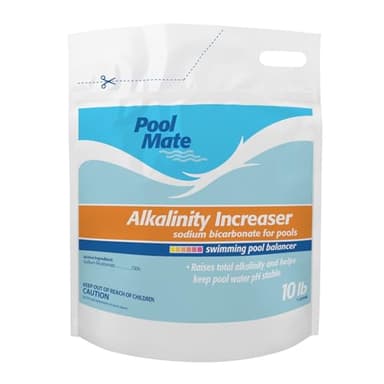
Pick 4 - Raising total alkalinity
Pool Mate Premium Alkalinity Increaser, 10 lb
100% sodium bicarbonate and it says so, which is the only claim that lets you compute the dose yourself.
The published figure
Listing states 100% sodium bicarbonate
Alkalinity increaser is sodium bicarbonate. Every brand sells the same compound, and the only thing worth checking is whether the label admits it.
Because this one states 100% purity, the arithmetic below applies exactly: 1.4 lb raises 10,000 gallons by 10 ppm.
Raise alkalinity before pH. Alkalinity is what stops pH bouncing, so correcting pH first means correcting it again.
What it does well
- States 100% purity, so the dose is computable
- Sold in a size that matches a real correction
- Cheapest per ppm of the balancers here
What it costs you
- Raises pH slightly as a side effect
- Needs a full circulation cycle before retesting
Skip it if your alkalinity is already above 120 ppm — you need acid, not bicarbonate.
#ad · how this is funded · price as of October 9, 2026
Testing it properly
- **Sample elbow-deep, away from returns and the skimmer.** Surface water and water near a return are not representative.
- **Test at the same time of day.** Aeration and sunlight both move pH through the day, so morning and evening readings are not comparable.
- **Read in daylight.** Color matching under a porch light is a real source of error, and pH is a color test on almost every kit.
- **Test pH and alkalinity together, always.** A pH reading alone cannot tell you whether you have a problem or a treadmill.
- **Retest after every correction** rather than stacking doses. Acid works faster than people wait.
Questions people actually ask
What causes high pH in a pool?
How do I lower pH in my pool?
Why does my pool pH keep going up?
Is high pH in a pool dangerous?
Does high pH make chlorine less effective?
Can I use muriatic acid instead of dry acid?
Sources
Every figure on this page traces to one of these. Where a number could not be sourced, the page says so rather than estimating.
- HTH Pool Care pH Down - product page, sodium bisulfate, states a 7.2-7.6 target and a 4-6 hour wait after shocking
- HTH Pool Care Alkalinity Up - product page, states the 80-120 ppm total alkalinity target and a 6-8 hour circulation wait
- Michigan EGLE, Maximum Disinfectant Residuals and Operational Ranges: Guidance for Michigan Licensed Pools (December 2025) - quotes CDC MAHC 5.7.3.1.1.5.0, the EPA FIFRA label rule and the NSF 10 ppm application ceiling
- Pool & Hot Tub Alliance - PHTA standards program, the ANSI-accredited consensus standards for residential and public pools
- Skim & Soak methodology - the constants, formulas and worked examples behind every dose on this site
- HTH Pool Care pH Down, sodium bisulfate - Amazon listing, read 2026-09-02
- Taylor K-1004 with acid demand test - Amazon listing, read 2026-09-02
Read next

How to Lower Your Pool's Alkalinity
Acid lowers both alkalinity and pH; aeration raises pH alone. Alternating the two is how you separate them.
Top pick
HTH Pool Care pH Down, 5 lb
Lowering pH
How to Balance Pool Water
The correction order that stops you doing the same job twice, with computed dose tables and the formulas behind them.
Top pick
Pool Mate Premium Alkalinity Increaser, 10 lb
Raising total alkalinity
#ad · how this is funded · price as of October 9, 2026

Cloudy Water With High Chlorine
High chlorine plus cloudiness points at dead algae, a calcium reaction, a saturated test, or a filter that cannot keep up.
Top pick
Taylor Technologies K-2006-SALT FAS-DPD 9-in-1 Test Kit
Knowing the number rather than the color
#ad · how this is funded · price as of October 9, 2026
Best test kit
Best Pool Test Kits
Titration kits, color comparators, strips and a photometer compared on precision, speed and what each one cannot see.
Top pick
AquaChek Select Connect 7-Way Test Strips, complete kit
Weekly testing you will actually do
#ad · how this is funded · price as of October 9, 2026