Green Water & Algae
How to Identify Pool Algae
Green, mustard and black look similar in a photograph and need entirely different treatment. Two tests tell them apart.
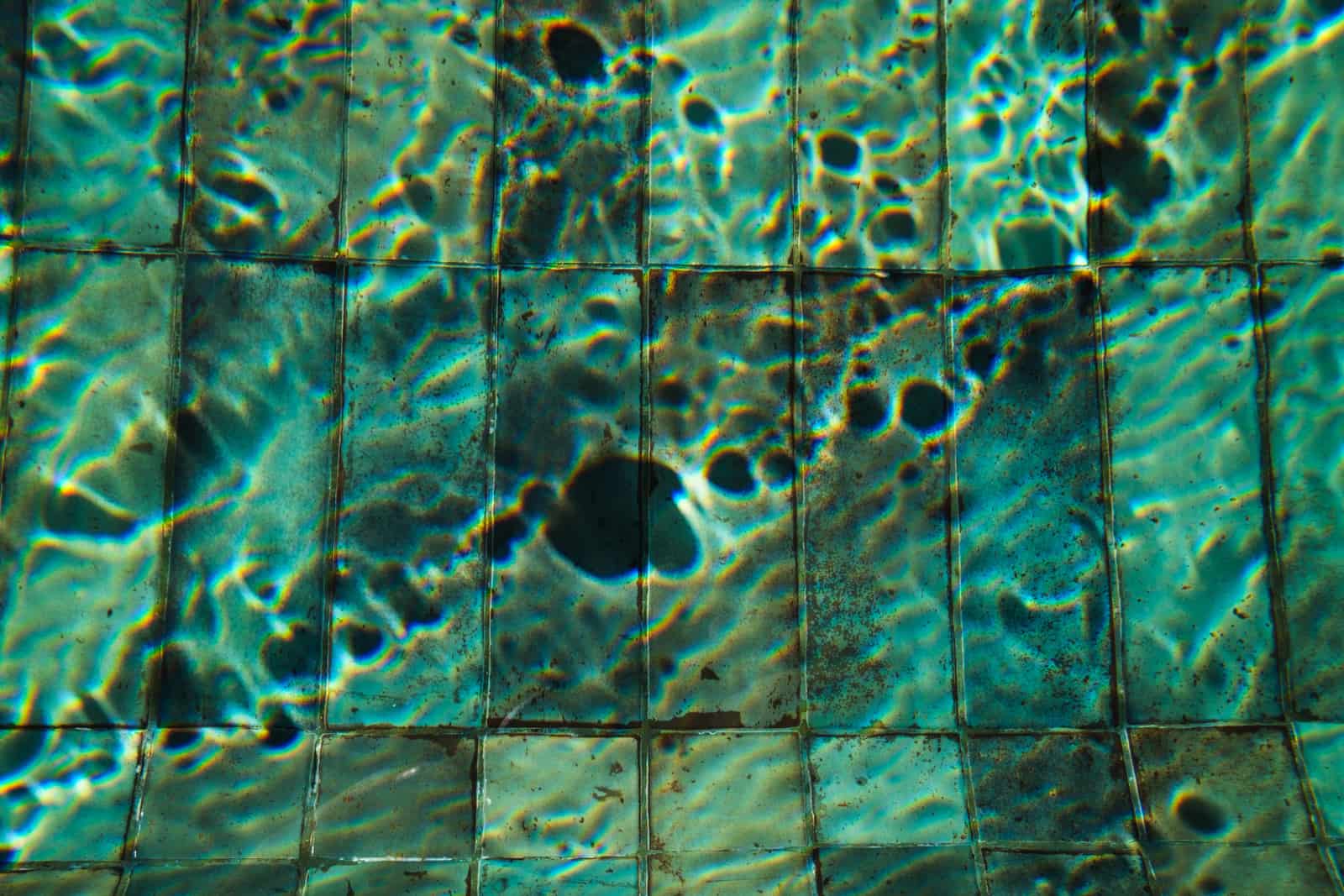
The two tests
You do not need a microscope. You need to answer two questions, and the answers narrow it to one of three.
- **Where is it?** Suspended through the whole water body, or attached to a surface? Green algae clouds the water; mustard and black attach.
- **Does it brush off?** Take a brush to it. Green and mustard lift with almost no pressure. Black resists, and when it does come away it leaves a visible pit or stain in the plaster where it was anchored.
The three types, side by side
| Green algae | Mustard algae | Black algae | |
|---|---|---|---|
| Color | Bright green to gray-green | Yellow, tan or brownish | Dark blue-green to near black |
| Where it grows | Suspended throughout the water | Shaded walls, steps, behind ladders | Rough plaster, grout lines, corners |
| Appearance | Cloudy or green water | Powdery, looks like sand or pollen | Small raised spots with a crust |
| Brushes off? | Easily | Easily, but returns in the same place | Resists; leaves a mark when it goes |
| Chlorine alone? | Yes, at shock level | Yes, at higher levels and repeated | No - it is shielded |
| Treatment | Shock plus filtration | Shock, brush daily, treat everything that touched the water | Brush hard, then copper algaecide, repeat |
| Difficulty | Easy | Persistent | Hard, sometimes needs resurfacing |
Green algae
The common one. It reproduces in the water column rather than on surfaces, which is why the whole pool changes color rather than developing patches. It is also the easiest to kill: a correctly sized shock breaks it in a day, and the remaining work is filtration.
Green algae in a pool with good chlorine is a sign that the chlorine is not doing what the number says. That usually means cyanuric acid, occasionally pH above 7.8. Go straight to clearing it, then find out why.
Mustard algae, and why it keeps coming back
Mustard algae is the one people mistake for dirt or pollen, because it is powdery, it sits on the floor and shaded walls, and it puffs into a cloud when disturbed. It brushes away completely - and then it is back in the same place the next day, which is the diagnostic.
It survives chlorine levels that kill green algae, and it survives on things that touch the pool: floats, brushes, swimsuits, the vacuum hose, pool toys. That is the real reason it recurs. Treating the water without treating the equipment gets you a two-week cycle - the full treatment is on how to get rid of mustard algae.
- Shock to a higher level than you would for green algae and hold it for longer
- Brush the affected areas daily during treatment, not once
- Put every piece of pool equipment and every swimsuit through the shocked water, or wash them separately
- Run the filter continuously and clean it afterwards
- Use an algaecide the maker names for mustard specifically, rather than a generic one
Black algae, which is not really algae
Black algae is a cyanobacterium. It anchors into rough plaster and grout with root-like structures, and it grows a protective layer over itself that chlorine cannot penetrate at any reasonable concentration. That is the whole problem: the treatment is not chemical strength, it is breaking the layer.
It is far more common in gunite and plaster pools than in vinyl, because it needs a rough surface to anchor into. If you have a vinyl liner and you think you have black algae, it is much more likely to be a stain or mold on the liner surface.
- Brush each spot hard with a stainless brush - the goal is to break the crust, not remove the spot
- Apply a copper-based algaecide directly to the brushed areas, following the label
- Maintain elevated chlorine while you work through it
- Repeat every two or three days. Black algae takes weeks, not days
- Check that pH stays in range throughout, because copper stains at high pH
Things that look like algae and are not
- **Green water with no growth on any surface** is often dissolved metal, not algae. Copper and iron do this, and shocking makes it worse.
- **Pink or orange slime** in corners and behind fittings is a bacterium rather than algae. It needs the same shock treatment plus scrubbing, but algaecide will not touch it.
- **A yellow-brown film after a storm** is often pollen or fine silt. Wipe some onto a white cloth: pollen smears yellow and rinses out, mustard algae does not.
- **White or gray flakes** are usually calcium, particularly if your water is hard and pH has drifted up. That is a balance problem, not a living one.
Questions people actually ask
How do I know if it is black algae or a stain?
What is the difference between mustard algae and dead algae?
Is black algae dangerous?
Why does mustard algae keep coming back?
Sources
Every figure on this page traces to one of these. Where a number could not be sourced, the page says so rather than estimating.
- HTH Pool Care Algae Guard Advanced - product page, states coverage of green, black and mustard algae
- Michigan EGLE, Maximum Disinfectant Residuals and Operational Ranges: Guidance for Michigan Licensed Pools (December 2025) - quotes CDC MAHC 5.7.3.1.1.5.0, the EPA FIFRA label rule and the NSF 10 ppm application ceiling
- Skim & Soak methodology - the constants, formulas and worked examples behind every dose on this site
- In The Swim Black Algaecide, copper sulfate pentahydrate - Amazon listing, read 2026-09-02
Why there is nothing to buy here: This is a diagnostic page and it exists to stop you buying the wrong thing. The treatment products live on best pool algaecide and best pool shock, one click away, once you know which problem you have.
Read next
Best for prevention
Best Pool Algaecide
Polyquat 60 for prevention without staining, copper for black algae, and one combination product we would not buy.
Top pick
In The Swim Algaecide 60 Plus, 1 quart
Prevention without staining
How to Clear a Green Pool Fast
The ordered fix: test, brush, shock by weight, filter continuously, clear the dead algae, then prevent the next one.
Green Water That Is Not Algae
Copper and iron turn water green when they oxidize. The bucket test tells you which problem you have in five minutes.

Best for green water
Best Pool Shock for a Green Pool
Cal-hypo, dichlor and liquid chlorine compared on available chlorine percentage, with a dose table computed for six pool sizes.
Top pick
In The Swim Pool Shock, 68% Cal-Hypo Granular, 25 lb
Clearing an algae bloom
#ad · how this is funded · price as of October 18, 2026