Testing & Chemistry
Best Pool Test Kits
The best kit is the one you will actually run. The second-best consideration is whether it can read chlorine when you are shocking.
We have not handled these products and we do not pretend to have. Here is what we did instead. Links to Amazon earn us a commission at no extra cost to you, and commission never decides a pick — disclosure.
| # | Product | Best for | The spec it turns on | Price |
|---|---|---|---|---|
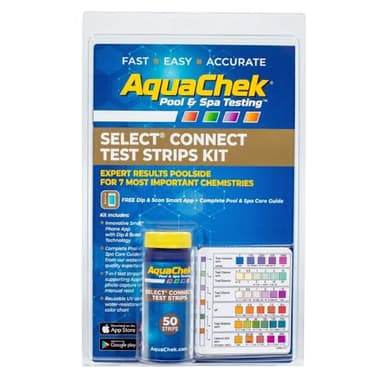
| 1 | 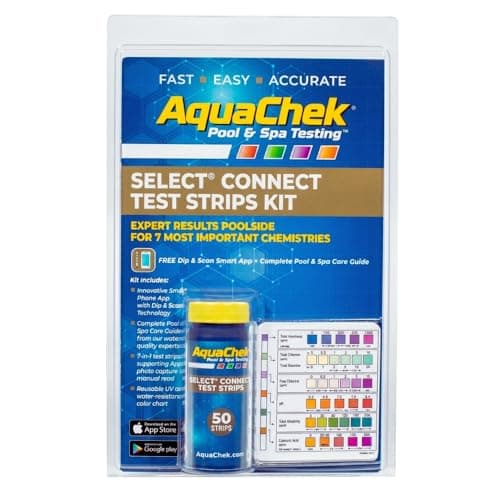 AquaChek Select Connect 7-Way Test Strips, complete kitTop pickThe kit that gets used. Seven readings in fifteen seconds beats a laboratory-grade kit that stays in the shed. | Weekly testing you will actually do | Seven parameters per strip: pH, total and free chlorine, bromine, alkalinity, hardness, cyanuric acid | |
| 2 | 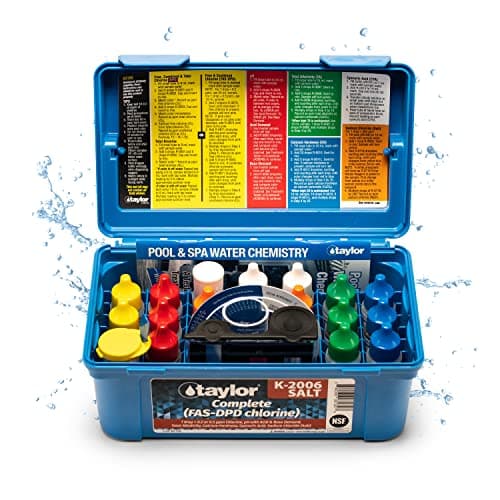 Taylor Technologies K-2006-SALT FAS-DPD 9-in-1 Test KitFAS-DPD is a drop-count titration, so the chlorine reading is a number you counted rather than a color you matched. | Knowing the number rather than the color | FAS-DPD titration; tests free and combined chlorine, salt, pH, alkalinity, hardness, cyanuric acid | |
| 3 | 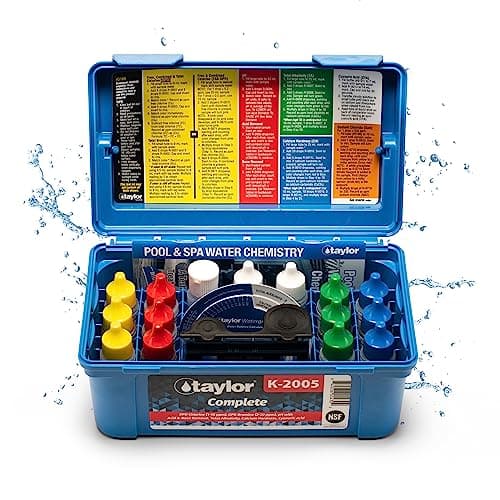 Taylor Technologies K-2005 DPD 9-in-1 Complete Pool Test KitThe same nine tests as the K-2006 with color matching instead of titration, which is faster and less precise at the top of the chlorine range. | Full chemistry without the titration | DPD color comparator; free and total chlorine, bromine, pH, alkalinity, hardness, cyanuric acid | |
| 4 | 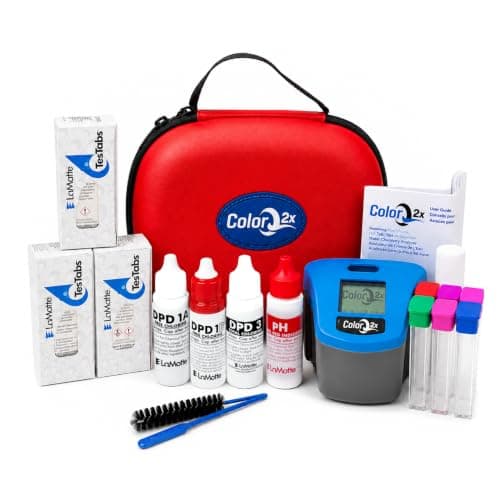 LaMotte ColorQ 2X Pro 7 Waterproof Bluetooth PhotometerA photometer reads the color for you, which removes the one variable a color-match kit cannot control: your eyes and your lighting. | Taking the judgment out of color matching | Digital photometer reading seven parameters from liquid and tablet reagents | |
| 5 | 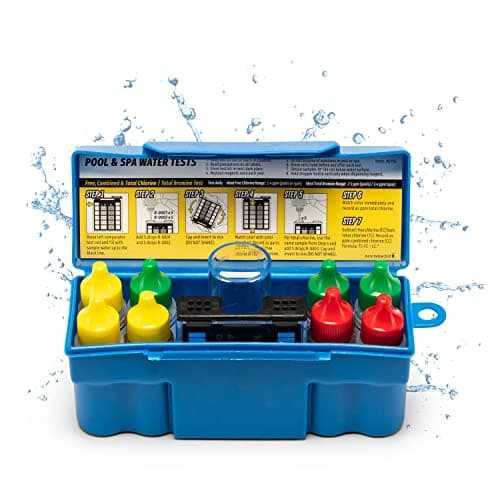 Taylor Technologies K-1004 DPD 6-in-1 Pool Test KitIncludes an acid demand test, which is the only honest way to know how much pH reducer your pool needs. | The acid demand test | DPD kit including acid and base demand titrations | |
| 6 |  AquaChek 7-Way Silver Test StripsThe refill bottle. Same chemistry, no case, cheaper per strip. | Refills | Seven-parameter strips including free and total chlorine and cyanuric acid |
The four methods
| Method | How it reads | Speed | Precision | Fails at |
|---|---|---|---|---|
| Test strips | Color pads compared against a printed chart | 15 seconds | Approximate, especially on alkalinity | Precision, and once the bottle has been open in humidity |
| DPD color comparator | Reagent drops, color matched against a block | 2-3 minutes | Good at normal levels | Above about 5 ppm free chlorine, where the scale saturates |
| FAS-DPD titration | Count drops until a color disappears | 5 minutes | Highest available at home | Nothing much, except your patience |
| Photometer | An instrument reads the sample optically | 2-3 minutes | High, and repeatable | Cost, and it still uses reagents that expire |
Why titration matters exactly when it matters
Every strip and every color-match kit asks you to judge a shade. FAS-DPD asks you to count drops until a color disappears, which removes the judgment entirely and gives you a number rather than a range. The reference kit for that method is reviewed on Taylor K-2006.
That is a nicety at 2 ppm and it is the whole ball game at 15 ppm. Color-match scales top out around 5 ppm and read 'high' for anything above - so when you are shocking a green pool and need to know whether you landed at 8 ppm or 25, the cheap methods cannot tell you.
FAS-DPD also measures combined chlorine separately, which is the reading that tells you whether a shock has finished its work or the pool needs another round. Nothing else on this page does that.
What each kit can and cannot see
- **Cyanuric acid.** The most commonly omitted test and the most commonly needed. It is the reading that explains a green pool with a normal chlorine number, and cheap strips frequently leave it out. Check the parameter list before buying.
- **Salt.** Only relevant on a salt-chlorinated pool, and only some kits include it.
- **Acid demand.** A titration that tells you how much acid your specific water needs to move pH, which depends on your alkalinity. Taylor's K-1004 includes it; most kits do not. It is why this site publishes no pH-down dose table.
- **Phosphate.** Not on any of the general kits here. It needs its own test - see are phosphates bad for your pool.
The picks
Top pick - Weekly testing you will actually do
AquaChek Select Connect 7-Way Test Strips, complete kit
The kit that gets used. Seven readings in fifteen seconds beats a laboratory-grade kit that stays in the shed.
The published figure
Seven parameters per strip: pH, total and free chlorine, bromine, alkalinity, hardness, cyanuric acid
The best test kit is the one you run. A strip takes fifteen seconds, which is the difference between testing weekly and testing when something looks wrong.
Seven parameters on one strip includes cyanuric acid, which most cheaper strips omit and which is the reading that explains chlorine that will not hold.
Strips are less precise than either Taylor kit and they degrade once the bottle has been opened. Note the date you opened it on the lid.
What it does well
- Fast enough that weekly testing actually happens
- Includes cyanuric acid, unlike most cheap strips
- No reagents to mix or spill
What it costs you
- Less precise than a drop kit, particularly on alkalinity
- Degrades after the bottle is opened, especially in humidity
Skip it if you are diagnosing a problem rather than monitoring. Precision matters when you are about to dose.
#ad · how this is funded · price as of October 18, 2026
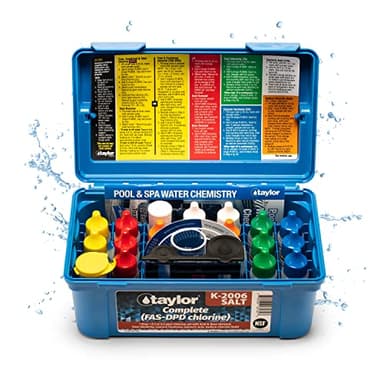
Pick 2 - Knowing the number rather than the color
Taylor Technologies K-2006-SALT FAS-DPD 9-in-1 Test Kit
FAS-DPD is a drop-count titration, so the chlorine reading is a number you counted rather than a color you matched.
The published figure
FAS-DPD titration; tests free and combined chlorine, salt, pH, alkalinity, hardness, cyanuric acid
Every strip and every DPD color-match kit asks you to judge a shade. FAS-DPD asks you to count drops until a color disappears, which removes the judgment entirely.
That matters most exactly where the cheap methods fail: above about 5 ppm free chlorine, color-match scales saturate and read 'high' for anything from 6 ppm to 30 ppm. When you are shocking, that is the range you are in.
It also measures combined chlorine separately, which is the reading that tells you whether the shock worked or the pool needs another round.
What it does well
- Titration rather than color matching, so chlorine is a counted number
- Reads accurately at shock-level chlorine where strips saturate
- Measures combined chlorine, cyanuric acid and salt in one kit
What it costs you
- Slowest kit here to use — several minutes per full test
- Reagents expire and need replacing each season
- The most expensive way to test
Skip it if you will not actually run it. A kit used monthly is worse than strips used weekly.
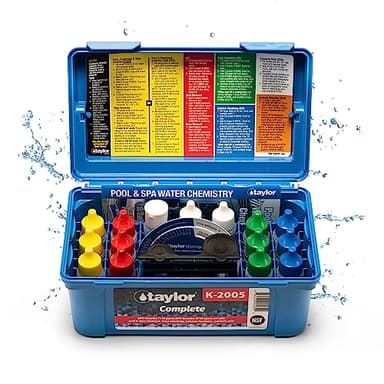
Pick 3 - Full chemistry without the titration
Taylor Technologies K-2005 DPD 9-in-1 Complete Pool Test Kit
The same nine tests as the K-2006 with color matching instead of titration, which is faster and less precise at the top of the chlorine range.
The published figure
DPD color comparator; free and total chlorine, bromine, pH, alkalinity, hardness, cyanuric acid
DPD is a color comparator: you match your sample against a printed block. It is quick and it is perfectly adequate at normal chlorine levels.
It saturates at high chlorine. If you shock regularly and want to know whether you are at 8 ppm or 25 ppm, this kit will not tell you.
For everything other than chlorine — pH, alkalinity, hardness, cyanuric acid — it is the same reagents and the same accuracy as the more expensive kit.
What it does well
- Full nine-parameter coverage
- Faster to run than a titration
- Same non-chlorine reagents as the K-2006
What it costs you
- Chlorine reading saturates above roughly 5 ppm
- Color matching is a judgment call in poor light
Skip it if you shock often and need to know where the chlorine actually landed. Buy the FAS-DPD.
#ad · how this is funded · price as of October 18, 2026
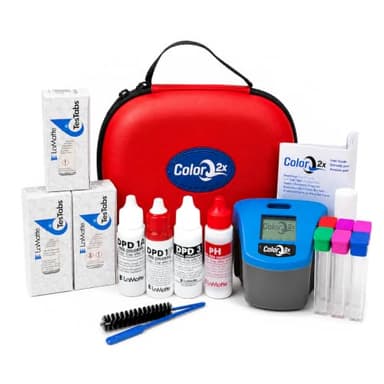
Pick 4 - Taking the judgment out of color matching
LaMotte ColorQ 2X Pro 7 Waterproof Bluetooth Photometer
A photometer reads the color for you, which removes the one variable a color-match kit cannot control: your eyes and your lighting.
The published figure
Digital photometer reading seven parameters from liquid and tablet reagents
Color matching goes wrong in shade, at dusk, and for anyone with a color vision deficiency. A photometer measures the sample optically and prints a number.
It still uses reagents, so the running cost and the expiry dates are unchanged from a drop kit. The instrument replaces your eye, not the chemistry.
Bluetooth logging is genuinely useful for spotting a trend rather than a snapshot, which is how most chemistry problems announce themselves.
What it does well
- Removes color-matching judgment entirely
- Logs readings so trends are visible
- Waterproof, which matters for something used at the pool edge
What it costs you
- Reagents still expire and cost money
- Most expensive option here by a wide margin
- A device with a battery is one more thing to maintain
Skip it if you can read a color comparator reliably. The instrument solves a problem you do not have.
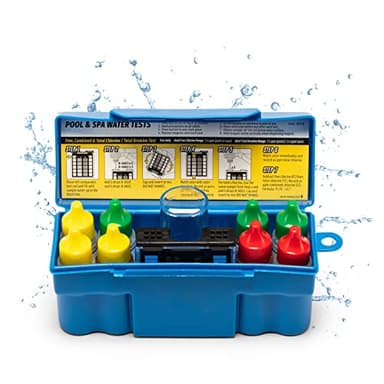
Pick 5 - The acid demand test
Taylor Technologies K-1004 DPD 6-in-1 Pool Test Kit
Includes an acid demand test, which is the only honest way to know how much pH reducer your pool needs.
The published figure
DPD kit including acid and base demand titrations
How much acid a pool needs to move pH from 8.0 to 7.5 depends on its total alkalinity, and no chart can tell you without knowing it. An acid demand test measures it directly.
That is why this site does not print a pH-down dose table: the number is a property of your water, not of the product, and the test costs a few dollars.
Six parameters rather than nine, so it does not cover cyanuric acid or salt.
What it does well
- Acid and base demand titrations, which most kits omit
- Cheaper than the nine-parameter kits
What it costs you
- No cyanuric acid test
- No salt test
Skip it if you need a cyanuric acid reading — that is a common problem this kit cannot see.
Pick 6 - Refills
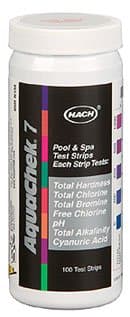
AquaChek 7-Way Silver Test Strips
The refill bottle. Same chemistry, no case, cheaper per strip.
The published figure
Seven-parameter strips including free and total chlorine and cyanuric acid
Once you own a kit, you are buying strips. Buying the complete kit again wastes the case and the color chart.
Store them dry and closed. Humidity is what kills strips, not age.
Same seven parameters as the complete kit above.
What it does well
- Cheaper per strip than the boxed kit
- Same seven parameters
What it costs you
- No case or chart included
- Same precision limits as any strip
Skip it if this is your first kit — buy the complete one for the chart.
#ad · how this is funded · price as of October 18, 2026
Getting an honest reading
- **Sample elbow-deep, away from returns and skimmers.** Surface water and water near a return are not representative of the pool.
- **Test at the same time of day.** Chlorine varies through the day with sunlight, so comparing a morning reading to an evening one is comparing two different things.
- **Keep reagents and strips dry and out of heat.** Humidity kills strips faster than age does. Write the date you opened the bottle on the lid.
- **Replace reagents each season.** They expire, and an expired reagent reads low without telling you.
- **Read colors in daylight, not under a porch light.** Color matching under artificial light is where a lot of the error comes from.
- **Rinse the vial with pool water before filling it.** Residue from the last test skews the next one.
What we could not verify
Manufacturer-stated accuracy figures for any of these kits. Taylor and LaMotte publish detailed reagent documentation but not a simple parts-per-million tolerance we could quote, and the strip makers publish nothing of the kind. This page therefore compares the methods on how they work rather than on accuracy claims we cannot source.
Questions people actually ask
What is the best pool test kit?
Are pool test strips accurate enough?
What is the difference between the Taylor K-2005 and K-2006?
Do I need a test for cyanuric acid?
Is a digital pool tester worth it?
Sources
Every figure on this page traces to one of these. Where a number could not be sourced, the page says so rather than estimating.
- Michigan EGLE, Maximum Disinfectant Residuals and Operational Ranges: Guidance for Michigan Licensed Pools (December 2025) - quotes CDC MAHC 5.7.3.1.1.5.0, the EPA FIFRA label rule and the NSF 10 ppm application ceiling
- HTH Pool Care Chlorine Stabilizer - product page, states up to 90% chlorine loss from UV and CYA targets of 30-50 ppm for trichlor and dichlor pools, 60-80 ppm for saltwater
- Skim & Soak methodology - the constants, formulas and worked examples behind every dose on this site
- Taylor K-2006-SALT FAS-DPD 9-in-1 Test Kit - Amazon listing, read 2026-09-02
- AquaChek Select Connect 7-Way Test Strips - Amazon listing, read 2026-09-02
- LaMotte ColorQ 2X Pro 7 Photometer - Amazon listing, read 2026-09-02
Read next
Test Strips vs Liquid Test Kits
Strips for monitoring a trend, titration for diagnosing a problem - and why owning both is the sensible answer.
Top pick
AquaChek Select Connect 7-Way Test Strips, complete kit
Weekly testing you will actually do
#ad · how this is funded · price as of October 18, 2026

How to Balance Pool Water
The correction order that stops you doing the same job twice, with computed dose tables and the formulas behind them.
Top pick
Pool Mate Premium Alkalinity Increaser, 10 lb
Raising total alkalinity
#ad · how this is funded · price as of October 18, 2026
Cyanuric Acid: Stabilizer, and Its Limit
How stabilizer works, the targets HTH publishes, and why the only way down is dilution.
Top pick
In The Swim Pool Stabilizer, 100% Cyanuric Acid, 25 lb
Stabilizing a liquid-chlorine or salt pool
#ad · how this is funded · price as of October 18, 2026
How to Clear a Green Pool Fast
The ordered fix: test, brush, shock by weight, filter continuously, clear the dead algae, then prevent the next one.