Testing & Chemistry
Taylor K-2006 Review
The one test kit every pool forum agrees on, judged on what the method does rather than on its reputation.
We have not handled these products and we do not pretend to have. Here is what we did instead. Links to Amazon earn us a commission at no extra cost to you, and commission never decides a pick — disclosure.
| # | Product | Best for | The spec it turns on | Price |
|---|---|---|---|---|
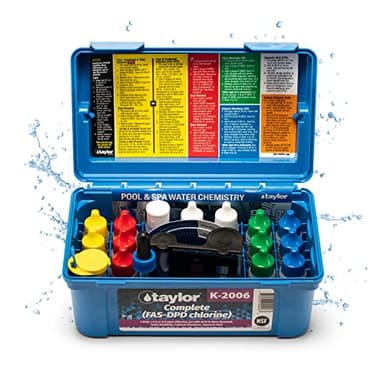
| 1 | 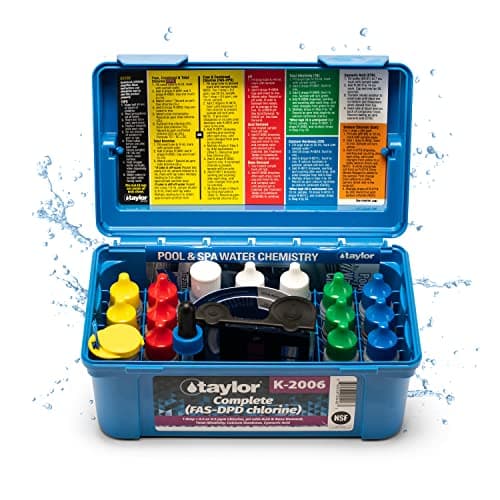 Taylor K-2006 Complete FAS-DPD Pool Test KitTop pickThe kit every pool forum names, and for once the consensus is right - because titration is the one chlorine method that does not saturate exactly when you need it. | The reference residential kit | FAS-DPD titration for free and combined chlorine, plus pH, acid and base demand, total alkalinity, calcium hardness and cyanuric acid; 3/4 oz reagents | |
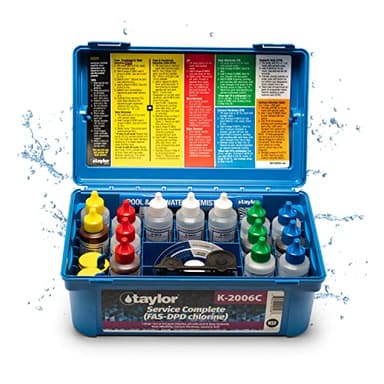
| 2 | 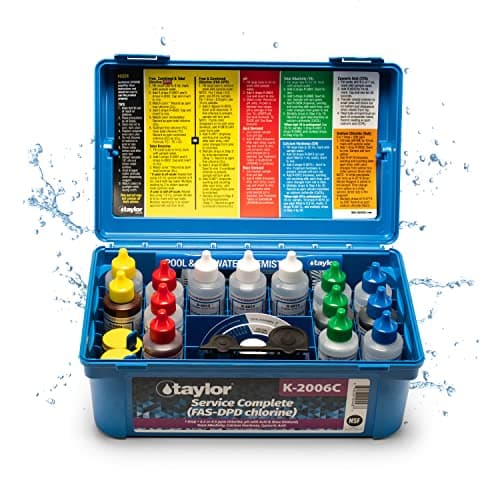 Taylor K-2006C Service Complete Pool Test Kit, 2 oz reagentsThe K-2006 with reagent bottles nearly three times the size, which pays for itself the first season you would otherwise have re-bought reagents. | Testing more than once a week | The same FAS-DPD titration kit with 2 oz reagent bottles; free and total chlorine, bromine, pH, acid and base demand, calcium hardness, total alkalinity and stabilizer | |
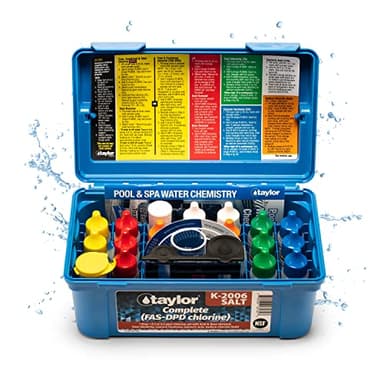
| 3 | 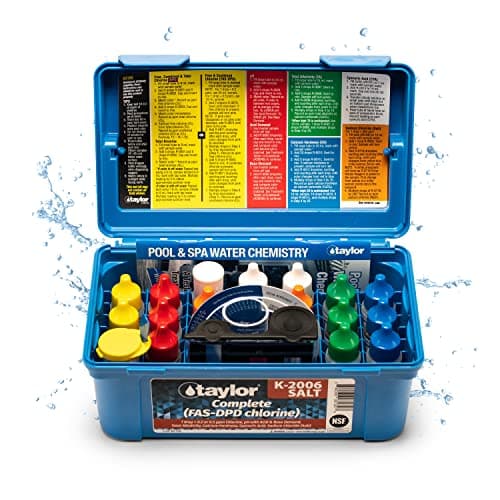 Taylor Technologies K-2006-SALT FAS-DPD 9-in-1 Test KitFAS-DPD is a drop-count titration, so the chlorine reading is a number you counted rather than a color you matched. | Knowing the number rather than the color | FAS-DPD titration; tests free and combined chlorine, salt, pH, alkalinity, hardness, cyanuric acid | |
| 4 | 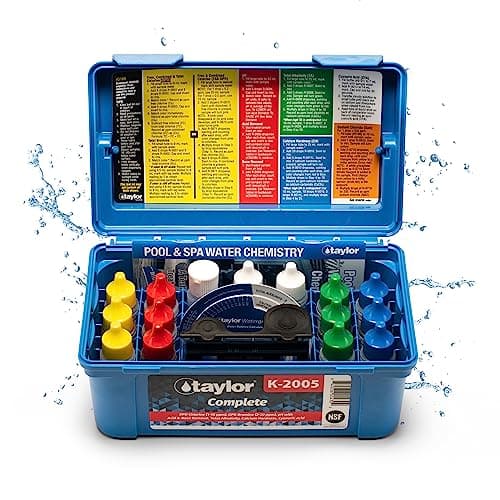 Taylor Technologies K-2005 DPD 9-in-1 Complete Pool Test KitThe same nine tests as the K-2006 with color matching instead of titration, which is faster and less precise at the top of the chlorine range. | Full chemistry without the titration | DPD color comparator; free and total chlorine, bromine, pH, alkalinity, hardness, cyanuric acid |
What this review is
We have not run a K-2006 against a laboratory reference. What follows is the method and what it means for a pool owner - which is a more useful thing to understand than a star rating, because this kit's entire value rests on one chemical difference that most reviews never explain.
The difference: a titration, not a color match
A strip or a DPD comparator measures chlorine by how pink the sample turns, matched against printed shades. That scale ends where the pink stops getting darker - about 5 ppm on most residential comparators, and strips are worse. Above that, 8 ppm and 20 ppm look identical. That is precisely the range you are in for the two days after a shock, when the one thing you want to know is whether it is safe to swim yet.
FAS-DPD does not match a color at all. You add DPD powder, the sample goes pink, then you add FAS reagent one drop at a time until the pink disappears, and you count the drops. Each drop represents a fixed amount of chlorine - the value is printed in the kit's instructions for the sample size you used - so 20 ppm is simply more drops than 5 ppm, and the kit reads it without complaint. The same reagents then give you combined chlorine, which the color methods cannot separate cleanly at all.
The seven tests, and what each is for
| Test | Method | Why it matters |
|---|---|---|
| Free chlorine | FAS-DPD titration | The sanitizer actually working, readable at shock levels |
| Combined chlorine | FAS-DPD, second reagent | Chloramines - the smell and the sting, and the reading that says shock again |
| pH | Color comparator | 7.2-7.6; drifts upward on salt pools - see high pH |
| Acid and base demand | Drop count from the pH sample | How much acid or base to add - a computed dose rather than a guess |
| Total alkalinity | Drop-count titration | The buffer that holds pH - see balance pool water |
| Calcium hardness | Drop-count titration | Scale above the range, etching below it; what cheap strips read worst |
| Cyanuric acid | Turbidity - the black dot disappears | The stabilizer that blunts chlorine - see cyanuric acid |
Six of the seven are shared with the cheaper K-2005. The seventh - the chlorine method - is the entire difference between the two kits, and the entire reason to pay more for one.
K-2006, K-2006C, K-2006-SALT and K-2005
| Kit | Chlorine method | Reagent bottles | Extra test | Buy it if |
|---|---|---|---|---|
| K-2006 | FAS-DPD titration | 3/4 oz | - | You shock and test about weekly |
| K-2006C | FAS-DPD titration | 2 oz | - | You test more than weekly |
| K-2006-SALT | FAS-DPD titration | 3/4 oz | Sodium chloride | You own a salt pool |
| K-2005 | DPD color comparator | 3/4 oz | Bromine | You never shock, or you run bromine |
The C suffix is nothing but reagent volume - 2 oz bottles against 3/4 oz. The chlorine reagents are what run out, because the FAS titration uses several drops per test, and a season of twice-weekly testing on one pool will empty the small bottles well before the season ends.
What it costs to keep running
Reagents expire - check the dates on the bottles - and the FAS titrant and the DPD powder go first. Every reagent is sold individually, which is why a K-2006 case lasts for years while its contents turn over several times. That is a real advantage over a photometer, whose consumables are proprietary, and it is what makes the kit's high price buy something durable rather than something disposable.
The cost in time is the honest downside. A full seven-test run takes several minutes and a steady hand; a strip takes fifteen seconds. Our position on strips versus liquid kits is that the strip is the weekly test because it actually gets used, and the K-2006 is the kit for the days that matter. Owning both is the right answer, and nothing on this page argues otherwise.
Getting an honest reading from it
- **Sample from elbow depth, away from a return.** Surface water and water straight from a return jet both read differently from the pool as a whole.
- **Use the sample size the instructions specify for the drop value you are using.** Taylor gives a drop value per sample size, and the larger sample reads in finer steps.
- **Swirl after every drop.** The color change is sharp when it arrives, and adding two drops at once overshoots by a whole increment.
- **Keep the DPD powder dry and the FAS bottle capped.** Both degrade in humidity, and degraded FAS reads chlorine low - which is the direction that gets someone in the water too early.
- **Run the cyanuric acid test in good light at arm's length.** It is the one test that depends on your eye, and it is read at the point where the black dot vanishes.
The picks
Top pick - The reference residential kit
Taylor K-2006 Complete FAS-DPD Pool Test Kit
The kit every pool forum names, and for once the consensus is right - because titration is the one chlorine method that does not saturate exactly when you need it.
The published figure
FAS-DPD titration for free and combined chlorine, plus pH, acid and base demand, total alkalinity, calcium hardness and cyanuric acid; 3/4 oz reagents
The chlorine test is FAS-DPD: you add reagent drop by drop until a pink sample turns clear, and count the drops. Each drop is a fixed amount of chlorine, so 20 ppm reads as more drops rather than as an impossible shade of pink. Every color-match method tops out around 5 ppm - the range you are in during a shock.
The other six tests are the same reagents as the cheaper K-2005. What you pay extra for is the chlorine method and nothing else.
The 3/4 oz reagent bottles are what separate it from the K-2006C. They run out in a season of frequent testing on one pool; the C's 2 oz bottles do not.
What it does well
- Reads chlorine accurately at shock levels, which no strip can
- Covers all seven residential parameters
- Reagents are sold individually, so the case lasts for years
What it costs you
- 3/4 oz bottles empty quickly if you test more than weekly
- A full run takes minutes rather than seconds
- Several times the price of a strip bottle
Skip it if you never shock and test once a week. A strip kit gets used, and this one might not.
Pick 2 - Testing more than once a week
Taylor K-2006C Service Complete Pool Test Kit, 2 oz reagents
The K-2006 with reagent bottles nearly three times the size, which pays for itself the first season you would otherwise have re-bought reagents.
The published figure
The same FAS-DPD titration kit with 2 oz reagent bottles; free and total chlorine, bromine, pH, acid and base demand, calcium hardness, total alkalinity and stabilizer
Taylor states 2 oz reagent bottles against the K-2006's 3/4 oz. The tests are identical and the chemistry is identical; you are buying volume. Test twice a week through a season and the small kit runs dry on the chlorine reagents while this one does not.
The 'service' in the name means it is the size a pool technician carries. For an owner it means fewer top-ups and a larger case to store.
Reagents still carry expiry dates, so buying the bigger bottles only pays if you will actually use them.
What it does well
- 2 oz reagents last a season or more of frequent testing
- Identical accuracy and method to the K-2006
- Cheaper per test than buying refills for the small kit
What it costs you
- Higher price up front
- Larger case to store
- Reagents expire whether or not you use them
Skip it if you test weekly or less. The K-2006's smaller bottles will expire before you empty them, and these will expire with more left in them.
#ad · how this is funded · price as of October 10, 2026
Pick 3 - Knowing the number rather than the color
Taylor Technologies K-2006-SALT FAS-DPD 9-in-1 Test Kit
FAS-DPD is a drop-count titration, so the chlorine reading is a number you counted rather than a color you matched.
The published figure
FAS-DPD titration; tests free and combined chlorine, salt, pH, alkalinity, hardness, cyanuric acid
Every strip and every DPD color-match kit asks you to judge a shade. FAS-DPD asks you to count drops until a color disappears, which removes the judgment entirely.
That matters most exactly where the cheap methods fail: above about 5 ppm free chlorine, color-match scales saturate and read 'high' for anything from 6 ppm to 30 ppm. When you are shocking, that is the range you are in.
It also measures combined chlorine separately, which is the reading that tells you whether the shock worked or the pool needs another round.
What it does well
- Titration rather than color matching, so chlorine is a counted number
- Reads accurately at shock-level chlorine where strips saturate
- Measures combined chlorine, cyanuric acid and salt in one kit
What it costs you
- Slowest kit here to use — several minutes per full test
- Reagents expire and need replacing each season
- The most expensive way to test
Skip it if you will not actually run it. A kit used monthly is worse than strips used weekly.
#ad · how this is funded · price as of October 10, 2026
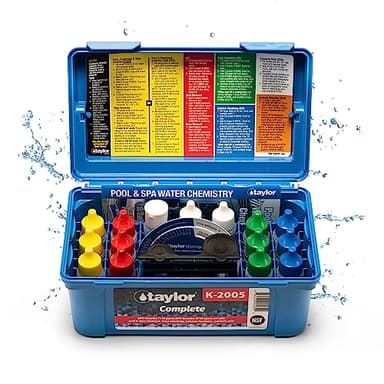
Pick 4 - Full chemistry without the titration
Taylor Technologies K-2005 DPD 9-in-1 Complete Pool Test Kit
The same nine tests as the K-2006 with color matching instead of titration, which is faster and less precise at the top of the chlorine range.
The published figure
DPD color comparator; free and total chlorine, bromine, pH, alkalinity, hardness, cyanuric acid
DPD is a color comparator: you match your sample against a printed block. It is quick and it is perfectly adequate at normal chlorine levels.
It saturates at high chlorine. If you shock regularly and want to know whether you are at 8 ppm or 25 ppm, this kit will not tell you.
For everything other than chlorine — pH, alkalinity, hardness, cyanuric acid — it is the same reagents and the same accuracy as the more expensive kit.
What it does well
- Full nine-parameter coverage
- Faster to run than a titration
- Same non-chlorine reagents as the K-2006
What it costs you
- Chlorine reading saturates above roughly 5 ppm
- Color matching is a judgment call in poor light
Skip it if you shock often and need to know where the chlorine actually landed. Buy the FAS-DPD.
#ad · how this is funded · price as of October 10, 2026
Who should buy it
- **Anyone who shocks their pool.** It is the only residential method that can read the result of what you just did.
- **Anyone on a tablet pool who has never tested cyanuric acid.** The turbidity test is in the box, and it is the test that explains a green pool with a perfectly good chlorine reading.
- **Anyone who wants a computed dose rather than a rule of thumb.** Acid and base demand are drop counts that translate directly into ounces of product.
Who should not
- **An owner who tests once a week and never shocks.** A seven-way strip covers that, gets used, and costs a tenth as much - see best pool test kits.
- **A bromine spa.** The K-2005 tests bromine; the K-2006 does not list it.
- **Anyone who will not read the instructions.** The drop values and sample sizes are the method. Skipped, the kit is an expensive box of pink water.
Questions people actually ask
Is the Taylor K-2006 worth it?
What is the difference between the Taylor K-2006 and K-2005?
What is the difference between the K-2006 and K-2006C?
How does FAS-DPD titration work?
Do Taylor reagents expire?
Does the K-2006 test salt?
Sources
Every figure on this page traces to one of these. Where a number could not be sourced, the page says so rather than estimating.
- Skim & Soak methodology - the constants, formulas and worked examples behind every dose on this site
- Taylor K-2006 Complete Pool Water Test Kit, FAS-DPD - Amazon listing, read 2026-09-12
- Taylor K-2006C Service Complete Pool Water Test Kit, 2 oz reagents - Amazon listing, read 2026-09-12
- Taylor K-2006-SALT FAS-DPD 9-in-1 Saltwater Pool Test Kit - Amazon listing, read 2026-09-12
- Taylor K-2005 DPD 9-in-1 Complete Pool Test Kit - Amazon listing, read 2026-09-12
Read next
Best test kit
Best Pool Test Kits
Titration kits, color comparators, strips and a photometer compared on precision, speed and what each one cannot see.
Top pick
AquaChek Select Connect 7-Way Test Strips, complete kit
Weekly testing you will actually do
#ad · how this is funded · price as of October 10, 2026
Test Strips vs Liquid Test Kits
Strips for monitoring a trend, titration for diagnosing a problem - and why owning both is the sensible answer.
Top pick
AquaChek Select Connect 7-Way Test Strips, complete kit
Weekly testing you will actually do
#ad · how this is funded · price as of October 10, 2026
Cyanuric Acid: Stabilizer, and Its Limit
How stabilizer works, the targets HTH publishes, and why the only way down is dilution.
Top pick
In The Swim Pool Stabilizer, 100% Cyanuric Acid, 25 lb
Stabilizing a liquid-chlorine or salt pool
#ad · how this is funded · price as of October 10, 2026
Best for green water
Best Pool Shock for a Green Pool
Cal-hypo, dichlor and liquid chlorine compared on available chlorine percentage, with a dose table computed for six pool sizes.
Top pick
In The Swim Pool Shock, 68% Cal-Hypo Granular, 25 lb
Clearing an algae bloom
#ad · how this is funded · price as of October 10, 2026
Best salt water chlorinator
Best Salt Water Chlorinator
Inline and drop-in salt chlorine generators compared on published daily output, pool rating, warranty and install - with the arithmetic that turns your pool's demand into a cell size.
Top pick
CircuPool RJ45+ Salt Chlorine Generator System, 45,000 gallons
Large pools and hot climates
#ad · how this is funded · price as of October 10, 2026