Cloudy Water
Cloudy Water With High Chlorine
Chlorine is meant to prevent this, so the combination is telling you something specific. Usually one of four things.
We have not handled these products and we do not pretend to have. Here is what we did instead. Links to Amazon earn us a commission at no extra cost to you, and commission never decides a pick — disclosure.
| # | Product | Best for | The spec it turns on | Price |
|---|---|---|---|---|
| 1 | 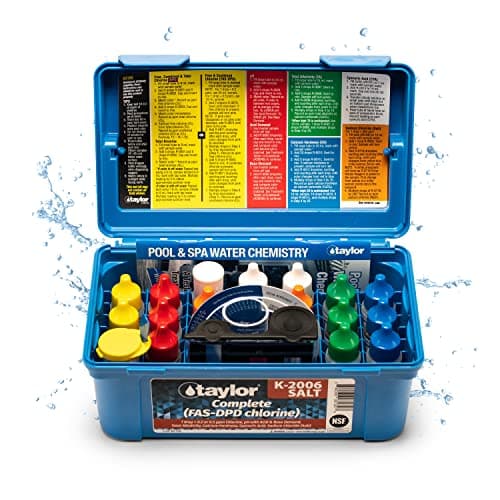 Taylor Technologies K-2006-SALT FAS-DPD 9-in-1 Test KitTop pickFAS-DPD is a drop-count titration, so the chlorine reading is a number you counted rather than a color you matched. | Knowing the number rather than the color | FAS-DPD titration; tests free and combined chlorine, salt, pH, alkalinity, hardness, cyanuric acid | |
| 2 | 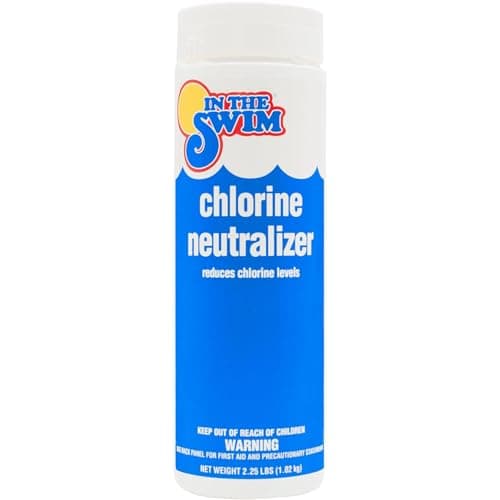 In The Swim Chlorine Neutralizer, 2.25 lbPublishes its purity, which is the only figure that lets you dose it rather than guess at it. | Bringing an over-shocked pool back | Listing states 90% sodium thiosulfate | |
| 3 | 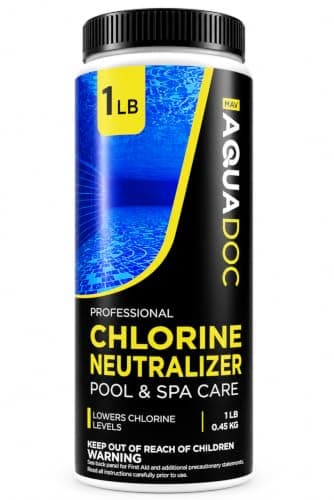 AquaDoc Chlorine Neutralizer, Sodium Thiosulfate, 1 lbThe small bottle, for the once-a-season case where you shocked too hard and want to swim tomorrow. | A one-off correction | 1 lb of sodium thiosulfate granules, for pools and hot tubs | |
| 4 | 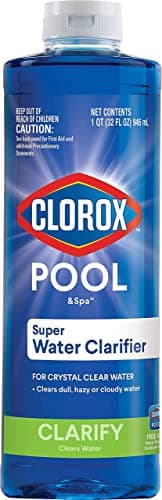 Clorox Pool&Spa Super Water Clarifier, 1 quartA conventional polymer clarifier from the most widely stocked brand, which matters when the water is cloudy on a Saturday. | Sand filters | Concentrated polymer clarifier, one quart |
Why the combination is informative
Chlorine is what prevents most causes of cloudy water, so cloudiness while chlorine is high rules out the largest single category - an unsanitized pool. That narrows things usefully.
What is left is nearly always something the chlorine itself created, which is why the timing matters more than the reading. Almost every case follows a shock.
The four causes
| Cause | The tell | Fix | How long |
|---|---|---|---|
| Dead algae in suspension | Gray or gray-green haze, following a green episode | Filter continuously, or flocculate | 1-3 days |
| Calcium out of solution | Milky white, after a cal-hypo shock, pH now high | Correct pH; test calcium hardness | Hours to days |
| Saturated test reading | Strip reads maximum; the real level is unknown | Retest with FAS-DPD titration | Immediate |
| Filter overwhelmed | Pressure high, or media overdue | Clean or replace the media | Immediate, then filter |
Cause 1: dead algae, which is the usual one
If the pool was green in the past week, stop here - this is your answer. Gray-cloudy water with elevated chlorine after a shock is dead algae in suspension, and it means the shock worked.
It is also indistinguishable from failure if you do not know to expect it, which is why people re-shock at this point and make no progress. Full detail on cloudy pool water after shock.
Cause 2: calcium, if you shocked with cal-hypo
Calcium hypochlorite adds calcium hardness and raises pH. Do both at once in water already carrying plenty of calcium and some of it comes out of solution as fine white particulate - a milky haze rather than a gray one.
The tell is color and timing: milky white rather than gray, following a cal-hypo shock, with pH now above 7.6. Correcting pH usually clears it on its own, which makes this the cheapest of the four to fix - see how to balance pool water.
If it happens every time you shock, your calcium hardness is probably near saturation and the durable answer is switching to liquid chlorine, which adds none.
Cause 3: your chlorine reading may not be real
This one is worth checking before acting on any of the others, because it is free and it changes what the other three mean.
This matters because the correct action differs enormously between 6 ppm, which will fall on its own by tomorrow, and 30 ppm, which will not. See best pool test kits for the method that reads it.
Cause 4: the filter cannot keep up
A shock puts a large load of oxidized organic material into the water at once. A filter that was coping fine with routine duty may not cope with that, and the symptom is cloudiness that never clears no matter how long you run the pump.
Check the pressure gauge against the clean reading, and clean or backwash before concluding anything else. See how to clean a pool filter.
When to use a neutralizer, and when not to
Sodium thiosulfate reduces free chlorine directly, and it is the right tool in a narrow set of cases: chlorine genuinely very high, confirmed by a titration rather than a saturated strip, and people wanting to swim sooner than nature will allow.
It is the wrong tool for most of this page. Chlorine falls on its own - sunlight and normal demand bring an over-shocked pool back within a day or two at no cost. And overshooting a neutralizer takes free chlorine to zero, which leaves the pool unsanitized and is a worse problem than the one you started with.
- Confirm the actual level with a FAS-DPD titration, not a strip.
- Decide whether you can simply wait. Usually you can.
- If not, dose deliberately under the label rate for the reduction you want.
- Circulate, then retest before adding any more.
- Stop while chlorine is still in a sanitizing range. Zero is not the target.
The picks
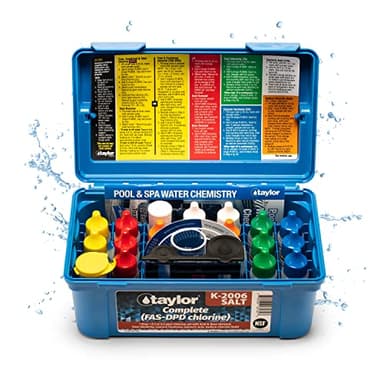
Top pick - Knowing the number rather than the color
Taylor Technologies K-2006-SALT FAS-DPD 9-in-1 Test Kit
FAS-DPD is a drop-count titration, so the chlorine reading is a number you counted rather than a color you matched.
The published figure
FAS-DPD titration; tests free and combined chlorine, salt, pH, alkalinity, hardness, cyanuric acid
Every strip and every DPD color-match kit asks you to judge a shade. FAS-DPD asks you to count drops until a color disappears, which removes the judgment entirely.
That matters most exactly where the cheap methods fail: above about 5 ppm free chlorine, color-match scales saturate and read 'high' for anything from 6 ppm to 30 ppm. When you are shocking, that is the range you are in.
It also measures combined chlorine separately, which is the reading that tells you whether the shock worked or the pool needs another round.
What it does well
- Titration rather than color matching, so chlorine is a counted number
- Reads accurately at shock-level chlorine where strips saturate
- Measures combined chlorine, cyanuric acid and salt in one kit
What it costs you
- Slowest kit here to use — several minutes per full test
- Reagents expire and need replacing each season
- The most expensive way to test
Skip it if you will not actually run it. A kit used monthly is worse than strips used weekly.
#ad · how this is funded · price as of October 9, 2026
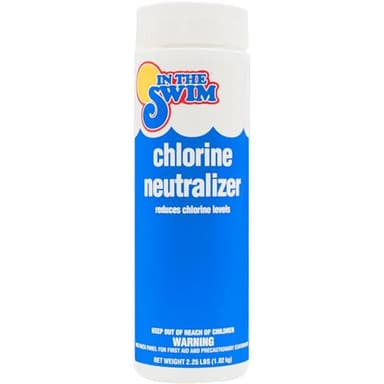
Pick 2 - Bringing an over-shocked pool back
In The Swim Chlorine Neutralizer, 2.25 lb
Publishes its purity, which is the only figure that lets you dose it rather than guess at it.
The published figure
Listing states 90% sodium thiosulfate
Sodium thiosulfate reduces free chlorine directly. It is the tool for a pool that has been over-shocked to the point where nobody can swim and waiting is not acceptable.
A stated 90% purity is unusual in this category and it is the reason to prefer this one - a product that does not state its concentration cannot be dosed to a target, only added and re-tested.
Under-dose deliberately and re-test. Overshooting takes free chlorine to zero, which leaves the pool unsanitized and is a worse problem than the one you started with.
What it does well
- States 90% purity, so the dose is computable rather than guessed
- Acts quickly - the reading moves within an hour or so of circulation
- Sized for several corrections rather than one
What it costs you
- Very easy to overshoot to zero chlorine
- Treats the symptom; it does not stop you over-shocking next time
Skip it if you can simply wait. Sunlight and normal demand bring chlorine down on their own within a day or two, and that costs nothing.
#ad · how this is funded · price as of October 9, 2026
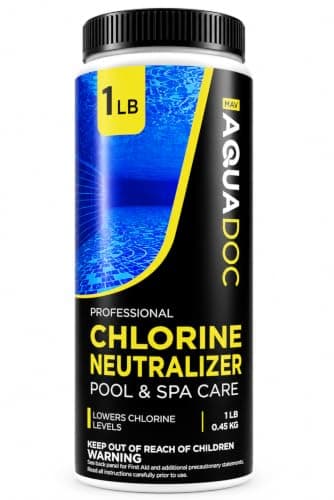
Pick 3 - A one-off correction
AquaDoc Chlorine Neutralizer, Sodium Thiosulfate, 1 lb
The small bottle, for the once-a-season case where you shocked too hard and want to swim tomorrow.
The published figure
1 lb of sodium thiosulfate granules, for pools and hot tubs
Neutralizer is a product most pools need once or twice ever. Buying 15 lb of it is buying a decade of shelf life.
One pound is the sensible quantity for a correction on a residential pool.
Same caution as any neutralizer: go under, circulate, re-test. Zero chlorine is not the goal.
What it does well
- Right quantity for an occasional correction
- Works in pools and spas alike
What it costs you
- The listing does not state a purity percentage, so dosing is by label rather than calculation
- Worse value per pound than the larger tubs
Skip it if you over-shock regularly. That is a dosing problem worth fixing rather than repeatedly correcting.
#ad · how this is funded · price as of October 9, 2026
Pick 4 - Sand filters
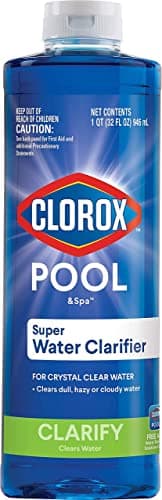
Clorox Pool&Spa Super Water Clarifier, 1 quart
A conventional polymer clarifier from the most widely stocked brand, which matters when the water is cloudy on a Saturday.
The published figure
Concentrated polymer clarifier, one quart
A clarifier is a coagulant: it makes fine particles clump until they are large enough for the filter to catch. That means it only works if the filter is running and clean, which is the step people skip before deciding the product failed.
Polymer clarifiers suit sand filters well, because sand catches particles down to roughly 20 microns and the clarifier's job is to lift the haze above that threshold.
Give it a full filter cycle. Clarifier is a 24 to 48 hour product, and re-dosing at hour six because nothing has happened is how people end up over-treating.
What it does well
- Stocked nearly everywhere, which is the whole point in an emergency
- Concentrated, so a quart treats several doses
- Works with the filter you already have rather than requiring vacuum-to-waste
What it costs you
- Needs a clean, running filter to do anything
- Slower than flocculant when the water is badly clouded
Skip it if your water is so cloudy you cannot see the bottom step. That is flocculant territory, not clarifier.
Is it safe to swim?
Two separate questions, and the visibility one is the harder line. If you cannot see the bottom of the deep end, the pool is unsafe regardless of chemistry, because a swimmer in difficulty is invisible.
On the chlorine side, the binding figure is the one on your product label. Michigan's state guidance for licensed pools notes that many pool chlorine products carry an NSF-listed maximum application rate of 10 ppm, and advises a closure order above that level. Your own label is the authority; that figure is the common ceiling.
Questions people actually ask
Why is my pool cloudy when the chlorine is high?
Should I add a chlorine neutralizer to a cloudy pool?
Can chlorine itself make a pool cloudy?
My test strip says chlorine is off the scale. What now?
How long until high chlorine comes down on its own?
Sources
Every figure on this page traces to one of these. Where a number could not be sourced, the page says so rather than estimating.
- Michigan EGLE, Maximum Disinfectant Residuals and Operational Ranges: Guidance for Michigan Licensed Pools (December 2025) - quotes CDC MAHC 5.7.3.1.1.5.0, the EPA FIFRA label rule and the NSF 10 ppm application ceiling
- HTH Pool Care Shock Advanced - product page, cal hypo formulation, adds no cyanuric acid
- HTH Pool Care pH Down - product page, sodium bisulfate, states a 7.2-7.6 target and a 4-6 hour wait after shocking
- Skim & Soak methodology - the constants, formulas and worked examples behind every dose on this site
- In The Swim Chlorine Neutralizer, 90% sodium thiosulfate - Amazon listing, read 2026-09-02
- Taylor K-2006-SALT FAS-DPD Test Kit - Amazon listing, read 2026-09-02
Read next
Cloudy Pool Water After Shock
Gray after a shock is dead algae in suspension. Filter it or floc it; do not re-shock.
Top pick
HTH Pool Care Drop Out Flocculant, 32 oz
Clearing a pool overnight
#ad · how this is funded · price as of October 9, 2026
Why Is My Pool Cloudy?
Check filtration, then chemistry, then everything else. Two of the six causes get worse if you add a chemical first.
Best test kit
Best Pool Test Kits
Titration kits, color comparators, strips and a photometer compared on precision, speed and what each one cannot see.
Top pick
AquaChek Select Connect 7-Way Test Strips, complete kit
Weekly testing you will actually do
#ad · how this is funded · price as of October 9, 2026
Pool pH Too High
High pH blunts chlorine and clouds water. Correct it with acid, then find the cause - usually alkalinity or aeration.
Top pick
HTH Pool Care pH Down, 5 lb
Lowering pH