Cloudy Water
Cloudy Pool Water After Shock
Green went to gray and you think you failed. You did not - gray is what a dead bloom looks like on the way out.
We have not handled these products and we do not pretend to have. Here is what we did instead. Links to Amazon earn us a commission at no extra cost to you, and commission never decides a pick — disclosure.
| # | Product | Best for | The spec it turns on | Price |
|---|---|---|---|---|
| 1 | 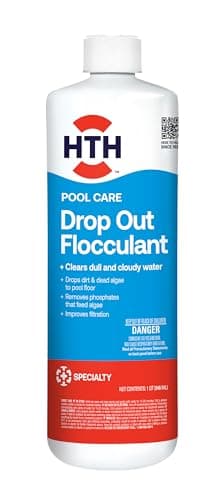 HTH Pool Care Drop Out Flocculant, 32 ozTop pickThe flocculant whose maker also claims phosphate removal, which is a genuinely useful second job after an algae bloom. | Clearing a pool overnight | HTH states it drops debris overnight for vacuum-to-waste, and removes phosphates | |
| 2 | 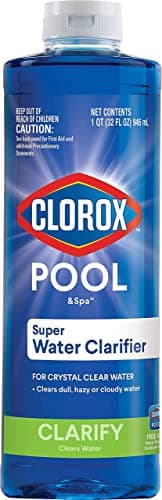 Clorox Pool&Spa Super Water Clarifier, 1 quartA conventional polymer clarifier from the most widely stocked brand, which matters when the water is cloudy on a Saturday. | Sand filters | Concentrated polymer clarifier, one quart |
What actually happened
Living algae is green because it is photosynthesizing. Kill it and it stops - the cells lose their color and become fine gray-white debris that stays suspended because it is neutrally buoyant and far too small for a typical filter to catch on the first pass.
So the color change from green to gray is the visible signature of a successful shock. It is also, from the deck, indistinguishable from failure, which is why this is one of the most commonly asked questions in the whole niche.
Two ways forward
| Filter it out | Flocculant and vacuum | |
|---|---|---|
| Time | 1-3 days | Overnight |
| Requires | A clean filter and continuous running | A multiport valve with WASTE |
| Effort | Backwash or rinse repeatedly | One careful vacuum |
| Water lost | Backwash water only | Several inches |
| Best when | Light bloom, filter in good shape | Heavy bloom, or the filter is already struggling |
If you are filtering it out
- Run the pump continuously - not on a timer - until the water is clear.
- Watch the filter pressure. A bloom's worth of dead algae will load a filter two or three times over, and each backwash or rinse restores its capacity.
- Vacuum the floor daily. A lot of the debris settles overnight, and lifting it out is faster than asking the filter to catch it again - and which vacuum you use decides whether the debris leaves the pool or comes back through the returns.
- Add a clarifier after the first filter clean, not before. It clumps what remains above the filter's threshold, and it needs a filter with capacity left to be worth anything.
- Keep free chlorine elevated until the water is clear. Dead algae is organic load and it consumes sanitizer as it breaks down.
If you are flocculating it
This is the case flocculant was designed for, and it is genuinely much faster. The full procedure is on best pool flocculant; the short version is dose, pump off overnight, vacuum to waste in the morning without brushing first.
There is a second reason it suits this situation: dead algae releases phosphate back into the water as it breaks down, and phosphate is what feeds the next bloom. HTH's Drop Out Flocculant page states that its formula removes phosphates alongside the settling action, which addresses both problems in one operation.
Why re-shocking is the wrong move
- The algae is already dead. More chlorine does not make dead algae smaller or heavier.
- If you shocked with cal-hypo, another dose adds more calcium hardness - which is itself a cloudiness cause.
- If you shocked with dichlor, another dose adds more cyanuric acid, which will make the next bloom harder to fight.
- You are paying for a chemical to solve what is now purely a filtration problem.
When it is genuinely not working
Give it three days of continuous filtration with the filter cleaned at least twice. Past that, something else is wrong:
- **Free chlorine falling fast** means the bloom is still alive and consuming it. Re-test cyanuric acid; very high stabilizer is the usual explanation. If chlorine is instead staying high while the pool stays cloudy, that is a different set of four causes.
- **Filter pressure never rising** means water is bypassing the media rather than going through it. Check for a torn cartridge, a cracked sand-filter lateral, or a mis-seated element.
- **Water clears then goes hazy again each afternoon** points at a chemistry cause on top of the algae - usually high pH.
- **Persistent milky white** rather than gray is more likely calcium than algae. Test calcium hardness.
The picks
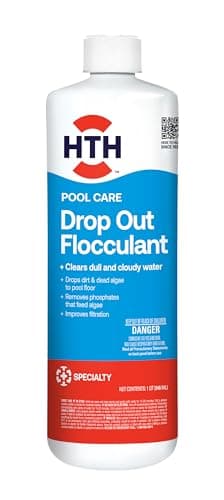
Top pick - Clearing a pool overnight
HTH Pool Care Drop Out Flocculant, 32 oz
The flocculant whose maker also claims phosphate removal, which is a genuinely useful second job after an algae bloom.
The published figure
HTH states it drops debris overnight for vacuum-to-waste, and removes phosphates
Flocculant does the opposite of clarifier: instead of making particles filterable, it makes them heavy enough to sink so you vacuum them out. That is faster, and it requires vacuum-to-waste.
HTH's product page states this formula also removes phosphates. After a bloom that matters, because dead algae releases the phosphate that fed it back into the water.
If your pump has no waste setting, do not buy this. Vacuuming the settled layer back through the filter puts everything you just dropped straight back into the pool.
What it does well
- Overnight result rather than a 48-hour filter cycle
- Claims phosphate removal alongside the settling action
- Stated safe across pool types and pH levels
What it costs you
- Requires a multiport valve with a waste setting
- You will lose several inches of water vacuuming to waste
Skip it if your filter has no vacuum-to-waste option. Use a clarifier and be patient instead.
#ad · how this is funded · price as of October 18, 2026
Pick 2 - Sand filters
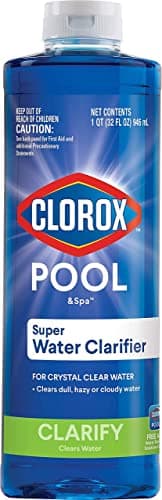
Clorox Pool&Spa Super Water Clarifier, 1 quart
A conventional polymer clarifier from the most widely stocked brand, which matters when the water is cloudy on a Saturday.
The published figure
Concentrated polymer clarifier, one quart
A clarifier is a coagulant: it makes fine particles clump until they are large enough for the filter to catch. That means it only works if the filter is running and clean, which is the step people skip before deciding the product failed.
Polymer clarifiers suit sand filters well, because sand catches particles down to roughly 20 microns and the clarifier's job is to lift the haze above that threshold.
Give it a full filter cycle. Clarifier is a 24 to 48 hour product, and re-dosing at hour six because nothing has happened is how people end up over-treating.
What it does well
- Stocked nearly everywhere, which is the whole point in an emergency
- Concentrated, so a quart treats several doses
- Works with the filter you already have rather than requiring vacuum-to-waste
What it costs you
- Needs a clean, running filter to do anything
- Slower than flocculant when the water is badly clouded
Skip it if your water is so cloudy you cannot see the bottom step. That is flocculant territory, not clarifier.
Questions people actually ask
Why is my pool cloudy after shocking it?
How long does it take for cloudy water to clear after shocking?
Should I shock again if the pool is still cloudy?
Can I swim in a pool that is cloudy from dead algae?
Sources
Every figure on this page traces to one of these. Where a number could not be sourced, the page says so rather than estimating.
- HTH Pool Care Drop Out Flocculant - product page, states vacuum-to-waste removal and phosphate reduction
- HTH Pool Care Shock Advanced - product page, cal hypo formulation, adds no cyanuric acid
- HTH Pool Care Phosphate Remover - product page, states 2 fl oz per 10,000 gallons weekly and that levels above 200-500 ppb make algae harder to control
- Michigan EGLE, Maximum Disinfectant Residuals and Operational Ranges: Guidance for Michigan Licensed Pools (December 2025) - quotes CDC MAHC 5.7.3.1.1.5.0, the EPA FIFRA label rule and the NSF 10 ppm application ceiling
- Skim & Soak methodology - the constants, formulas and worked examples behind every dose on this site
Read next
Best for overnight clearing
Best Pool Flocculant
Four flocculants compared, plus the equipment check that decides whether you can use one at all.
Top pick
HTH Pool Care Drop Out Flocculant, 32 oz
Clearing a pool overnight
#ad · how this is funded · price as of October 18, 2026
How to Clear a Green Pool Fast
The ordered fix: test, brush, shock by weight, filter continuously, clear the dead algae, then prevent the next one.
Clarifier vs Flocculant
Clarifier works with your filter over 24 to 48 hours; flocculant bypasses it overnight but needs a waste setting.
Top pick
Clorox Pool&Spa Super Water Clarifier, 1 quart
Sand filters
Are Phosphates Bad for Your Pool?
Phosphate is algae food. The threshold that matters, where it comes from, and why a test comes before a remover.
Top pick
HTH Pool Care Phosphate Remover, 1 quart
A published dose rate
#ad · how this is funded · price as of October 18, 2026