Cloudy Water
Clarifier vs Flocculant
They sit beside each other on the shelf and do opposite things. Buying the wrong one is the most common mistake in this category.
We have not handled these products and we do not pretend to have. Here is what we did instead. Links to Amazon earn us a commission at no extra cost to you, and commission never decides a pick — disclosure.
| # | Product | Best for | The spec it turns on | Price |
|---|---|---|---|---|
| 1 | 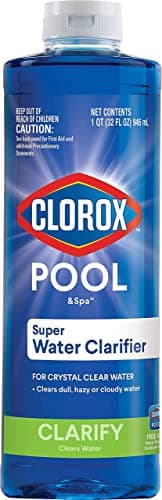 Clorox Pool&Spa Super Water Clarifier, 1 quartTop pickA conventional polymer clarifier from the most widely stocked brand, which matters when the water is cloudy on a Saturday. | Sand filters | Concentrated polymer clarifier, one quart | |
| 2 | 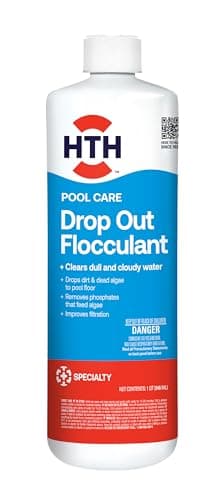 HTH Pool Care Drop Out Flocculant, 32 ozThe flocculant whose maker also claims phosphate removal, which is a genuinely useful second job after an algae bloom. | Clearing a pool overnight | HTH states it drops debris overnight for vacuum-to-waste, and removes phosphates | |
| 3 | 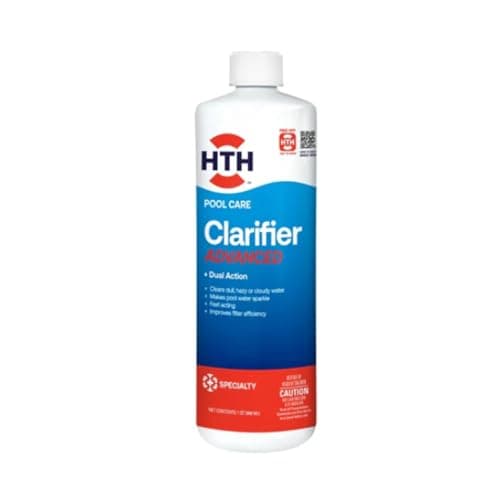 HTH Pool Care Clarifier AdvancedThe one whose maker explicitly states it will not move pH, which is worth something when you have just finished balancing. | Not disturbing pH | HTH states it clears in 24 hours and does not affect pH balance | |
| 4 | 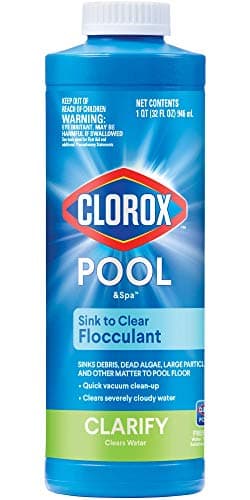 Clorox Pool&Spa Sink to Clear FlocculantPositioned specifically at post-shock dead algae, which is the single most common reason a pool goes from green to gray. | Dead algae after a shock | Settles dead algae and large particles for vacuuming |
The one-line difference
Clarifier makes the debris catchable. Flocculant makes the debris sink. Everything else follows from that.
| Clarifier | Flocculant | |
|---|---|---|
| Mechanism | Coagulates particles above the filter's micron rating | Binds particles into a heavy floc that settles |
| Where the debris goes | Into your filter | Onto the pool floor, then to waste |
| Filter runs? | Continuously - it does the work | Off overnight - circulation defeats it |
| Time to clear | 24-48 hours | Overnight plus a careful vacuum |
| Equipment required | A clean, working filter | Multiport valve with a WASTE setting |
| Water lost | None | Several inches |
| Filter aftermath | Needs cleaning afterwards | Filter barely touched |
| Risk if you get it wrong | Slow, but nothing is made worse | Debris goes back into the pool |
When clarifier is the right answer
- Your filter has no vacuum-to-waste option - cartridge filters usually do not
- The haze is mild and you can wait a day or two
- You do not want to lose several inches of water, particularly on metered supply
- The cause is oils and lotions rather than dead algae - a chitosan clarifier targets those specifically
- You want the simplest possible intervention: add it, run the filter, wait
When flocculant is the right answer
- You cannot see the bottom of the pool at all
- You have just shocked a green pool and the water is full of dead algae
- Your filter has a multiport valve with a WASTE setting
- You need the pool usable tomorrow rather than at the weekend
- The debris load would clog your filter several times over if you tried to catch it
The mistakes worth naming
- **Using flocculant without a waste setting.** The single most common one. You vacuum the floor, everything goes through the filter, and half of it comes straight back out of the returns.
- **Leaving the pump running after a flocculant dose.** Circulation keeps the floc suspended. Pump off, overnight, no exceptions.
- **Brushing before vacuuming a flocculant treatment.** You spent the night getting it to settle. Do not stir it back up.
- **Adding clarifier to a dirty filter.** The clarifier does its job, the filter cannot accept the result, and the water stays hazy while you conclude the bottle failed.
- **Re-dosing clarifier at hour six.** It is a 24 to 48 hour product. Impatience here is how people end up over-treating and gumming the filter.
- **Using both at once.** They work against each other. Pick one.
What about the combination products?
Bottles that combine a clarifier with an algaecide - or a clarifier with a flocculant - exist and we would not buy them. Clarifier is a reactive treatment you dose once when the water is hazy; algaecide is a preventative you dose weekly at a low rate. There is no single dose at which both are correct, so hitting one target means missing the other. Two bottles cost slightly more and let you treat the problem you actually have.
The picks
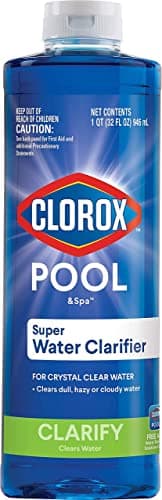
Top pick - Sand filters
Clorox Pool&Spa Super Water Clarifier, 1 quart
A conventional polymer clarifier from the most widely stocked brand, which matters when the water is cloudy on a Saturday.
The published figure
Concentrated polymer clarifier, one quart
A clarifier is a coagulant: it makes fine particles clump until they are large enough for the filter to catch. That means it only works if the filter is running and clean, which is the step people skip before deciding the product failed.
Polymer clarifiers suit sand filters well, because sand catches particles down to roughly 20 microns and the clarifier's job is to lift the haze above that threshold.
Give it a full filter cycle. Clarifier is a 24 to 48 hour product, and re-dosing at hour six because nothing has happened is how people end up over-treating.
What it does well
- Stocked nearly everywhere, which is the whole point in an emergency
- Concentrated, so a quart treats several doses
- Works with the filter you already have rather than requiring vacuum-to-waste
What it costs you
- Needs a clean, running filter to do anything
- Slower than flocculant when the water is badly clouded
Skip it if your water is so cloudy you cannot see the bottom step. That is flocculant territory, not clarifier.
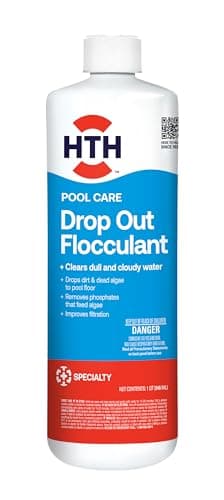
Pick 2 - Clearing a pool overnight
HTH Pool Care Drop Out Flocculant, 32 oz
The flocculant whose maker also claims phosphate removal, which is a genuinely useful second job after an algae bloom.
The published figure
HTH states it drops debris overnight for vacuum-to-waste, and removes phosphates
Flocculant does the opposite of clarifier: instead of making particles filterable, it makes them heavy enough to sink so you vacuum them out. That is faster, and it requires vacuum-to-waste.
HTH's product page states this formula also removes phosphates. After a bloom that matters, because dead algae releases the phosphate that fed it back into the water.
If your pump has no waste setting, do not buy this. Vacuuming the settled layer back through the filter puts everything you just dropped straight back into the pool.
What it does well
- Overnight result rather than a 48-hour filter cycle
- Claims phosphate removal alongside the settling action
- Stated safe across pool types and pH levels
What it costs you
- Requires a multiport valve with a waste setting
- You will lose several inches of water vacuuming to waste
Skip it if your filter has no vacuum-to-waste option. Use a clarifier and be patient instead.
#ad · how this is funded · price as of October 18, 2026
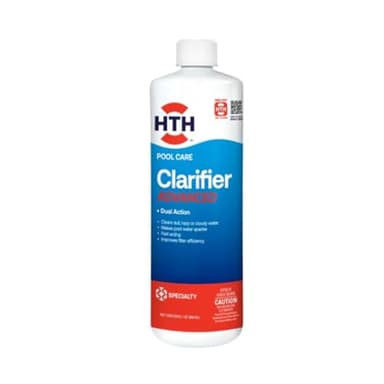
Pick 3 - Not disturbing pH
HTH Pool Care Clarifier Advanced
The one whose maker explicitly states it will not move pH, which is worth something when you have just finished balancing.
The published figure
HTH states it clears in 24 hours and does not affect pH balance
HTH's product page states this formula does not affect pH. That is a specific, checkable claim, and it matters because a clarifier added straight after a pH correction can undo the correction.
It is also stated as safe for vinyl and saltwater systems, which rules out the two most common compatibility questions.
As with any clarifier, the filter does the actual work. This product only makes the debris catchable.
What it does well
- Maker states no pH impact, which most clarifier labels leave vague
- Stated compatible with vinyl-lined and saltwater pools
- 24-hour window stated rather than implied
What it costs you
- Sold in smaller volumes than the concentrated competition
- Still requires a clean filter running continuously
Skip it if your filter is overdue a clean. No clarifier can outperform a clogged cartridge.
Pick 4 - Dead algae after a shock
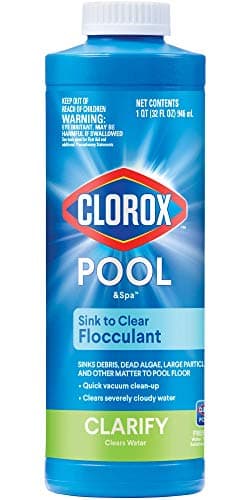
Clorox Pool&Spa Sink to Clear Flocculant
Positioned specifically at post-shock dead algae, which is the single most common reason a pool goes from green to gray.
The published figure
Settles dead algae and large particles for vacuuming
The gray-cloudy stage after a successful shock is dead algae in suspension. It is the correct outcome of shocking and it looks like a failure, which is why so many people re-shock at this point instead of clearing it.
Flocculant is the fast route through that stage. Drop it, let it settle overnight, vacuum to waste.
Widely stocked, which is the practical argument for it over a specialist brand at 9pm on a Sunday.
What it does well
- Aimed at the specific post-shock case rather than generic cloudiness
- Stocked in general retail as well as pool stores
What it costs you
- Vacuum-to-waste required
- Water loss during vacuuming
Skip it if the pool is still actively green. Finish killing the algae first, then drop what is left.
#ad · how this is funded · price as of October 18, 2026
Questions people actually ask
What is the difference between clarifier and flocculant?
Which works faster, clarifier or flocculant?
Can I use clarifier and flocculant together?
Do I need to vacuum after using a clarifier?
Sources
Every figure on this page traces to one of these. Where a number could not be sourced, the page says so rather than estimating.
- HTH Pool Care Clarifier Advanced - product page, states clarity within 24 hours and no effect on pH
- HTH Pool Care Drop Out Flocculant - product page, states vacuum-to-waste removal and phosphate reduction
- Skim & Soak methodology - the constants, formulas and worked examples behind every dose on this site
- HTH Drop Out Flocculant - Amazon listing, read 2026-09-02
Read next
Best for cloudy water
Best Pool Clarifier
Polymer clarifiers for silt and dead algae, chitosan for oils and sunscreen, matched to sand and cartridge filters.
Top pick
Clorox Pool&Spa Super Water Clarifier, 1 quart
Sand filters
Best for overnight clearing
Best Pool Flocculant
Four flocculants compared, plus the equipment check that decides whether you can use one at all.
Top pick
HTH Pool Care Drop Out Flocculant, 32 oz
Clearing a pool overnight
#ad · how this is funded · price as of October 18, 2026
How to Clear Cloudy Pool Water Fast
Clean the filter, correct pH, run the pump continuously, then choose clarifier or flocculant based on your valve.
Top pick
Clorox Pool&Spa Super Water Clarifier, 1 quart
Sand filters
Cloudy Pool Water After Shock
Gray after a shock is dead algae in suspension. Filter it or floc it; do not re-shock.
Top pick
HTH Pool Care Drop Out Flocculant, 32 oz
Clearing a pool overnight
#ad · how this is funded · price as of October 18, 2026