Cloudy Water
Best Pool Flocculant
The fastest way to clear a badly cloudy pool, and the one that will not work at all without the right valve.
We have not handled these products and we do not pretend to have. Here is what we did instead. Links to Amazon earn us a commission at no extra cost to you, and commission never decides a pick — disclosure.
| # | Product | Best for | The spec it turns on | Price |
|---|---|---|---|---|
| 1 | 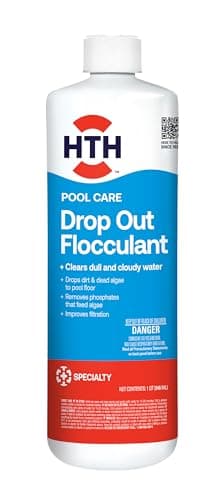 HTH Pool Care Drop Out Flocculant, 32 ozTop pickThe flocculant whose maker also claims phosphate removal, which is a genuinely useful second job after an algae bloom. | Clearing a pool overnight | HTH states it drops debris overnight for vacuum-to-waste, and removes phosphates | |
| 2 | 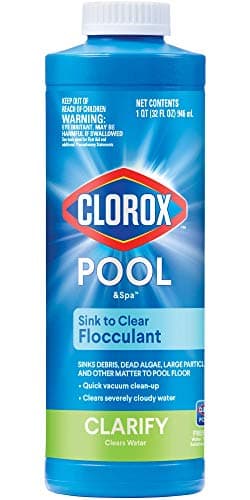 Clorox Pool&Spa Sink to Clear FlocculantPositioned specifically at post-shock dead algae, which is the single most common reason a pool goes from green to gray. | Dead algae after a shock | Settles dead algae and large particles for vacuuming | |
| 3 | 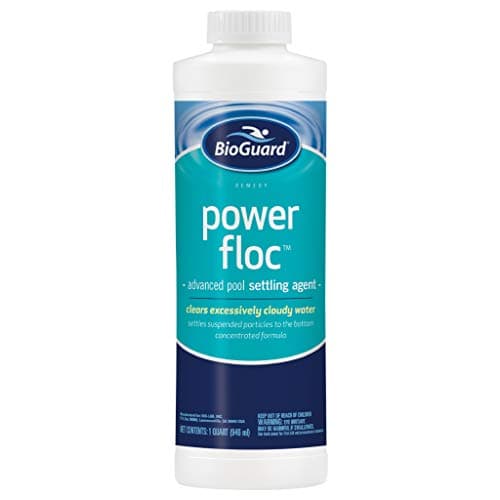 BioGuard PowerFloc Advanced Pool Settling Agent, 1 quartThe trade-channel option, at a concentration that suits water you genuinely cannot see through. | Severe cloudiness | Concentrated settling agent sold through pool professionals | |
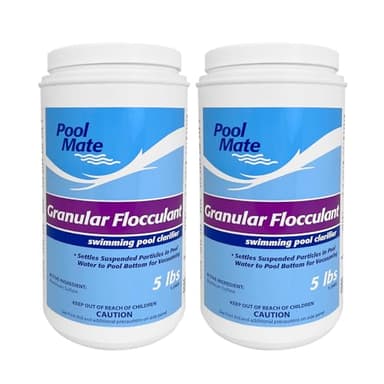
| 4 | 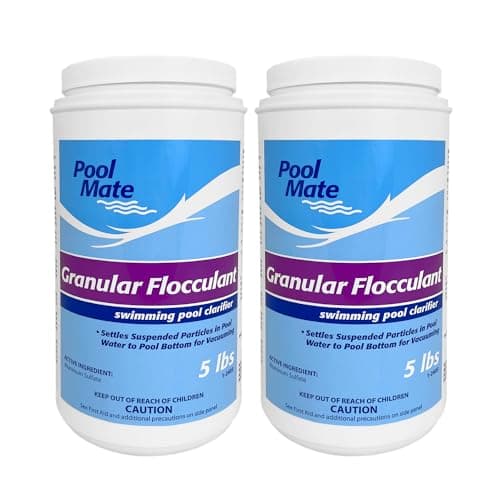 Pool Mate Premium Granular Flocculant, 5 lb, 2-packThe skip. Granular flocculant needs pre-dissolving and lands unevenly, and the liquids on this page do the same job without either problem. | Nothing, over the liquids | Granular aluminum-salt flocculant, 5 lb tubs |
Check this first
Look at your filter's multiport valve. If the positions read FILTER, BACKWASH, RINSE, WASTE, RECIRCULATE and CLOSED, you can use a flocculant. If your filter is a cartridge with no valve at all, you cannot - there is nowhere for the settled debris to go except back through the cartridge and into the pool.
That is the whole gate on this page, and it costs nothing to check. Buying flocculant without it is the most common wasted purchase in pool care.
What flocculant is genuinely best at
- **Dead algae after a shock.** A bloom's worth of dead algae would clog a filter several times over. Sinking it and vacuuming it out bypasses that entirely.
- **Water you cannot see the bottom step through.** Beyond a certain load, clarifier plus filtration is a multi-day project and flocculant is one night.
- **Opening a pool that was closed badly.** A winter's debris is the case flocculant was designed for.
- **Very fine silt after a storm**, particularly on a sand filter that would otherwise pass it repeatedly.
The costs, stated plainly
| Cost | Detail |
|---|---|
| Water | Several inches, vacuumed out to waste. On metered supply that is a real number. |
| Time on the day | A slow, careful vacuum. Rushing it stirs the layer back up and wastes the night. |
| Downtime | Pump off overnight, so no filtration and no sanitizer circulation during that period. |
| Rebalancing | Aluminum-salt flocculants pull pH down noticeably. Expect a correction afterwards. |
| Equipment | A multiport valve with a WASTE position. Non-negotiable. |
The picks
Top pick - Clearing a pool overnight
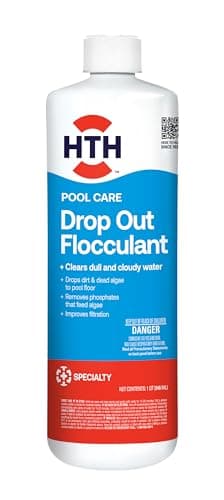
HTH Pool Care Drop Out Flocculant, 32 oz
The flocculant whose maker also claims phosphate removal, which is a genuinely useful second job after an algae bloom.
The published figure
HTH states it drops debris overnight for vacuum-to-waste, and removes phosphates
Flocculant does the opposite of clarifier: instead of making particles filterable, it makes them heavy enough to sink so you vacuum them out. That is faster, and it requires vacuum-to-waste.
HTH's product page states this formula also removes phosphates. After a bloom that matters, because dead algae releases the phosphate that fed it back into the water.
If your pump has no waste setting, do not buy this. Vacuuming the settled layer back through the filter puts everything you just dropped straight back into the pool.
What it does well
- Overnight result rather than a 48-hour filter cycle
- Claims phosphate removal alongside the settling action
- Stated safe across pool types and pH levels
What it costs you
- Requires a multiport valve with a waste setting
- You will lose several inches of water vacuuming to waste
Skip it if your filter has no vacuum-to-waste option. Use a clarifier and be patient instead.
#ad · how this is funded · price as of October 18, 2026
Pick 2 - Dead algae after a shock
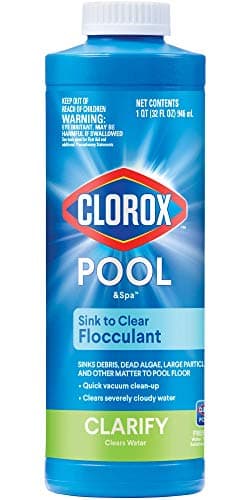
Clorox Pool&Spa Sink to Clear Flocculant
Positioned specifically at post-shock dead algae, which is the single most common reason a pool goes from green to gray.
The published figure
Settles dead algae and large particles for vacuuming
The gray-cloudy stage after a successful shock is dead algae in suspension. It is the correct outcome of shocking and it looks like a failure, which is why so many people re-shock at this point instead of clearing it.
Flocculant is the fast route through that stage. Drop it, let it settle overnight, vacuum to waste.
Widely stocked, which is the practical argument for it over a specialist brand at 9pm on a Sunday.
What it does well
- Aimed at the specific post-shock case rather than generic cloudiness
- Stocked in general retail as well as pool stores
What it costs you
- Vacuum-to-waste required
- Water loss during vacuuming
Skip it if the pool is still actively green. Finish killing the algae first, then drop what is left.
#ad · how this is funded · price as of October 18, 2026
Pick 3 - Severe cloudiness
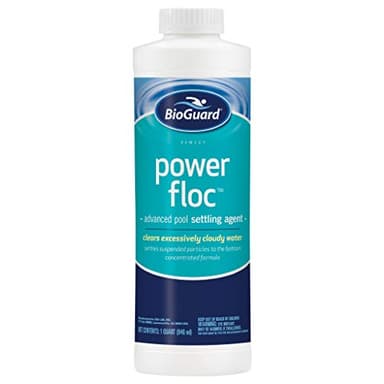
BioGuard PowerFloc Advanced Pool Settling Agent, 1 quart
The trade-channel option, at a concentration that suits water you genuinely cannot see through.
The published figure
Concentrated settling agent sold through pool professionals
BioGuard is a dealer brand rather than a big-box one, and the concentration reflects that — it is dosed lower per gallon than most retail flocculants.
That makes it well suited to a large pool, where the retail bottles start requiring several units per treatment.
The settling and vacuum-to-waste requirement is identical to every other flocculant here. No product removes that step.
What it does well
- High concentration suits large pools
- Established professional-channel formulation
What it costs you
- Harder to find in general retail
- Vacuum-to-waste still mandatory
Skip it if you own a small above-ground pool. The dose granularity is wrong for the volume.
#ad · how this is funded · price as of October 18, 2026
Pick 4 - Nothing, over the liquids
Pool Mate Premium Granular Flocculant, 5 lb, 2-pack
The skip. Granular flocculant needs pre-dissolving and lands unevenly, and the liquids on this page do the same job without either problem.
The published figure
Granular aluminum-salt flocculant, 5 lb tubs
Granular flocculant has to be dissolved in a bucket before it goes in, and any that reaches the floor undissolved settles as a patch rather than treating the water column.
Aluminum-salt flocculants also drag pH down noticeably, so a treatment usually needs a pH correction behind it.
There is a real case for granular at commercial volumes where you are treating hundreds of thousands of gallons. There is no case for it in a backyard pool.
What it does well
- Cheaper per treated gallon at very large volumes
- Long shelf life in the tub
What it costs you
- Must be pre-dissolved, and settles unevenly if it is not
- Pulls pH down, adding a correction step
Skip it if your pool is under about 40,000 gallons — which is nearly every residential pool. Buy a liquid.
#ad · how this is funded · price as of October 18, 2026
The procedure, which matters more than the brand
- Balance pH first. Flocculants work best in range and most of them move pH on the way through.
- Dose per the label with the pump running, so it distributes.
- Turn the pump OFF and leave it off overnight. Eight hours minimum.
- In the morning, do not brush, do not swim, do not turn the pump on. The layer on the floor is the result.
- Set the valve to WASTE and vacuum slowly, keeping the head just above the layer.
- Top up the pool as you go so the pump never runs dry.
- Return the valve to FILTER, run the pump, retest and rebalance.
Liquid or granular?
Liquid, for any residential pool. Granular flocculant must be pre-dissolved, and any that reaches the floor undissolved settles as a patch rather than treating the water column. It also pulls pH down harder than the liquids do. Granular earns its place at commercial volumes where you are treating hundreds of thousands of gallons; below about 40,000 gallons there is no case for it.
Questions people actually ask
How long does pool flocculant take to work?
Do I turn the pump off after adding flocculant?
Can I use flocculant with a cartridge filter?
How do I get flocculant off the bottom of the pool?
Sources
Every figure on this page traces to one of these. Where a number could not be sourced, the page says so rather than estimating.
- HTH Pool Care Drop Out Flocculant - product page, states vacuum-to-waste removal and phosphate reduction
- HTH Pool Care Shock Advanced - product page, cal hypo formulation, adds no cyanuric acid
- Skim & Soak methodology - the constants, formulas and worked examples behind every dose on this site
- HTH Pool Care Drop Out Flocculant, 32 oz - Amazon listing, read 2026-09-02
- Clorox Pool&Spa Sink to Clear Flocculant - Amazon listing, read 2026-09-02
Read next
Clarifier vs Flocculant
Clarifier works with your filter over 24 to 48 hours; flocculant bypasses it overnight but needs a waste setting.
Top pick
Clorox Pool&Spa Super Water Clarifier, 1 quart
Sand filters
Cloudy Pool Water After Shock
Gray after a shock is dead algae in suspension. Filter it or floc it; do not re-shock.
Top pick
HTH Pool Care Drop Out Flocculant, 32 oz
Clearing a pool overnight
#ad · how this is funded · price as of October 18, 2026
Best for cloudy water
Best Pool Clarifier
Polymer clarifiers for silt and dead algae, chitosan for oils and sunscreen, matched to sand and cartridge filters.
Top pick
Clorox Pool&Spa Super Water Clarifier, 1 quart
Sand filters
How to Clear a Green Pool Fast
The ordered fix: test, brush, shock by weight, filter continuously, clear the dead algae, then prevent the next one.