Testing & Chemistry
How to Raise Calcium Hardness
The reading nobody tests until the plaster is already etched - and the only correction on this site with no way back.
We have not handled these products and we do not pretend to have. Here is what we did instead. Links to Amazon earn us a commission at no extra cost to you, and commission never decides a pick — disclosure.
| # | Product | Best for | The spec it turns on | Price |
|---|---|---|---|---|
| 1 | 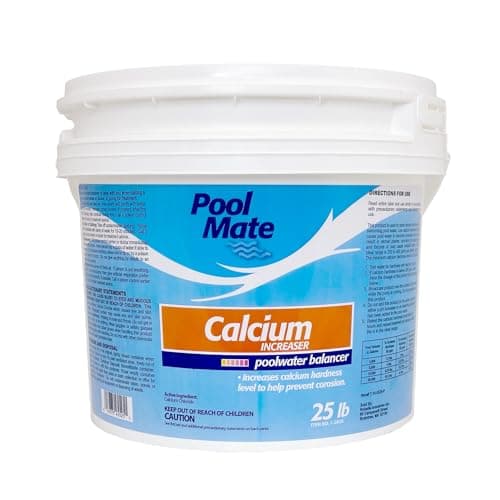 Pool Mate Premium Calcium Hardness Increaser, 25 lbTop pickPublishes its dose and its target range, in the size a genuine hardness correction actually needs. | A real correction on a full-size pool | Listing states calcium chloride, a 200-400 ppm target and 8 oz per 5,000 gallons per 10 ppm | |
| 2 | 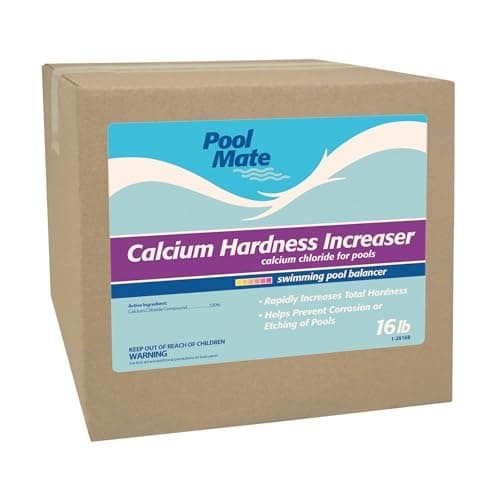 Pool Mate Premium Calcium Hardness Increaser, 16 lbThe same product in the size most corrections actually need. Check the price per pound against the 25 lb tub before assuming bigger is cheaper. | A mid-size correction | Same stated chemistry and dose as the 25 lb tub: calcium chloride, 200-400 ppm, 8 oz per 5,000 gal per 10 ppm | |
| 3 | 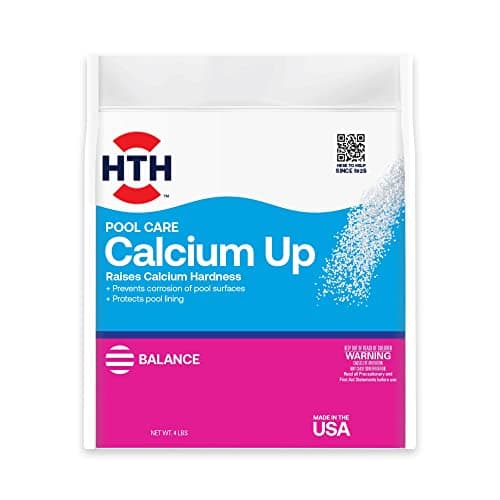 HTH Pool Care Calcium Hardness Up, 4 lbThe small container, and the widest published range. Useful for topping a reading up rather than moving it a long way. | A small top-up from a brand this site already cites | Listing states a 200-500 ppm maintenance range and that it protects liners, metal and plastic surfaces from corrosive water | |
| 4 | 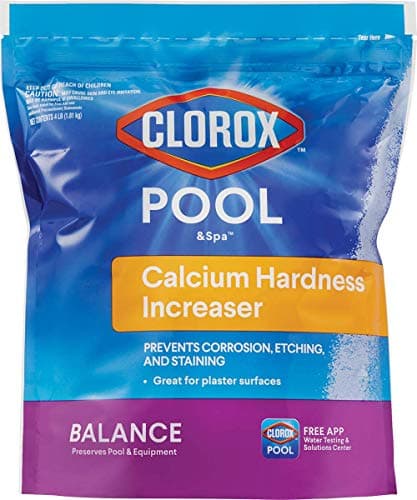 Clorox Pool&Spa Swimming Pool Calcium Hardness Increaser, 4 lbThe brand most people can buy locally, aimed squarely at the pool that needs it most: plaster on soft fill water. | Plaster pools on soft water | Listing states it is aimed at plaster pools and soft-water areas, and prevents corrosion, etching and staining | |
| 5 | 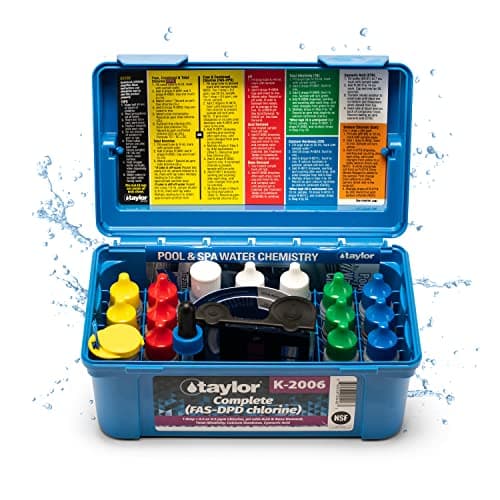 Taylor K-2006 Complete FAS-DPD Pool Test KitThe kit every pool forum names, and for once the consensus is right - because titration is the one chlorine method that does not saturate exactly when you need it. | The reference residential kit | FAS-DPD titration for free and combined chlorine, plus pH, acid and base demand, total alkalinity, calcium hardness and cyanuric acid; 3/4 oz reagents |
What low hardness actually does
Water wants to carry a certain amount of dissolved calcium. If it is short, it takes it from whatever it can reach - and in a pool that means the plaster, the grout, the tile and the metal in the heater.
The symptoms are slow and easy to blame on age: plaster that feels rough or looks etched, grout that washes out around tile, a faint permanent haze that chemistry never quite fixes, and corrosion inside equipment you cannot see. Clorox states its increaser is aimed at plaster pools in soft-water areas for exactly this reason, and HTH states the product protects liners, metal and plastic surfaces from corrosive water.
A vinyl-lined or fiberglass pool has no plaster to dissolve, which is why hardness gets ignored on those pools. The heater, the pump seals and the metal fittings are still in the same water.
The target, and where the labels disagree
Hardness is one leg of the balance that decides whether water is corrosive or scale-forming; pH and alkalinity are the others. That is why a pool with low hardness and high pH can scale and etch in different places at once, and why the three readings are corrected together rather than in isolation.
The arithmetic
Calcium hardness increaser is calcium chloride. The labels publish a dose, and it is worth seeing where that dose comes from - because the gap between the chemistry and the label tells you something about what is in the tub.
In round numbers: 1 lb per 10,000 gallons per 10 ppm. A 20,000 gallon pool reading 120 ppm and aiming for 220 needs a 100 ppm rise, which is 1 x 2 x 10 = 20 lb. That is most of a 25 lb tub in one correction, which is why the small containers are top-ups rather than fixes.
How to add it
- Test first, with a kit that actually measures hardness. Strips read it poorly; a drop kit titrates it. The Taylor K-2006 does both hardness and everything else worth measuring.
- Work out your pool's volume if you do not know it, because every dose is per 10,000 gallons. The shape formulas are on how to balance pool water.
- Correct alkalinity and pH first. Both are easier to move than hardness and both affect whether the water is scaling or etching.
- Broadcast the calcium chloride slowly over the deep end with the pump running. It dissolves fast and gives off heat as it does - do not pre-dissolve it in a bucket unless the label says to.
- Split a large correction in half, with a full turnover between the two doses. Overshooting hardness cannot be undone with a chemical.
- Retest after a full circulation cycle, and again a day later once it has mixed completely.
The one reading with no way back
Every other correction on this site is reversible. Alkalinity comes down with acid and aeration; pH moves either way; chlorine burns off; cyanuric acid at least dilutes out slowly.
Calcium hardness only comes down by replacing water. There is no chemical that removes it, so a pool dosed to 600 ppm stays there until you drain part of it and refill - which also costs you every other chemical in the water you drained.
Test your fill water before you dose
Hardness comes into the pool with every gallon you add, so fill water does much of this work for you in hard-water regions. A pool topped up all summer from a hard municipal supply may climb toward the top of the range on its own.
Test a sample straight from the hose. If it reads 250 ppm you may never need an increaser; if it reads 40 ppm you will be adding calcium at every opening, and the 25 lb tub is the sensible purchase.
The picks
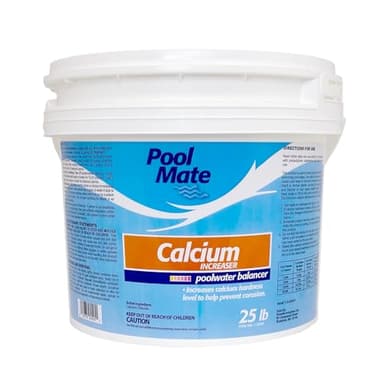
Top pick - A real correction on a full-size pool
Pool Mate Premium Calcium Hardness Increaser, 25 lb
Publishes its dose and its target range, in the size a genuine hardness correction actually needs.
The published figure
Listing states calcium chloride, a 200-400 ppm target and 8 oz per 5,000 gallons per 10 ppm
Pool Mate states 8 ounces raises calcium hardness 10 ppm per 5,000 gallons - which is 1 lb per 10,000 gallons for the same move, and the arithmetic on this page lands in the same place.
The stated ideal range is 200 to 400 ppm. HTH's label says 200 to 500, so the labels disagree at the top; the overlap is 200 to 400.
Calcium chloride dissolves fast and gives off heat as it does. Broadcast it rather than dumping it in one spot, and do not pre-dissolve it in a bucket unless the label tells you to.
What it does well
- States both the dose and the target range
- 25 lb covers a 100 ppm correction on a large pool
- Sold and shipped by Amazon
What it costs you
- Calcium chloride generates heat as it dissolves
- No purity percentage published
- Nothing removes calcium afterwards except draining and refilling
Skip it if your fill water is already hard. Test before you add anything - hardness is the one reading you cannot walk back.
#ad · how this is funded · price as of October 10, 2026
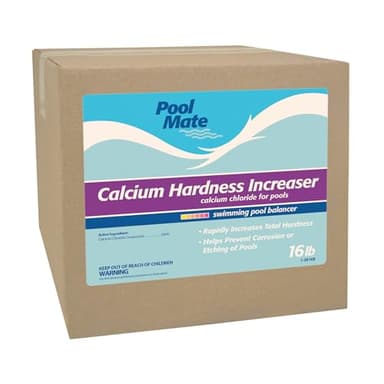
Pick 2 - A mid-size correction
Pool Mate Premium Calcium Hardness Increaser, 16 lb
The same product in the size most corrections actually need. Check the price per pound against the 25 lb tub before assuming bigger is cheaper.
The published figure
Same stated chemistry and dose as the 25 lb tub: calcium chloride, 200-400 ppm, 8 oz per 5,000 gal per 10 ppm
Identical stated chemistry and dose to the 25 lb tub: calcium chloride, 8 oz per 5,000 gallons per 10 ppm, 200 to 400 ppm target.
16 lb raises a 20,000 gallon pool by roughly 80 ppm, which covers the common case of a vinyl or fiberglass pool sitting somewhere near 100 ppm and needing to reach 200.
Buying the smaller tub also limits the damage if you overshoot, because there is no chemical that lowers hardness.
What it does well
- Same published dose and range as the bigger tub
- Enough for roughly an 80 ppm correction on 20,000 gallons
- Less product sitting in the shed absorbing moisture
What it costs you
- Sometimes costs more per pound than the 25 lb
- Still generates heat as it dissolves
- No purity figure published
Skip it if your pool is large and far below target. Price the 25 lb tub first.
#ad · how this is funded · price as of October 10, 2026
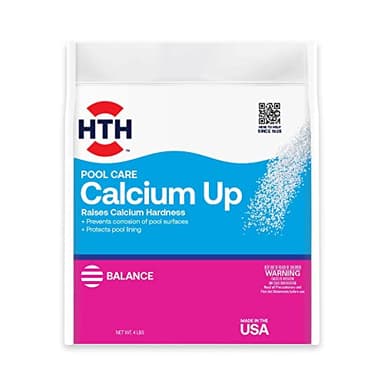
Pick 3 - A small top-up from a brand this site already cites
HTH Pool Care Calcium Hardness Up, 4 lb
The small container, and the widest published range. Useful for topping a reading up rather than moving it a long way.
The published figure
Listing states a 200-500 ppm maintenance range and that it protects liners, metal and plastic surfaces from corrosive water
HTH states a maintenance range of 200 to 500 ppm, which is wider at the top than the 200 to 400 the calcium chloride labels give. We use 200 to 400 as the working range because it is the overlap.
The listing states the product protects pool liners, metal and plastic surfaces and equipment from corrosive, low-hardness water. That is the real argument for correcting hardness at all: soft water dissolves what it can find.
No dose figure is published on this listing, so compute from the arithmetic on this page or follow the container.
What it does well
- 4 lb suits a small correction or a top-up
- States the surfaces low hardness attacks
- Sold and shipped by Amazon
What it costs you
- No dose figure published on the listing
- Its 500 ppm ceiling is higher than other labels give
- Costs the most per pound of the increasers here
Skip it if you are more than about 20 ppm below target on a full-size pool. Buy by the tub.
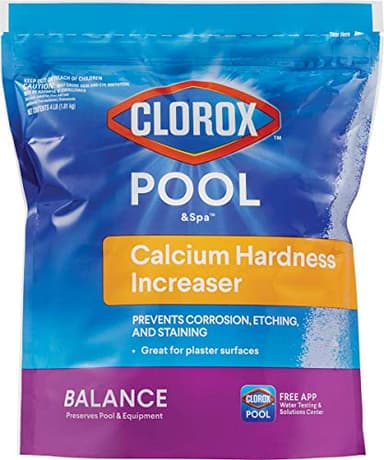
Pick 4 - Plaster pools on soft water
Clorox Pool&Spa Swimming Pool Calcium Hardness Increaser, 4 lb
The brand most people can buy locally, aimed squarely at the pool that needs it most: plaster on soft fill water.
The published figure
Listing states it is aimed at plaster pools and soft-water areas, and prevents corrosion, etching and staining
Clorox states the product is ideal for plaster pools and areas with soft water. That is exactly the case where low hardness does visible damage, because soft water pulls calcium out of the plaster itself.
The listing states it prevents corrosion, etching and staining and extends equipment life - the same argument every hardness increaser makes, and a fair one.
No target range and no dose are published on this listing, which is the main reason it sits below the tubs that state both.
What it does well
- Names the pool type that needs it: plaster on soft water
- Small container for a measured correction
- Widely stocked brand
What it costs you
- No target range published
- No dose figure published
- 4 lb moves a full-size pool very little
Skip it if you want to dose from your own test result. Buy a tub that prints the numbers.
#ad · how this is funded · price as of October 10, 2026
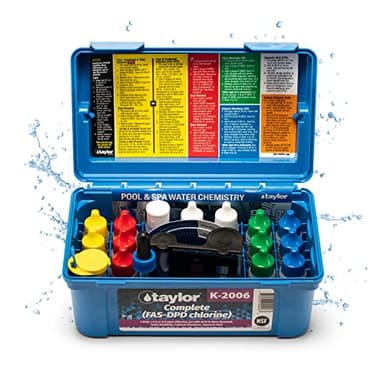
Pick 5 - The reference residential kit
Taylor K-2006 Complete FAS-DPD Pool Test Kit
The kit every pool forum names, and for once the consensus is right - because titration is the one chlorine method that does not saturate exactly when you need it.
The published figure
FAS-DPD titration for free and combined chlorine, plus pH, acid and base demand, total alkalinity, calcium hardness and cyanuric acid; 3/4 oz reagents
The chlorine test is FAS-DPD: you add reagent drop by drop until a pink sample turns clear, and count the drops. Each drop is a fixed amount of chlorine, so 20 ppm reads as more drops rather than as an impossible shade of pink. Every color-match method tops out around 5 ppm - the range you are in during a shock.
The other six tests are the same reagents as the cheaper K-2005. What you pay extra for is the chlorine method and nothing else.
The 3/4 oz reagent bottles are what separate it from the K-2006C. They run out in a season of frequent testing on one pool; the C's 2 oz bottles do not.
What it does well
- Reads chlorine accurately at shock levels, which no strip can
- Covers all seven residential parameters
- Reagents are sold individually, so the case lasts for years
What it costs you
- 3/4 oz bottles empty quickly if you test more than weekly
- A full run takes minutes rather than seconds
- Several times the price of a strip bottle
Skip it if you never shock and test once a week. A strip kit gets used, and this one might not.
Where hardness fits with everything else
- Alkalinity first. It buffers pH, and pH is what decides whether hardness deposits or dissolves - how to raise alkalinity covers that correction.
- pH second, into 7.2 to 7.6. High pH with high hardness scales; low pH with low hardness etches.
- Hardness third, and slowly. It is the least urgent of the three and the hardest to undo.
- Salt pools scale at the cell before they scale at the tile, so a salt pool near the top of the range needs the cell inspected - see best salt cell cleaner.
Questions people actually ask
What should calcium hardness be in a pool?
How much calcium chloride do I need to raise hardness?
Can you lower calcium hardness in a pool?
Does calcium hardness matter in a vinyl pool?
Will raising calcium hardness cloud my pool?
Do I need calcium increaser if my fill water is hard?
Sources
Every figure on this page traces to one of these. Where a number could not be sourced, the page says so rather than estimating.
- Pool & Hot Tub Alliance - PHTA standards program, the ANSI-accredited consensus standards for residential and public pools
- Skim & Soak methodology - the constants, formulas and worked examples behind every dose on this site
- Pool Mate Premium Calcium Hardness Increaser, 25 lb, 8 oz per 5,000 gal per 10 ppm - Amazon listing, read 2026-09-20
- Pool Mate Premium Calcium Hardness Increaser, 16 lb - Amazon listing, read 2026-09-20
- HTH Pool Care Calcium Hardness Up, 4 lb, states 200-500 ppm - Amazon listing, read 2026-09-20
- Clorox Pool&Spa Calcium Hardness Increaser, 4 lb - Amazon listing, read 2026-09-20
Read next
How to Balance Pool Water
The correction order that stops you doing the same job twice, with computed dose tables and the formulas behind them.
Top pick
Pool Mate Premium Alkalinity Increaser, 10 lb
Raising total alkalinity
#ad · how this is funded · price as of October 10, 2026
How to Raise Your Pool's Alkalinity
Sodium bicarbonate raises total alkalinity; soda ash raises pH. Which one your reading calls for, how much of it, and why three labels give three different doses.
Top pick
Pool Mate Premium Alkalinity Increaser, 10 lb
Raising total alkalinity
#ad · how this is funded · price as of October 10, 2026
Pool pH Too High
High pH blunts chlorine and clouds water. Correct it with acid, then find the cause - usually alkalinity or aeration.
Top pick
HTH Pool Care pH Down, 5 lb
Lowering pH
Best pool tile cleaner
Best Pool Tile Cleaner
Calcium scale against oily scum at the waterline, the non-acid sprays and the pumice route, and the surfaces each listing rules out.
Top pick
Guardian Pool & Tile Cleaner, 1 quart
Scale above the waterline without scrubbing
#ad · how this is funded · price as of October 10, 2026
Best test kit
Best Pool Test Kits
Titration kits, color comparators, strips and a photometer compared on precision, speed and what each one cannot see.
Top pick
AquaChek Select Connect 7-Way Test Strips, complete kit
Weekly testing you will actually do
#ad · how this is funded · price as of October 10, 2026