Testing & Chemistry
Pool Opening Chemicals
The sequence matters more than the products. Two of these steps in the wrong order cost you a season of stains.
We have not handled these products and we do not pretend to have. Here is what we did instead. Links to Amazon earn us a commission at no extra cost to you, and commission never decides a pick — disclosure.
| # | Product | Best for | The spec it turns on | Price |
|---|---|---|---|---|
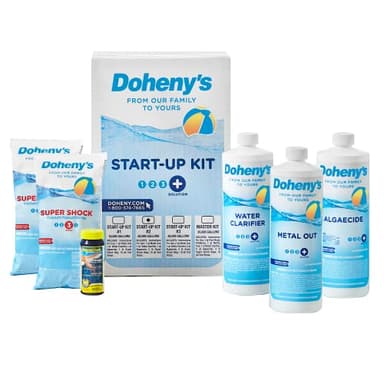
| 1 | 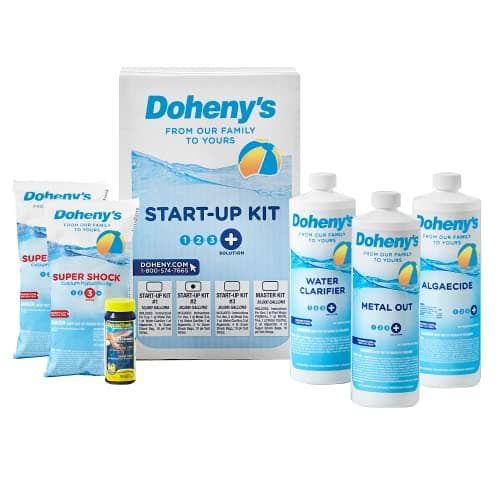 Doheny's Ultimate Pool Opening Start-Up KitTop pickThe most complete opening kit here and the only one that states its gallon range. Metal Out first is the right sequence, and the kit is packed in that order. | One box that covers the whole opening | Listing states Metal Out, algae control, clarifier and Super Shock Plus, plus test strips; treats 10,000-30,000 gallons | |
| 2 | 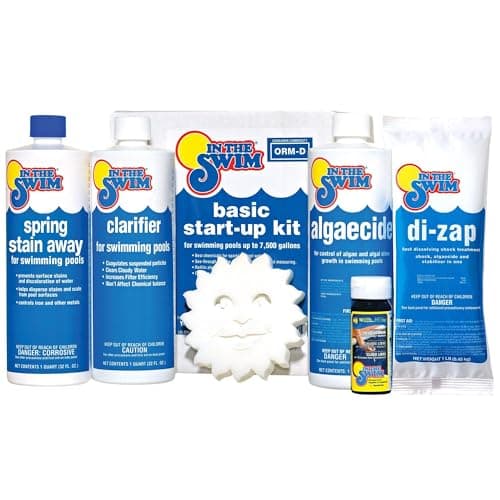 In The Swim Well Water Pool Start-Up KitThe opening kit for the pools that stain every spring. If your fill water comes from a well, this is the version to buy. | A pool filled from a well | Listing states shock, clarifier, algaecide, stain prevention, oil absorber and test strips, aimed at iron and mineral-heavy fill water | |
| 3 | 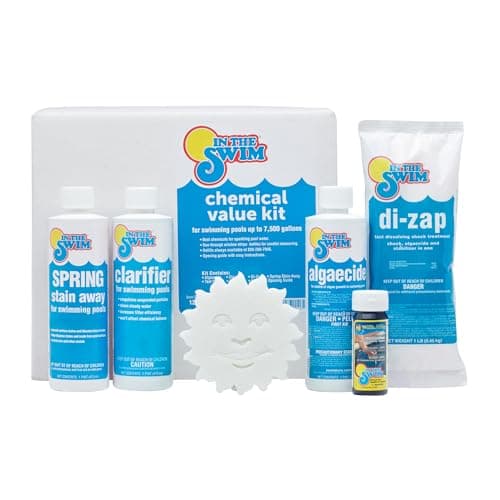 In The Swim Basic Swimming Pool Chemical Value KitEvery quantity published, at the lowest price of the kits here. The trade is that one pound of shock does not open a large pool. | The cheapest complete set of opening chemicals | Listing states 1 qt Stain Away, 1 qt clarifier, 1 lb Di-Zap multi-shock, 1 qt algaecide, a Sun Sorb absorber and 4-way test strips | |
| 4 | 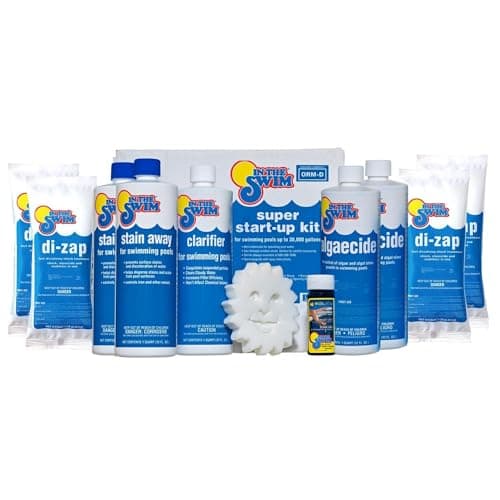 In The Swim Saltwater Pool Opening Chemical Kit, up to 35,000 gallonsThe only kit here that publishes its quantities. Four pounds of dichlor, a non-metallic algaecide and a sequestrant, sized for a big pool. | A salt pool, and the biggest stated volume here | Listing states four 1 lb bags of dichlor, non-metallic algaecide, clarifier, stain and scale preventer and Sun Sorb; up to 35,000 gallons | |
| 5 | 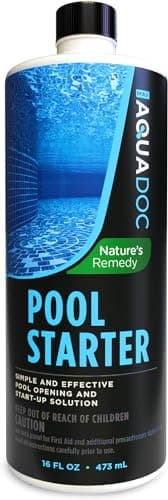 MAV AquaDoc Pool Opening Chemical, 16 oz enzymeNot a kit - one bottle that does the job shock does badly. Enzymes break down the oily film a closed pool grows, instead of burning chlorine on it. | The winter scum line a shock will not touch | Listing states a natural enzyme treatment for up to 15,000 gallons, compatible with cartridge, DE and sand filters and all sanitizers | |
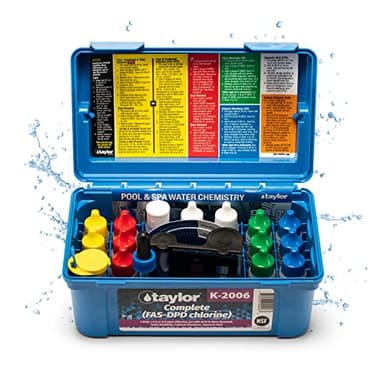
| 6 | 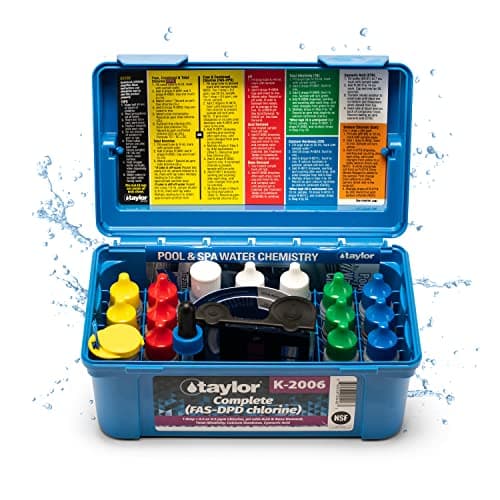 Taylor K-2006 Complete FAS-DPD Pool Test KitThe kit every pool forum names, and for once the consensus is right - because titration is the one chlorine method that does not saturate exactly when you need it. | The reference residential kit | FAS-DPD titration for free and combined chlorine, plus pH, acid and base demand, total alkalinity, calcium hardness and cyanuric acid; 3/4 oz reagents |
Filter before you dose anything
A pool coming off a winter cover is not a chemistry problem yet. Water that has sat still for months is stratified, full of suspended debris, and completely unrepresentative at the surface where you are about to take a sample.
Get the equipment running, let the water turn over at least once, and skim and vacuum the obvious debris out. Only then test. Dosing a pool from a sample taken out of stagnant water means dosing for a pool that does not exist.
The sequence, and the one step people reverse
- Circulate and filter. Run the pump continuously, backwash or clean the filter once the pressure climbs, and get the water moving before anything else.
- Test. Alkalinity, pH, calcium hardness, cyanuric acid and chlorine. Winter changes all of them, and the dose tables on how to balance pool water all start from a number you measured.
- Add a metal sequestrant. Every kit here includes one, called Metal Out or Stain Away. It binds dissolved iron and copper so they stay in solution.
- Correct alkalinity, then pH. Alkalinity is the buffer, so it comes first - how to raise alkalinity and how to lower it cover both directions.
- Shock. Now, after the sequestrant has had a few hours to work and with the pump running. Best pool shock covers which type to use.
- Algaecide once chlorine drops back toward normal. High chlorine destroys most algaecides, so adding it with the shock wastes it.
- Retest 24 hours later and again after a few days. Opening chemistry moves as the water warms.
What an opening kit actually contains
Kits bundle four or five products that are all bought separately anyway. The value is convenience and a sequence someone has already thought about - not a lower price per pound.
| Kit | Sequestrant | Shock | Algaecide | Clarifier | Stated size |
|---|---|---|---|---|---|
| Doheny's Ultimate Start-Up | Metal Out | Super Shock Plus | Algae control | Yes | 10,000-30,000 gal |
| In The Swim Well Water | Stain prevention | Yes | Yes | Yes | Not stated |
| In The Swim Chemical Value Kit | 1 qt Stain Away | 1 lb Di-Zap multi-shock | 1 qt | 1 qt | Not stated |
| In The Swim Saltwater | Stain and scale preventer | 4 x 1 lb dichlor | Non-metallic | Yes | Up to 35,000 gal |
| AquaDoc opening enzyme | No | No | No | No | Up to 15,000 gal |
Two of these publish quantities and two publish a gallon rating. That is the difference between knowing what you bought and trusting the box - and it is why the value kit, which itemizes every bottle, is the easiest to judge even though it is the smallest.
Sizing the shock, not the kit
The weakest part of most kits is the shock quantity. One pound of dichlor is a single dose for a small pool, and an opening frequently needs more than a single dose because the water has a season of organic load in it.
If your pool is over roughly 15,000 gallons, buy the shock separately and treat the kit as the sequestrant, clarifier and algaecide bundle it really is.
Which kit for which pool
- Well water, or a history of spring stains. The In The Swim well-water kit is built around metal staining rather than treating it as a secondary feature.
- Salt pool. The In The Swim saltwater kit uses dichlor and a non-metallic algaecide, and states the largest volume here at 35,000 gallons. Copper-based algaecides and salt systems are a poor combination.
- Standard chlorine pool up to 30,000 gallons. Doheny's Ultimate is the only kit that publishes a gallon range and includes everything.
- Small pool on a budget. The In The Swim value kit itemizes every bottle and costs least, as long as you accept the 1 lb shock limit.
- A pool that was closed dirty. Add the enzyme bottle to whichever kit you buy - it targets the oily film shock burns itself out on.
What a kit will not do
No kit balances your water. Not one of them contains alkalinity increaser, pH adjuster or calcium hardness increaser, because those doses depend on readings nobody can guess from a box.
That is the honest limit of the format: a kit handles the seasonal jobs - sequester, shock, clarify, kill algae - and you still need the balancing chemicals and a test kit that reads more than chlorine and pH. A drop kit that measures alkalinity, hardness and cyanuric acid pays for itself in a single opening.
The picks
Top pick - One box that covers the whole opening
Doheny's Ultimate Pool Opening Start-Up Kit
The most complete opening kit here and the only one that states its gallon range. Metal Out first is the right sequence, and the kit is packed in that order.
The published figure
Listing states Metal Out, algae control, clarifier and Super Shock Plus, plus test strips; treats 10,000-30,000 gallons
Doheny's states the kit contains Metal Out (stain, rust and scale preventer), algae control, water clarifier and Premium Super Shock Plus, with a 10-pack of test strips included.
The stated treatment range is 10,000 to 30,000 gallons, and for larger pools the listing says to buy multiple kits. That is a real number to size against, which most kits do not give.
Metal sequestrant before shock is the part people get backwards. Shocking first oxidizes dissolved iron and copper and drops them onto the plaster as stains - see the metal remover page for the full argument.
What it does well
- States a treated volume range, 10,000-30,000 gallons
- Includes sequestrant, algaecide, clarifier and shock
- Test strips included, so you can check before dosing
What it costs you
- No individual product quantities published
- Shipped by a pool retailer, so delivery time varies
- One kit will not cover a 40,000 gallon pool
Skip it if your fill water is well water heavy in iron. The well-water kit is built for that instead.
#ad · how this is funded · price as of October 9, 2026
Pick 2 - A pool filled from a well
In The Swim Well Water Pool Start-Up Kit
The opening kit for the pools that stain every spring. If your fill water comes from a well, this is the version to buy.
The published figure
Listing states shock, clarifier, algaecide, stain prevention, oil absorber and test strips, aimed at iron and mineral-heavy fill water
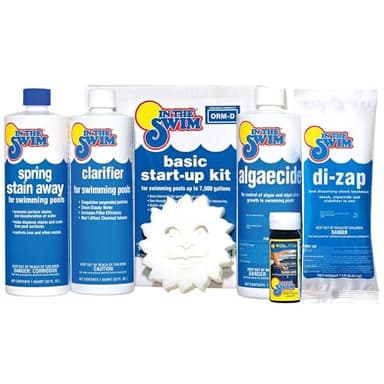
In The Swim states the kit is built for the problems well water causes at opening: iron, metals and mineral-heavy fill water, with a stain prevention treatment to reduce discoloration on liners, steps and surfaces.
The contents are stated as shock, clarifier, algaecide, stain prevention, oil absorber and test strips - the same shape as a standard kit with the sequestrant doing more of the work.
It is stated to suit both above-ground and inground pools.
What it does well
- Built around metal staining rather than treating it as an afterthought
- Includes an oil absorber, which most kits leave out
- Test strips included
What it costs you
- No treated-volume figure published
- No individual quantities stated
- Overkill if your fill water is municipal and soft
Skip it if you are on city water with no staining history. A standard kit costs less.
#ad · how this is funded · price as of October 9, 2026
Pick 3 - The cheapest complete set of opening chemicals
In The Swim Basic Swimming Pool Chemical Value Kit
Every quantity published, at the lowest price of the kits here. The trade is that one pound of shock does not open a large pool.
The published figure
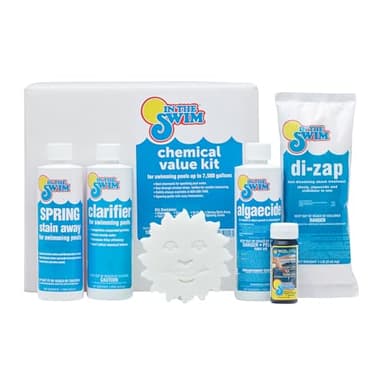
Listing states 1 qt Stain Away, 1 qt clarifier, 1 lb Di-Zap multi-shock, 1 qt algaecide, a Sun Sorb absorber and 4-way test strips
The listing itemizes the kit: 1 quart Stain Away, 1 quart clarifier, 1 lb Di-Zap multi-shock, 1 quart algaecide, one Sun Sorb oil absorber and a 10-count 4-way test strip pack.
One pound of dichlor is a single shock dose for a small pool. On anything above roughly 15,000 gallons, plan on buying shock separately - the shock page covers what to buy.
The listing notes the label may read 'Opening Kit' or 'Chemical Value Kit', which are the same product.
What it does well
- Every quantity published
- Cheapest complete kit on this page
- Includes sequestrant, clarifier, algaecide and strips
What it costs you
- Only 1 lb of shock, which is thin for a full opening
- No treated-volume figure published
- Label naming is inconsistent, per the listing
Skip it if your pool is over about 15,000 gallons. Buy shock separately or buy a larger kit.
#ad · how this is funded · price as of October 9, 2026
Pick 4 - A salt pool, and the biggest stated volume here
In The Swim Saltwater Pool Opening Chemical Kit, up to 35,000 gallons
The only kit here that publishes its quantities. Four pounds of dichlor, a non-metallic algaecide and a sequestrant, sized for a big pool.
The published figure
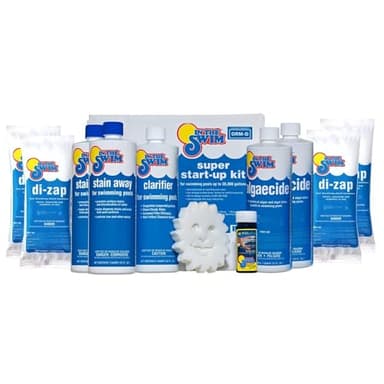
Listing states four 1 lb bags of dichlor, non-metallic algaecide, clarifier, stain and scale preventer and Sun Sorb; up to 35,000 gallons
In The Swim states the contents precisely: four 1 lb bags of Di-Zap sodium dichlor, a non-metallic algaecide, a clarifier, a stain and scale preventer, and a Sun Sorb oil absorber.
Dichlor is the right shock for a salt pool at opening because it dissolves fast and is pH-neutral enough not to fight the chemistry you are about to set - though it adds cyanuric acid, which matters over a season.
The listing carries an unusually honest note: the packaging does not say 'salt water opening', but the treatments included are compatible with salt pools. That is the maker telling you what the box will look like when it arrives.
What it does well
- Publishes actual quantities, four 1 lb bags of dichlor
- Non-metallic algaecide, which suits a salt pool
- Rated up to 35,000 gallons
What it costs you
- Dichlor adds cyanuric acid with every dose
- The packaging does not match the product name, per the listing
- The most expensive kit on this page
Skip it if your pool is chlorine rather than salt, or under about 20,000 gallons. You are paying for volume you will not use.
#ad · how this is funded · price as of October 9, 2026
Pick 5 - The winter scum line a shock will not touch
MAV AquaDoc Pool Opening Chemical, 16 oz enzyme
Not a kit - one bottle that does the job shock does badly. Enzymes break down the oily film a closed pool grows, instead of burning chlorine on it.
The published figure
Listing states a natural enzyme treatment for up to 15,000 gallons, compatible with cartridge, DE and sand filters and all sanitizers
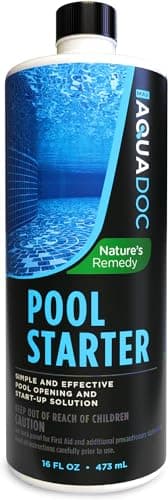
AquaDoc states the product contains natural enzymes that break down non-living organic debris, and is sized for pools up to 15,000 gallons.
That is a genuinely different job from shocking. Chlorine will oxidize the oils and waterline film a covered pool accumulates over winter, but it spends a lot of itself doing it - which is why a pool can swallow shock at opening and still look dull.
It is stated to work with cartridge, DE and sand filters and with chlorine, bromine or saltwater sanitizing.
What it does well
- Targets the organic film rather than the chlorine demand
- Stated compatible with all three filter types and all sanitizers
- Cheapest single addition to an opening routine
What it costs you
- Not a kit - no shock, algaecide or sequestrant included
- Sized for 15,000 gallons per bottle
- Enzyme products publish no measurable result you can test for
Skip it if your pool was closed clean and covered tightly. There may be little organic film to break down.
#ad · how this is funded · price as of October 9, 2026
Pick 6 - The reference residential kit
Taylor K-2006 Complete FAS-DPD Pool Test Kit
The kit every pool forum names, and for once the consensus is right - because titration is the one chlorine method that does not saturate exactly when you need it.
The published figure
FAS-DPD titration for free and combined chlorine, plus pH, acid and base demand, total alkalinity, calcium hardness and cyanuric acid; 3/4 oz reagents
The chlorine test is FAS-DPD: you add reagent drop by drop until a pink sample turns clear, and count the drops. Each drop is a fixed amount of chlorine, so 20 ppm reads as more drops rather than as an impossible shade of pink. Every color-match method tops out around 5 ppm - the range you are in during a shock.
The other six tests are the same reagents as the cheaper K-2005. What you pay extra for is the chlorine method and nothing else.
The 3/4 oz reagent bottles are what separate it from the K-2006C. They run out in a season of frequent testing on one pool; the C's 2 oz bottles do not.
What it does well
- Reads chlorine accurately at shock levels, which no strip can
- Covers all seven residential parameters
- Reagents are sold individually, so the case lasts for years
What it costs you
- 3/4 oz bottles empty quickly if you test more than weekly
- A full run takes minutes rather than seconds
- Several times the price of a strip bottle
Skip it if you never shock and test once a week. A strip kit gets used, and this one might not.
Opening a green pool is a different job
If the cover comes off and the water is green rather than dull, stop treating this as an opening. A bloom needs a shock dose calculated for the algae, brushing, and filtration hours - the sequence is on how to clear a green pool fast.
The opening kit is still useful afterwards. Sequester the metals first, clear the algae, then use the clarifier and the algaecide as the preventative they are meant to be.
Questions people actually ask
What chemicals do I need to open a pool?
What order do you add pool opening chemicals in?
Should I shock my pool when I open it?
Are pool opening kits worth it?
Do I need a different opening kit for a salt pool?
How long after opening can I swim?
Sources
Every figure on this page traces to one of these. Where a number could not be sourced, the page says so rather than estimating.
- HTH Pool Care Shock Advanced - product page, cal hypo formulation, adds no cyanuric acid
- Pool & Hot Tub Alliance - PHTA standards program, the ANSI-accredited consensus standards for residential and public pools
- Skim & Soak methodology - the constants, formulas and worked examples behind every dose on this site
- Doheny's Ultimate Pool Opening Start-Up Kit, 10,000-30,000 gallons - Amazon listing, read 2026-09-20
- In The Swim Well Water Pool Start-Up Kit - Amazon listing, read 2026-09-20
- In The Swim Basic Pool Chemical Value Kit, contents itemized - Amazon listing, read 2026-09-20
- In The Swim Saltwater Pool Opening Chemical Kit, up to 35,000 gallons - Amazon listing, read 2026-09-20
- MAV AquaDoc Pool Opening Chemical, 16 oz enzyme, up to 15,000 gallons - Amazon listing, read 2026-09-20
Read next
Best pool closing kit
Pool Closing Chemicals: What to Buy
The closing sequence step by step, with the shock dose computed for your volume and the closing kits ranked on whether they tell you what is in the box.
Top pick
Doheny's Master Pool Closing Kit, up to 35,000 gallons
A large-pool kit that lists its contents
#ad · how this is funded · price as of October 9, 2026

How to Balance Pool Water
The correction order that stops you doing the same job twice, with computed dose tables and the formulas behind them.
Top pick
Pool Mate Premium Alkalinity Increaser, 10 lb
Raising total alkalinity
#ad · how this is funded · price as of October 9, 2026
Best for green water
Best Pool Shock for a Green Pool
Cal-hypo, dichlor and liquid chlorine compared on available chlorine percentage, with a dose table computed for six pool sizes.
Top pick
In The Swim Pool Shock, 68% Cal-Hypo Granular, 25 lb
Clearing an algae bloom
#ad · how this is funded · price as of October 9, 2026

Best pool metal remover
Best Pool Metal Remover
Sequestrants that hold copper and iron in solution, ascorbic acid lifters that take an existing stain off the surface, and the order to use them in.
Top pick
Pool Mate Concentrated Metal Out, 1 quart
A stated dose per volume
Best test kit
Best Pool Test Kits
Titration kits, color comparators, strips and a photometer compared on precision, speed and what each one cannot see.
Top pick
AquaChek Select Connect 7-Way Test Strips, complete kit
Weekly testing you will actually do
#ad · how this is funded · price as of October 9, 2026