Testing & Chemistry
Chlorine vs Bromine for a Pool
Bromine is the better spa sanitizer and the wrong outdoor pool sanitizer, and the reason is sunlight.
We have not handled these products and we do not pretend to have. Here is what we did instead. Links to Amazon earn us a commission at no extra cost to you, and commission never decides a pick — disclosure.
| # | Product | Best for | The spec it turns on | Price |
|---|---|---|---|---|
| 1 | 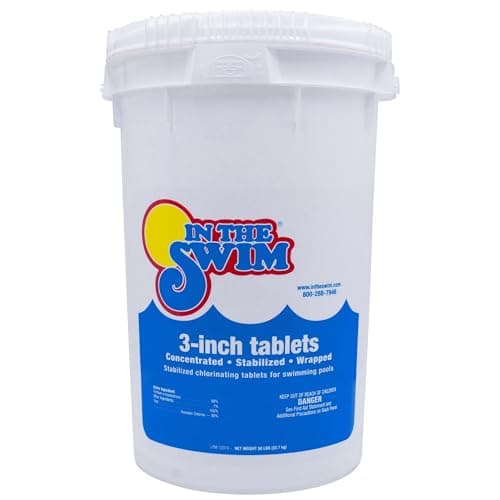 In The Swim 3 Inch Stabilized Chlorine Tablets, 50 lbTop pickTrichlor at 90% available chlorine, bought in the quantity a season actually consumes. | Season-long sanitizing | Trichlor, individually wrapped, slow dissolving, 50 lb bucket | |
| 2 | 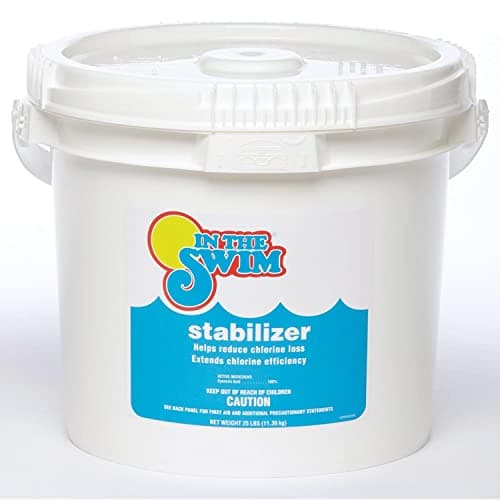 In The Swim Pool Stabilizer, 100% Cyanuric Acid, 25 lb100% cyanuric acid at a purity that lets you compute the dose, for pools whose chlorine source does not supply its own. | Stabilizing a liquid-chlorine or salt pool | 100% cyanuric acid, granular | |
| 3 | 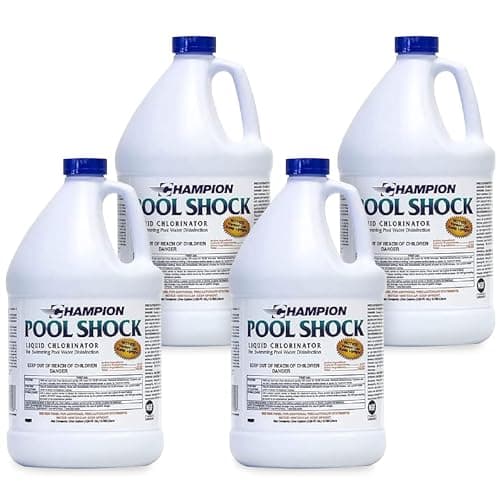 Champion Pool Shock Liquid Chlorine 12.5%, 1 gal, 4-packAdds nothing but chlorine and salt, which on a big bloom or a saltwater pool is exactly the point. | Large blooms and saltwater pools | 12.5% trade sodium hypochlorite, ready to use, no residue |
The comparison
| Chlorine | Bromine | |
|---|---|---|
| Protected from UV? | Yes, by cyanuric acid | No - there is no bromine stabilizer |
| Performance at high pH | Falls off noticeably above 7.8 | Holds up better |
| Performance in hot water | Dissipates fast | Stable - the spa argument |
| Smell | Chlorine smell, mostly from chloramines | Milder, but lingers on skin |
| Reactivates after shocking? | No - used chlorine is spent | Yes - spent bromide reactivates |
| Cost | Lower | Higher per unit |
| Availability | Everywhere | Specialist |
| Right for | Outdoor pools | Spas, indoor pools, covered pools |
The sunlight problem, which settles it
Chlorine breaks down in ultraviolet light quickly - HTH's stabilizer page puts the loss at up to 90% without protection. The answer is cyanuric acid, which shields chlorine from UV and is why every outdoor chlorine pool runs some.
There is no equivalent for bromine. Nothing stabilizes it, so an outdoor bromine pool loses sanitizer to sunlight continuously, all day, with no way to slow it down. On a spa - covered, indoors, or both - that does not matter. On an open pool it is the whole cost picture.
Where bromine is the better choice
- **Hot tubs and spas.** Chlorine dissipates fast in hot water; bromine is stable in it. This is the main case and it is a strong one.
- **Indoor pools.** No UV means bromine's central weakness never comes into play.
- **Pools kept covered.** Same reasoning, provided the cover is genuinely on most of the time.
- **Pools that struggle to hold pH down.** Bromine's effectiveness falls off far less at high pH than chlorine's does.
- **Swimmers sensitive to chloramines.** Bromamines are less irritating than chloramines, though bromine does linger on skin more.
Switching between them is not trivial
You cannot simply start adding bromine to a chlorine pool. The two build different reserves, and a partial conversion leaves you managing both badly.
Going from bromine to chlorine is harder still: bromide stays in the water, and every chlorine addition converts some of it back to bromine rather than sanitizing. The practical route is a substantial partial drain and refill.
The chloramine misunderstanding
The strong chlorine smell people associate with over-chlorinated pools is the opposite of what they think it is. It is chloramines - chlorine that has already combined with organic material and is spent. A pool that smells strongly of chlorine usually needs more chlorine, not less, to break the chloramines down.
Measuring combined chlorine is what tells you this, and it needs a FAS-DPD kit - see best pool test kits. Strips will not show it.
The picks
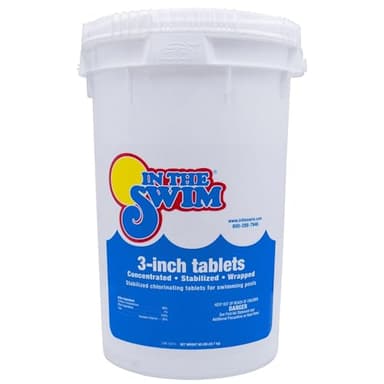
Top pick - Season-long sanitizing
In The Swim 3 Inch Stabilized Chlorine Tablets, 50 lb
Trichlor at 90% available chlorine, bought in the quantity a season actually consumes.
The published figure
Trichlor, individually wrapped, slow dissolving, 50 lb bucket
3 inch trichlor tablets are about 90% available chlorine and dissolve slowly in a floater, feeder or skimmer, which is what makes them the default residential sanitizer.
They are stabilized, so each tablet adds cyanuric acid as it dissolves. Over a season that adds up, which is why the cyanuric acid reading matters more on a tablet pool than on any other kind.
Trichlor is also acidic. Expect pH to drift down over the season and budget for alkalinity increaser.
What it does well
- Highest available chlorine of any format here at around 90%
- Slow dissolving, so a floater holds several days of sanitizer
- Individually wrapped, which slows degradation in the bucket
What it costs you
- Adds cyanuric acid continuously through the season
- Acidic, so pH drifts down and needs correcting
- Never put tablets in the skimmer if the pump cycles off — the concentrated acid sits in the line
Skip it if your cyanuric acid is already above about 50 ppm. More tablets will make chlorine progressively less effective.
#ad · how this is funded · price as of October 18, 2026
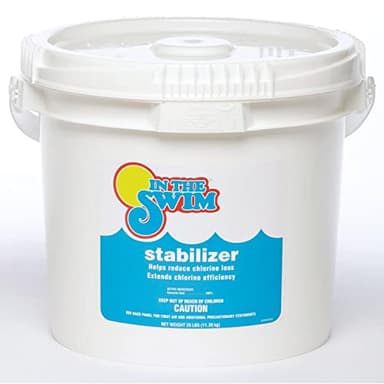
Pick 2 - Stabilizing a liquid-chlorine or salt pool
In The Swim Pool Stabilizer, 100% Cyanuric Acid, 25 lb
100% cyanuric acid at a purity that lets you compute the dose, for pools whose chlorine source does not supply its own.
The published figure
100% cyanuric acid, granular
Trichlor tablets and dichlor shock both add cyanuric acid as they dissolve. Liquid chlorine, cal-hypo and salt systems do not, so those pools need it added deliberately.
At 100% purity, 1 lb raises 10,000 gallons by 12 ppm. HTH's own stabilizer page states the useful targets: 30-50 ppm for trichlor and dichlor pools, 60-80 ppm for saltwater.
Cyanuric acid does not leave except by dilution. Adding too much is a mistake you fix by draining water, so under-dose and retest.
What it does well
- 100% purity means the arithmetic is exact
- Protects chlorine from UV loss, which HTH puts at up to 90%
- One correction lasts until you dilute the water
What it costs you
- Dissolves very slowly — 24 to 48 hours before a retest means anything
- Cannot be removed except by draining and refilling
Skip it if you sanitize with trichlor tablets. Those already add stabilizer, and your problem is more likely too much of it.
#ad · how this is funded · price as of October 18, 2026
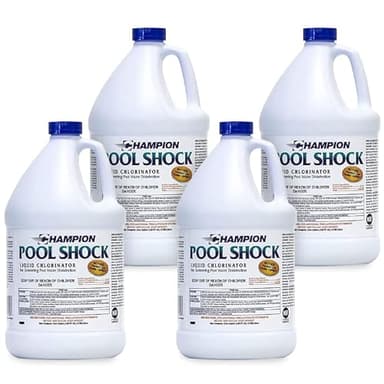
Pick 3 - Large blooms and saltwater pools
Champion Pool Shock Liquid Chlorine 12.5%, 1 gal, 4-pack
Adds nothing but chlorine and salt, which on a big bloom or a saltwater pool is exactly the point.
The published figure
12.5% trade sodium hypochlorite, ready to use, no residue
12.5% trade means one gallon raises 10,000 gallons by 12.5 ppm. That identity makes it the easiest chemistry on this page to dose in your head, and it stops being easy the moment your pool is not 10,000 gallons — see the calculator below.
Liquid chlorine adds no calcium and no cyanuric acid. For a pool that is already hard, already stabilized, or salt-chlorinated, that is the whole argument.
It also degrades. Sodium hypochlorite loses strength in storage, faster when warm, so a jug that has sat in a hot garage since last summer is not 12.5% any more.
What it does well
- Adds no calcium and no cyanuric acid
- Dissolves instantly, no pre-mixing, no granules on the liner
- Cheapest route to a large ppm swing on a big pool
What it costs you
- Loses strength in storage, particularly in heat
- Heavy and awkward to handle at four gallons
- Raises pH, so expect to follow with acid
Skip it if you cannot store it cool and use it within a couple of months — you will be dosing an unknown percentage.
Questions people actually ask
Is bromine better than chlorine for a pool?
Can I switch my pool from chlorine to bromine?
Does bromine smell less than chlorine?
Why do hot tubs use bromine?
Sources
Every figure on this page traces to one of these. Where a number could not be sourced, the page says so rather than estimating.
- HTH Pool Care Chlorine Stabilizer - product page, states up to 90% chlorine loss from UV and CYA targets of 30-50 ppm for trichlor and dichlor pools, 60-80 ppm for saltwater
- HTH Pool Care 3" Chlorine Tabs Advanced - product page, states one tablet per 10,000 gallons lasts up to 7 days and holds free chlorine at 1-4 ppm
- Michigan EGLE, Maximum Disinfectant Residuals and Operational Ranges: Guidance for Michigan Licensed Pools (December 2025) - quotes CDC MAHC 5.7.3.1.1.5.0, the EPA FIFRA label rule and the NSF 10 ppm application ceiling
- Skim & Soak methodology - the constants, formulas and worked examples behind every dose on this site
Read next
Cyanuric Acid: Stabilizer, and Its Limit
How stabilizer works, the targets HTH publishes, and why the only way down is dilution.
Top pick
In The Swim Pool Stabilizer, 100% Cyanuric Acid, 25 lb
Stabilizing a liquid-chlorine or salt pool
#ad · how this is funded · price as of October 18, 2026
Best for routine sanitizing
Best Pool Chlorine Tablets
Four trichlor tablets compared, with the cyanuric acid and pH arithmetic that decides whether they suit your pool.
Top pick
In The Swim 3 Inch Stabilized Chlorine Tablets, 50 lb
Season-long sanitizing
#ad · how this is funded · price as of October 18, 2026
Salt Water Pool vs Chlorine Pool
Same sanitizer, different delivery. What genuinely changes, and the cell replacement cost that decides the economics.
Top pick
Morton Pool Salt, 40 lb
Salt chlorinators
#ad · how this is funded · price as of October 18, 2026
Best test kit
Best Pool Test Kits
Titration kits, color comparators, strips and a photometer compared on precision, speed and what each one cannot see.
Top pick
AquaChek Select Connect 7-Way Test Strips, complete kit
Weekly testing you will actually do
#ad · how this is funded · price as of October 18, 2026