Cloudy Water
Cloudy From Sunscreen and Swimmers
If the pool clouds after a busy weekend rather than after a storm, the cause is what came off the swimmers.

We have not handled these products and we do not pretend to have. Here is what we did instead. Links to Amazon earn us a commission at no extra cost to you, and commission never decides a pick — disclosure.
| # | Product | Best for | The spec it turns on | Price |
|---|---|---|---|---|
| 1 | 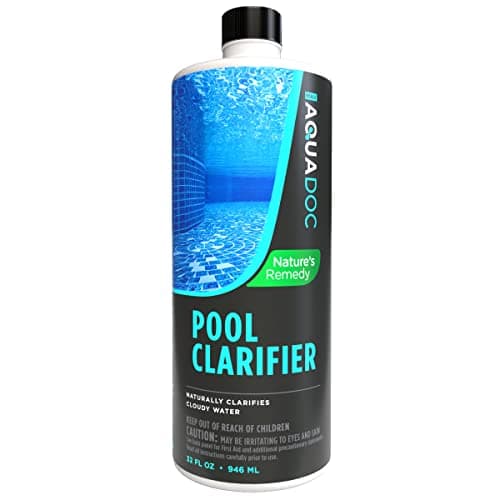 AquaDoc Natural Pool Clarifier, chitosan, 32 ozTop pickDifferent chemistry to the rest of this page: chitosan binds oils, which is the cause polymer clarifiers handle worst. | Oils and sunscreen | Chitosan-based clarifier, a shellfish-derived polymer | |
| 2 | 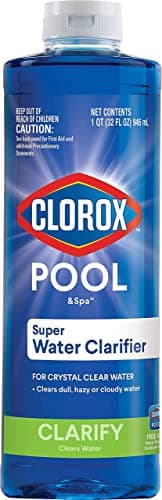 Clorox Pool&Spa Super Water Clarifier, 1 quartA conventional polymer clarifier from the most widely stocked brand, which matters when the water is cloudy on a Saturday. | Sand filters | Concentrated polymer clarifier, one quart | |
| 3 | 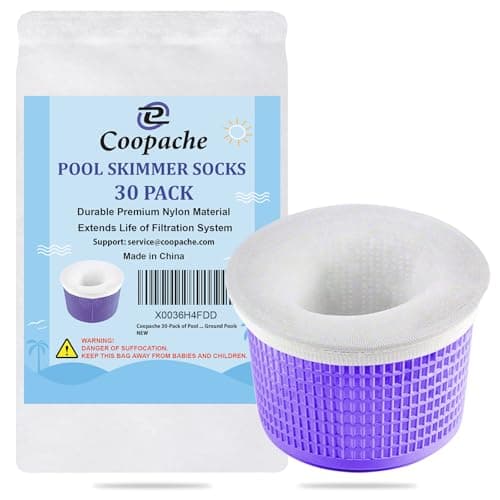 Coopache Pool Skimmer Socks, 30-packA few dollars of fine mesh over the skimmer basket removes more fine debris than any chemical on this site. | Catching what the net misses | Fine-mesh elastic liners for the skimmer basket, 30 per pack |
How to tell this is your cause
- **The cloudiness correlates with use, not weather.** Clear on Friday, hazy on Sunday evening, after a full pool.
- **There is often foam**, particularly where the returns break the surface or in a corner.
- **There is a visible scum line** at the waterline, or the tile feels slightly greasy. The same oils show up as foam on the surface on a heavily used pool.
- **Free chlorine dropped sharply** over the weekend without any obvious other cause.
- **A clarifier helped a bit and not enough**, if you already tried a polymer one.
What each swimmer actually brings
Sunscreen is the largest contributor and the hardest to remove, because it is formulated specifically to resist washing off. On top of that: body oils, sweat, cosmetics, hair product, deodorant and lotion. None of it dissolves, all of it consumes chlorine, and most of it is far below the micron rating of a residential filter.
The chlorine demand is the part people underestimate. A busy afternoon can drop free chlorine measurably, which is why a party pool goes cloudy and under-sanitized at the same moment.
The fix, in order
- **Test and restore free chlorine first.** The organic load has been consuming it. Use the dose tables for your volume.
- **Shock the pool.** This is one of the genuine cases for a routine shock: you are oxidizing an organic load rather than killing algae. Cal-hypo suits it, and evening is the right time.
- **Run the filter continuously for at least 24 hours.**
- **Add a chitosan clarifier rather than a polymer one.** Chitosan binds oils specifically, which is the case polymers handle worst.
- **Clean the waterline.** The scum line is oil that is out of the water column and will go back in the next time the level changes. If the band is hard and white rather than greasy, it is scale instead - see best pool tile cleaner.
- **Clean the filter afterwards.** Oil coats filter media and does not backwash off; a cartridge may need an enzyme soak or replacement.
Prevention, which works better than treatment here
- **A rinse before swimming removes a surprising amount** of what would otherwise end up in the water. It is the single most effective intervention and it costs nothing.
- **Apply sunscreen twenty minutes before swimming**, as most labels already advise, so it has bound to skin rather than washing straight off.
- **Fit a skimmer sock.** A few dollars of fine mesh over the skimmer basket removes far more fine organic debris than most people expect, and it does it before the pump.
- **Run the filter longer on days the pool was busy**, not the same hours as every other day.
- **Shock after a party, not three days later**, while the load is fresh and before it has fed anything.
Why a skimmer sock is in this list
It is the cheapest item on this site and one of the most effective. A skimmer basket catches leaves; everything smaller passes through it into the pump and then the filter - and a cracked or floating basket passes the leaves too. A fine-mesh sock over the basket intercepts hair, lotion residue, insects and grit before any of that happens.
The one caution is flow. Socks restrict as they load, so check them when you check the basket rather than weekly, and do not fit one to a pump already running at marginal flow.
The picks
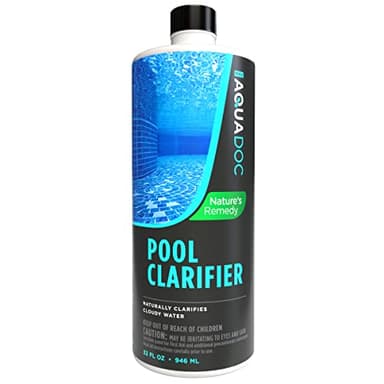
Top pick - Oils and sunscreen
AquaDoc Natural Pool Clarifier, chitosan, 32 oz
Different chemistry to the rest of this page: chitosan binds oils, which is the cause polymer clarifiers handle worst.
The published figure
Chitosan-based clarifier, a shellfish-derived polymer
Chitosan is derived from crustacean shells and binds organic material — body oils, sunscreen, lotion — more readily than the synthetic polymers do.
That makes it the specific answer to a pool that goes cloudy after a busy weekend rather than after a storm, which is a distinction almost nobody makes on the shelf.
It is also the one to avoid if anyone using the pool has a shellfish allergy, for obvious reasons.
What it does well
- Binds oils and lotions better than synthetic polymer clarifiers
- Biodegradable active ingredient
What it costs you
- Shellfish-derived, which is a real consideration for some households
- Less effective than a polymer on mineral and dead-algae haze
Skip it if your cloudiness followed a storm or a shock rather than a pool party — the cause is mineral or dead algae and a polymer clarifier suits it better.
Pick 2 - Sand filters
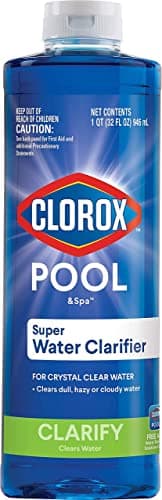
Clorox Pool&Spa Super Water Clarifier, 1 quart
A conventional polymer clarifier from the most widely stocked brand, which matters when the water is cloudy on a Saturday.
The published figure
Concentrated polymer clarifier, one quart
A clarifier is a coagulant: it makes fine particles clump until they are large enough for the filter to catch. That means it only works if the filter is running and clean, which is the step people skip before deciding the product failed.
Polymer clarifiers suit sand filters well, because sand catches particles down to roughly 20 microns and the clarifier's job is to lift the haze above that threshold.
Give it a full filter cycle. Clarifier is a 24 to 48 hour product, and re-dosing at hour six because nothing has happened is how people end up over-treating.
What it does well
- Stocked nearly everywhere, which is the whole point in an emergency
- Concentrated, so a quart treats several doses
- Works with the filter you already have rather than requiring vacuum-to-waste
What it costs you
- Needs a clean, running filter to do anything
- Slower than flocculant when the water is badly clouded
Skip it if your water is so cloudy you cannot see the bottom step. That is flocculant territory, not clarifier.
Pick 3 - Catching what the net misses
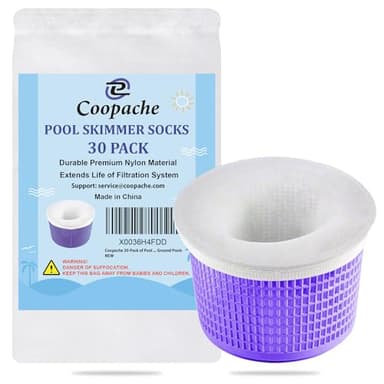
Coopache Pool Skimmer Socks, 30-pack
A few dollars of fine mesh over the skimmer basket removes more fine debris than any chemical on this site.
The published figure
Fine-mesh elastic liners for the skimmer basket, 30 per pack
A skimmer basket catches leaves. Everything smaller goes through it and into the pump, then into the filter, where it is your filter's problem.
A sock over the basket takes pollen, hair, insects and grit out before any of that happens, and it is the single cheapest upgrade to a pool's water clarity.
They restrict flow as they load. Check them at the same time you check the basket, not weekly.
What it does well
- Removes the fine debris that otherwise loads the filter
- Costs less per season than a single bottle of clarifier
- Extends the interval between filter cleans
What it costs you
- Restricts flow noticeably once loaded, and needs checking often
- Disposable, so there is a small ongoing cost
Skip it if your pump already runs at marginal flow. A loaded sock will starve it.
#ad · how this is funded · price as of October 18, 2026
Questions people actually ask
Does sunscreen make pool water cloudy?
How do I get rid of foam in my pool?
Should I shock my pool after a pool party?
What clarifier is best for oils and sunscreen?
Sources
Every figure on this page traces to one of these. Where a number could not be sourced, the page says so rather than estimating.
- HTH Pool Care Clarifier Advanced - product page, states clarity within 24 hours and no effect on pH
- HTH Pool Care Shock Advanced - product page, cal hypo formulation, adds no cyanuric acid
- Michigan EGLE, Maximum Disinfectant Residuals and Operational Ranges: Guidance for Michigan Licensed Pools (December 2025) - quotes CDC MAHC 5.7.3.1.1.5.0, the EPA FIFRA label rule and the NSF 10 ppm application ceiling
- Skim & Soak methodology - the constants, formulas and worked examples behind every dose on this site
- AquaDoc Natural Pool Clarifier, chitosan - Amazon listing, read 2026-09-02
Read next
Best for cloudy water
Best Pool Clarifier
Polymer clarifiers for silt and dead algae, chitosan for oils and sunscreen, matched to sand and cartridge filters.
Top pick
Clorox Pool&Spa Super Water Clarifier, 1 quart
Sand filters
Why Is My Pool Cloudy?
Check filtration, then chemistry, then everything else. Two of the six causes get worse if you add a chemical first.
Best for daily skimming
Best Pool Skimmers, Nets and Poles
Flat nets for the daily pass, deep rakes for a real drop, and the pole spec that decides whether it survives a season.
Top pick
POOLWHALE Pool Leaf Skimmer, flat surface net
Daily surface skimming
#ad · how this is funded · price as of October 18, 2026
Best for green water
Best Pool Shock for a Green Pool
Cal-hypo, dichlor and liquid chlorine compared on available chlorine percentage, with a dose table computed for six pool sizes.
Top pick
In The Swim Pool Shock, 68% Cal-Hypo Granular, 25 lb
Clearing an algae bloom
#ad · how this is funded · price as of October 18, 2026