Leaves & Debris
How to Get Leaves Out of a Pool
Do it in this order and a heavy drop is one session. Do it in any other order and it is three.

We have not handled these products and we do not pretend to have. Here is what we did instead. Links to Amazon earn us a commission at no extra cost to you, and commission never decides a pick — disclosure.
| # | Product | Best for | The spec it turns on | Price |
|---|---|---|---|---|
| 1 | 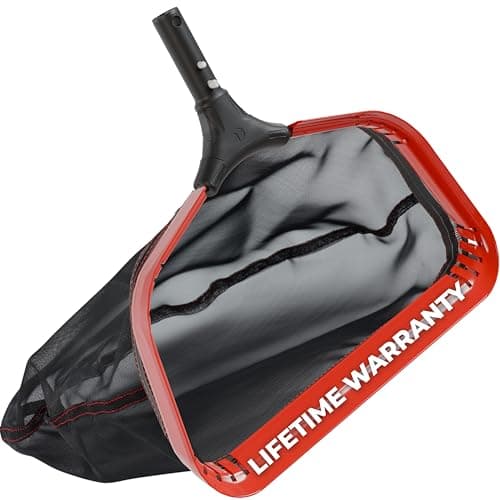 ProTuff 490 Promise Pro Pool Leaf Rake, 19.5 inTop pickA wide frame and a deep bag, which is the combination that decides how many passes a leaf drop takes. | Heavy leaf fall | 19.5 in frame with a deep bag; the widest opening in this roundup | |
| 2 | 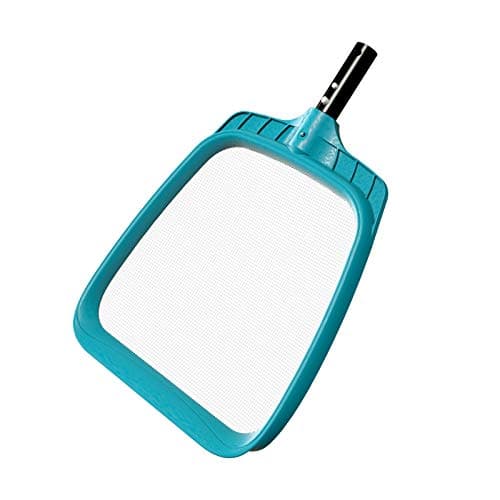 POOLWHALE Pool Leaf Skimmer, flat surface netThe everyday net. Flat, light and quick, for the two-minute pass that stops leaves sinking in the first place. | Daily surface skimming | Flat net for surface work, pole not included | |
| 3 | 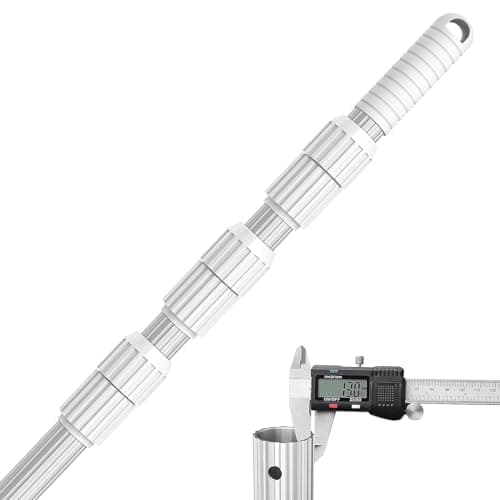 ARLBA Telescoping Pool Pole, 16.5 ft, 4-section aluminumWall thickness is the specification that decides whether a pole survives the season, and this one publishes it. | Reaching the middle of a wide pool | 16.5 ft extended, 1.30 mm anodized aluminum, four sections with three locking cams, 1-1/4 in end | |
| 4 | 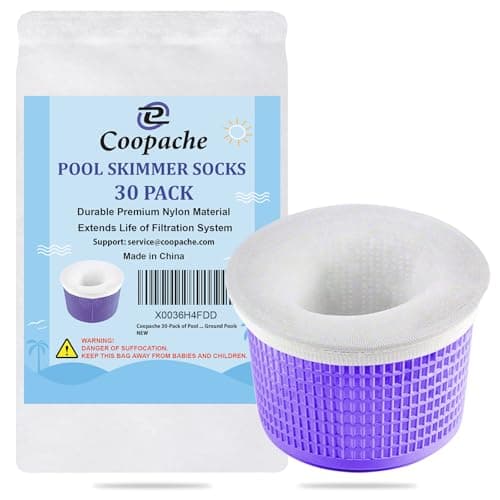 Coopache Pool Skimmer Socks, 30-packA few dollars of fine mesh over the skimmer basket removes more fine debris than any chemical on this site. | Catching what the net misses | Fine-mesh elastic liners for the skimmer basket, 30 per pack |
The order, and why it is the order
- **Turn the pump off and wait ten minutes.** Circulation keeps light debris suspended and pushes it around. Still water lets everything settle into two clear groups - floating and sunk - and you deal with them separately.
- **Skim the surface with a flat net.** Every leaf you remove here is a leaf you do not have to vacuum, and floating leaves are far quicker to collect than settled ones.
- **Clear the floor with a deep rake or vacuum.** Move slowly. Fast passes create currents that lift debris into suspension, and then you are waiting for it to settle again.
- **Empty the skimmer and pump baskets last.** They fill while you work, and emptying them first means doing it twice.
- **Then turn the pump back on** and let the filter deal with what is left in suspension.
Matching the tool to the job
| Stage | Tool | Why |
|---|---|---|
| Daily surface pass | Flat skimmer net | Light, fast, almost no drag. It gets used because it is easy. |
| Heavy drop on the surface | Deep-bag leaf rake, 18-20 in | Holds a full sweep without stopping to empty |
| Settled leaves on the floor | Deep rake, or a leaf vacuum | A flat net cannot lift anything off the bottom |
| A winter's worth at opening | Jet or battery leaf vacuum | Volume that would clog the pump basket several times over |
| Pollen and fine dust | Fine or double-layer mesh net | Coarse mesh passes it straight through |
The pole matters more than the net
Every net, brush and vacuum head attaches to the same pole, and the pole is where people economize and then replace twice. Two figures decide it: length, which has to reach the middle of your pool from the edge, and wall thickness, which decides whether it survives the season.
A 12 ft pole does not reach the center of a pool wider than about 20 ft. Thin-walled poles flex at full extension, and that flex eventually kinks them permanently at a joint. Comparison on best pool skimmers and nets.
Getting leaves out of the pump basket and skimmer
- **Turn the pump off before opening either.** A pump running dry, or drawing air, is a more expensive problem than leaves.
- **Check both, not just the skimmer.** The pump basket fills too, and a full one starves the pump while the skimmer looks fine.
- **Fit a skimmer sock.** Fine mesh over the basket catches what the basket passes, which is most of what eventually loads your filter.
- **Watch the flow, not the calendar.** During leaf fall the baskets may need emptying daily, and a weekly habit is not enough.
What to do with the leaves afterwards
Not back on the deck, and not on a lawn that drains toward the pool. Wet leaves stacked beside a pool blow back in, and leaf-laden runoff carries phosphate into the water the next time it rains - which is exactly what causes the bloom you are trying to avoid.
The picks
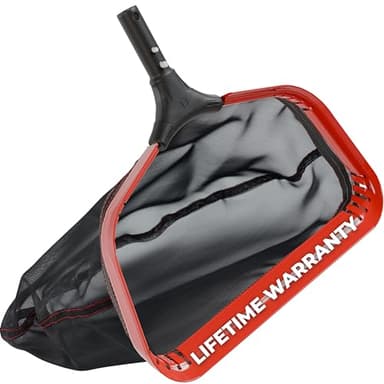
Top pick - Heavy leaf fall
ProTuff 490 Promise Pro Pool Leaf Rake, 19.5 in
A wide frame and a deep bag, which is the combination that decides how many passes a leaf drop takes.
The published figure
19.5 in frame with a deep bag; the widest opening in this roundup
Two numbers decide a leaf rake: the width of the opening and the depth of the bag. Width sets how much surface you sweep per pass; depth sets how much you can hold before you stop to empty it.
At 19.5 inches this is at the wide end of what fits comfortably down a standard skimmer throat and around a ladder.
A deep bag is what separates a leaf rake from a flat skimmer net. If you are scooping a heavy autumn drop, depth is the specification that matters.
What it does well
- Wide opening covers more surface per pass
- Deep bag holds a full sweep without emptying
- Reinforced frame, which is where cheap nets fail first
What it costs you
- A full deep bag is heavy on a long pole
- Too bulky for skimming a few surface leaves
Skip it if your daily job is a handful of floating leaves. A flat net is faster and lighter for that.
#ad · how this is funded · price as of October 18, 2026
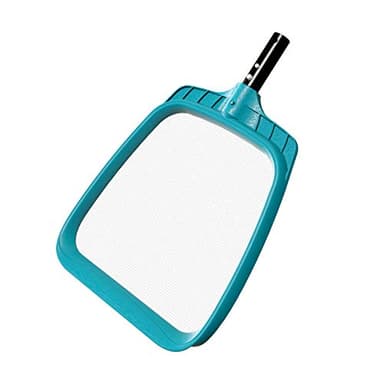
Pick 2 - Daily surface skimming
POOLWHALE Pool Leaf Skimmer, flat surface net
The everyday net. Flat, light and quick, for the two-minute pass that stops leaves sinking in the first place.
The published figure
Flat net for surface work, pole not included
A leaf that is still floating costs two minutes to remove. The same leaf on the floor two days later costs a vacuum cycle and has started releasing phosphate into the water.
That is the entire argument for owning a cheap flat net alongside a deep rake: you will actually use it daily, which is the only thing that matters.
Flat nets are wrong for anything on the bottom. Their whole design assumes the debris is on the surface.
What it does well
- Light enough that the daily pass actually happens
- Fast through the water with almost no drag
- Cheap enough to replace without thinking about it
What it costs you
- Useless for anything that has already sunk
- Small capacity
Skip it if you are clearing a heavy drop off the pool floor — that is a deep rake job.
#ad · how this is funded · price as of October 18, 2026
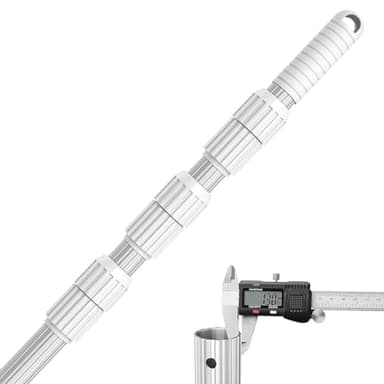
Pick 3 - Reaching the middle of a wide pool
ARLBA Telescoping Pool Pole, 16.5 ft, 4-section aluminum
Wall thickness is the specification that decides whether a pole survives the season, and this one publishes it.
The published figure
16.5 ft extended, 1.30 mm anodized aluminum, four sections with three locking cams, 1-1/4 in end
Every net, brush and vacuum head on this site attaches to a pole, and the pole is where people economize and then replace twice.
1.3 mm wall thickness is the published figure to compare against. Thin-walled poles flex at full extension, and the flex is what eventually kinks them permanently at the joint.
16.5 feet reaches the middle of most residential pools from the edge. A 12 ft pole does not, on anything wider than about 20 feet.
What it does well
- Publishes wall thickness, 1.30 mm, which most pole listings do not
- 16.5 ft reaches the center of a typical residential pool
- Standard fitting works with every net and brush on this site
What it costs you
- Four sections flex more at full extension than two
- Aluminum at this length is heavy overhead
Skip it if you own a small above-ground pool you can reach across. A 12 ft two-section pole is stiffer and lighter.
#ad · how this is funded · price as of October 18, 2026
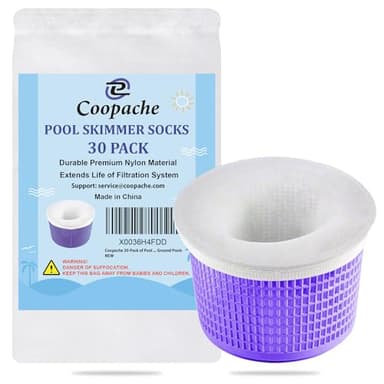
Pick 4 - Catching what the net misses
Coopache Pool Skimmer Socks, 30-pack
A few dollars of fine mesh over the skimmer basket removes more fine debris than any chemical on this site.
The published figure
Fine-mesh elastic liners for the skimmer basket, 30 per pack
A skimmer basket catches leaves. Everything smaller goes through it and into the pump, then into the filter, where it is your filter's problem.
A sock over the basket takes pollen, hair, insects and grit out before any of that happens, and it is the single cheapest upgrade to a pool's water clarity.
They restrict flow as they load. Check them at the same time you check the basket, not weekly.
What it does well
- Removes the fine debris that otherwise loads the filter
- Costs less per season than a single bottle of clarifier
- Extends the interval between filter cleans
What it costs you
- Restricts flow noticeably once loaded, and needs checking often
- Disposable, so there is a small ongoing cost
Skip it if your pump already runs at marginal flow. A loaded sock will starve it.
#ad · how this is funded · price as of October 18, 2026
Questions people actually ask
What is the fastest way to get leaves out of a pool?
Should the pump be on or off when I am netting leaves?
How do I get leaves off the bottom of the pool?
Can I vacuum leaves through the pool filter?
Sources
Every figure on this page traces to one of these. Where a number could not be sourced, the page says so rather than estimating.
- HTH Pool Care Shock Advanced - product page, cal hypo formulation, adds no cyanuric acid
- Skim & Soak methodology - the constants, formulas and worked examples behind every dose on this site
- ProTuff 490 Promise Pro Pool Leaf Rake - Amazon listing, read 2026-09-02
- ARLBA 16.5 ft Telescoping Pool Pole - Amazon listing, read 2026-10-03
Read next
Best for daily skimming
Best Pool Skimmers, Nets and Poles
Flat nets for the daily pass, deep rakes for a real drop, and the pole spec that decides whether it survives a season.
Top pick
POOLWHALE Pool Leaf Skimmer, flat surface net
Daily surface skimming
#ad · how this is funded · price as of October 18, 2026
Best for heavy leaf loads
Best Pool Vacuum for Leaves
Garden-hose jet, battery, or the pool's own suction - each keeps a different part of your system out of the job.
Top pick
U.S. Pool Supply Professional Leaf Terminator Vacuum, 15 in
Heavy leaf loads on a garden hose
#ad · how this is funded · price as of October 18, 2026
How to Keep Leaves Out of a Pool
Landscaping, covers, skimmer upgrades and automation, ordered by how much work each one genuinely eliminates.
Top pick
Blue Wave BWC564 Rectangular Leaf Net Cover, 20 ft x 40 ft
Sizing over an existing winter cover
#ad · how this is funded · price as of October 18, 2026
Skimmer Net vs Leaf Rake
Flat net for the surface, deep rake for the floor. Buy on bag depth and frame width, not on the word in the title.
Top pick
POOLWHALE Pool Leaf Skimmer, flat surface net
Daily surface skimming
#ad · how this is funded · price as of October 18, 2026