Robotic Cleaners & Vacuums
Wybot Pool Cleaners
The only brand in this roundup that publishes coverage area, micron rating, runtime and warranty for most of its range. That is worth something on its own.
We have not handled these products and we do not pretend to have. Here is what we did instead. Links to Amazon earn us a commission at no extra cost to you, and commission never decides a pick — disclosure.
| # | Product | Best for | The spec it turns on | Price |
|---|---|---|---|---|
| 1 | 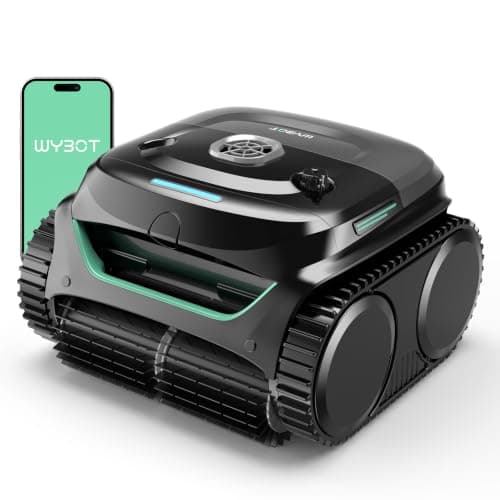 Wybot C2 Cordless Pool Vacuum for In-ground PoolsTop pickA 10 micron secondary filter is the finest figure published by any robot here, and it is the one that decides whether the water looks clean afterwards. | Finest published filtration | 180 min runtime, up to 2,152 sq ft per cycle, 10 micron ultra-fine plus 180 micron primary filter | |
| 2 | 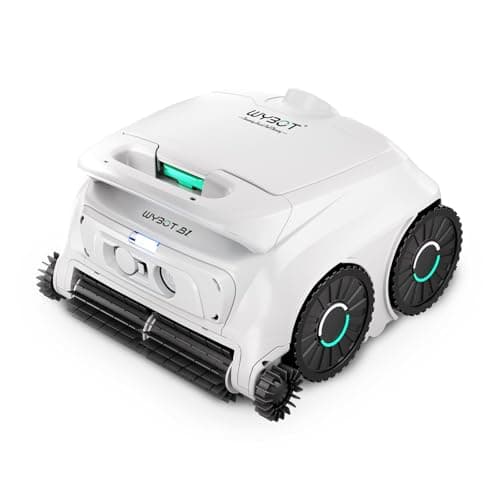 Wybot B1 Cordless Robotic Pool CleanerExplicitly rated for pools up to 1,150 sq ft, which is a more useful number than a runtime figure with no area attached. | Small pools | Rated by the maker for pools up to 1,150 sq ft, 120 min runtime, 180 micron filter | |
| 3 | 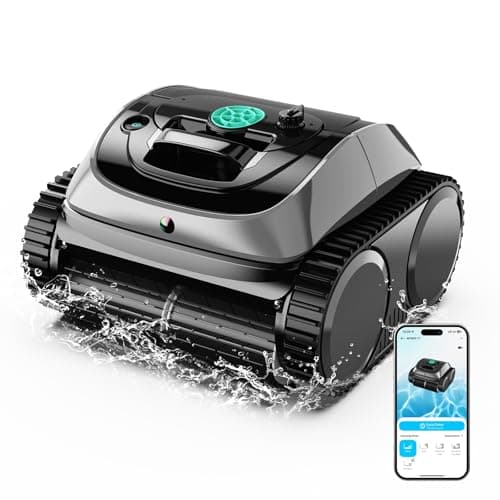 Wybot C1 Cordless Robotic Pool VacuumWall and waterline cleaning in a cordless unit priced below the flagship models, at the cost of the dual-stage filter. | Wall and waterline on a budget | Cordless, wall-climbing and waterline cleaning, four-in-one cleaning modes | |
| 4 | No image Wybot S3 Robotic Pool CleanerDocks, recharges and empties itself, which the maker states cuts hands-on maintenance to roughly once a month. | Hands-off ownership | 3D mapping navigation, auto-docking with self-emptying to a shore bin; maker states around monthly maintenance | Check price#ad |
Why a spec sheet is a reason to look
In a category where most listings publish a mode count and a marketing name, a brand that prints coverage area, micron rating, runtime and warranty is telling you something before you read a single review.
It also makes the four-number check we recommend actually possible. You cannot compare a robot against your pool's area if nobody has published an area figure, and for several models in this range you can.
The range, on Wybot's own published figures
| Model | Runtime | Coverage per cycle | Filtration | Warranty |
|---|---|---|---|---|
| B1 | 120 min | Up to 1,150 sq ft | 180 micron | 1 year |
| C1 | Published per listing | Not published | Single stage | Per listing |
| C2 | 180 min | Up to 2,152 sq ft | 10 micron + 180 micron | Per listing |
| S2 | Up to 210 min | Up to 3,230 sq ft | Dual layer | 2 years |
| S3 | Not published | 3D mapped | Self-emptying, 10 L bin | Per listing |
Every figure in that table comes from Wybot's own product pages, read on 2026-09-02. Where a cell says 'not published', that is what we found rather than a gap we chose to fill.
The C2 is the interesting one
Wybot publishes a 10 micron ultra-fine filter sitting behind a 180 micron primary. Only Aiper states a finer figure, at 3 micron, and most makers in our roundup state none at all. It addresses the complaint most robots do not: the pool is leaf-free and the water is still hazy.
180 micron catches leaves, grit and insects. Silt, pollen and fine dead algae pass straight through and go back into the water, however many cycles you run. A second stage at 10 micron is what stops that - at the cost of cleaning the filter more often, because it is now catching material it previously passed.
The B1 shows how sizing should work
Wybot rates the B1 for pools up to 1,150 sq ft with 120 minutes of runtime. That published pairing is more useful than a runtime figure alone, because it already accounts for how the machine moves.
The S3 is a different kind of product
Every other robot here is a device you carry to the pool, drop in, retrieve and empty. Wybot's S3 docks itself, recharges itself and empties into a shore-based bin. Its own page states 3D mapping on the first run, route planning from that map afterwards, a 10 L self-sanitizing debris bin, and maintenance reduced to around once a month.
That changes the ownership model rather than the cleaning. It is also the most mechanically complex machine on this site and the most expensive, and those are the same fact.
The picks
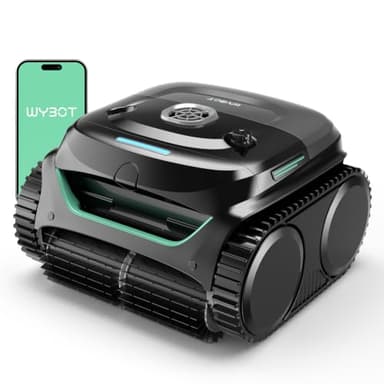
Top pick - Finest published filtration
Wybot C2 Cordless Pool Vacuum for In-ground Pools
A 10 micron secondary filter is the finest figure published by any robot here, and it is the one that decides whether the water looks clean afterwards.
The published figure
180 min runtime, up to 2,152 sq ft per cycle, 10 micron ultra-fine plus 180 micron primary filter
Wybot's own product page states a 10 micron ultra-fine filter behind a 180 micron primary. Most robots publish one number or none at all.
That matters because 180 micron catches leaves and grit while fine silt, pollen and dead algae pass straight through and go back into the water. The second stage is what stops that.
Wybot also publishes coverage per cycle — 2,152 sq ft — which is the honest way to compare against your own pool rather than against a runtime number in isolation.
What it does well
- 10 micron secondary filtration, the finest published figure in this roundup
- Coverage published per cycle, not just runtime
- Three brushless motors driving suction
What it costs you
- Fine filtration means more frequent filter cleaning
- 180 minutes is shorter than the longest-running units here
Skip it if your pool only ever collects leaves. You would be paying for filtration you never use.
#ad · how this is funded · price as of October 18, 2026
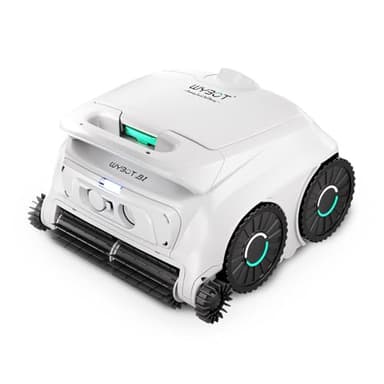
Pick 2 - Small pools
Wybot B1 Cordless Robotic Pool Cleaner
Explicitly rated for pools up to 1,150 sq ft, which is a more useful number than a runtime figure with no area attached.
The published figure
Rated by the maker for pools up to 1,150 sq ft, 120 min runtime, 180 micron filter
Wybot publishes a coverage area for this unit rather than leaving you to infer it. 1,150 sq ft is roughly a 16 x 32 pool including the walls.
Buying a unit rated well above your pool wastes money; buying one rated below it means the cycle ends before the pool is done. The published area is how you avoid both.
180 micron single-stage filtration here, not the dual stage of the C2. That is the trade at this size and price.
What it does well
- Coverage area published, so sizing is a decision rather than a guess
- Compact and light to lift out
- Quad roller brushes for edge work
What it costs you
- Single-stage 180 micron filter passes fine silt
- 120 minutes is short for anything above its rated area
Skip it if your pool is larger than about 1,150 sq ft. The maker's own rating is telling you not to.
#ad · how this is funded · price as of October 18, 2026
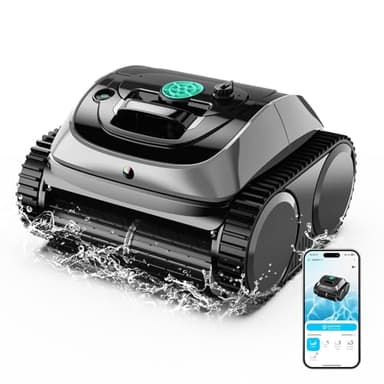
Pick 3 - Wall and waterline on a budget
Wybot C1 Cordless Robotic Pool Vacuum
Wall and waterline cleaning in a cordless unit priced below the flagship models, at the cost of the dual-stage filter.
The published figure
Cordless, wall-climbing and waterline cleaning, four-in-one cleaning modes
Waterline cleaning is the feature most often dropped from cheaper robots, and it is the one that visibly changes how a pool looks — the scum line sits exactly there.
Wybot positions the C1 around that capability, which makes it the value pick if the waterline is your complaint.
It carries the single-stage filter rather than the C2's dual stage.
What it does well
- Waterline cleaning at a price where it is usually omitted
- Cordless, so no cable management
- Multiple cleaning modes rather than one fixed cycle
What it costs you
- Single-stage filtration
- Shorter runtime than the flagship units
Skip it if fine silt is your problem rather than the waterline — the C2's second filter stage is what you want.
Pick 4 - Hands-off ownership
Wybot S3 Robotic Pool Cleaner
Docks, recharges and empties itself, which the maker states cuts hands-on maintenance to roughly once a month.
The published figure
3D mapping navigation, auto-docking with self-emptying to a shore bin; maker states around monthly maintenance
Every other robot here is a device you carry to the pool, drop in, retrieve and empty. This one docks and empties into a shore-based bin, which changes the ownership model rather than the cleaning.
Wybot's own page describes 3D mapping on the first run and route planning from that map on later runs, plus a 10 L self-emptying debris bin.
That is a lot of mechanism to go wrong, and it is the most expensive item on this page. Both facts are the same fact.
What it does well
- Self-docking and self-emptying, so the routine chore mostly disappears
- Maps the pool rather than running a fixed pattern
- Largest debris capacity here at 10 L
What it costs you
- The most complex and most expensive unit in this roundup
- Requires shore-side space for the dock
Skip it if you are happy to lift a robot out once a week. That habit is what this price premium replaces.
Questions people actually ask
Is Wybot a good pool cleaner brand?
What is the difference between the Wybot C1 and C2?
What size pool does the Wybot B1 suit?
Does the Wybot S3 empty itself?
Sources
Every figure on this page traces to one of these. Where a number could not be sourced, the page says so rather than estimating.
- WYBOT C2 - maker's product page, 180 minute runtime, up to 2,152 sq ft per cycle, 10 micron ultra-fine plus 180 micron primary filtration
- WYBOT B1 - maker's product page, rated for pools up to 1,150 sq ft with 120 minutes of runtime and 180 micron filtration
- WYBOT S2 - maker's product page, up to 210 minutes of runtime and coverage up to 3,230 sq ft
- WYBOT S3 - maker's product page, 3D mapping navigation, auto-docking and a 10 L self-emptying debris bin
- Skim & Soak methodology - the constants, formulas and worked examples behind every dose on this site
- Wybot C2 Cordless Pool Vacuum for Inground Pools - Amazon listing, read 2026-10-03
- Wybot B1 Cordless Robotic Pool Vacuum - Amazon listing, read 2026-09-02
Read next
Best robotic cleaner
Best Robotic Pool Cleaners
Corded and cordless robots compared on coverage per cycle, micron rating and runtime, with the sizing rule that decides it.
Top pick
Dolphin Nautilus CC Plus Wi-Fi Robotic Pool Vacuum
In-ground pools up to 50 ft
#ad · how this is funded · price as of October 18, 2026
Best corded range
Dolphin Pool Cleaners
The Nautilus range decoded: what each price step buys, and the model built specifically for above-ground pools.
Top pick
Dolphin Nautilus CC Plus Wi-Fi Robotic Pool Vacuum
In-ground pools up to 50 ft
#ad · how this is funded · price as of October 18, 2026
What a Robotic Pool Cleaner Costs to Run
Electricity per cycle and per season, computed from published power draw, plus the consumables that cost more than the power does.
Top pick
Dolphin Nautilus CC Plus Wi-Fi Robotic Pool Vacuum
In-ground pools up to 50 ft
#ad · how this is funded · price as of October 18, 2026
How Long Do Robotic Pool Cleaners Last?
What wears out and when, why the battery is the real lifespan limit, and the maintenance that genuinely extends it.
Top pick
Dolphin Nautilus CC Plus Wi-Fi Robotic Pool Vacuum
In-ground pools up to 50 ft
#ad · how this is funded · price as of October 18, 2026