Robotic Cleaners & Vacuums
How Long Do Robotic Pool Cleaners Last?
The parts fail in a predictable order, and on a cordless machine the last one in that order decides everything.
We have not handled these products and we do not pretend to have. Here is what we did instead. Links to Amazon earn us a commission at no extra cost to you, and commission never decides a pick — disclosure.
| # | Product | Best for | The spec it turns on | Price |
|---|---|---|---|---|
| 1 | 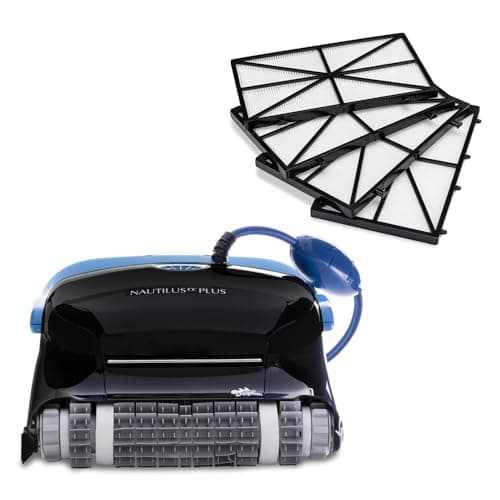 Dolphin Nautilus CC Plus Wi-Fi Robotic Pool VacuumTop pickThe corded default. Mains power means runtime is not a specification you have to think about. | In-ground pools up to 50 ft | Corded, wall-climbing with waterline scrubbing, ultra-fine top-load filter cartridges | |
| 2 | 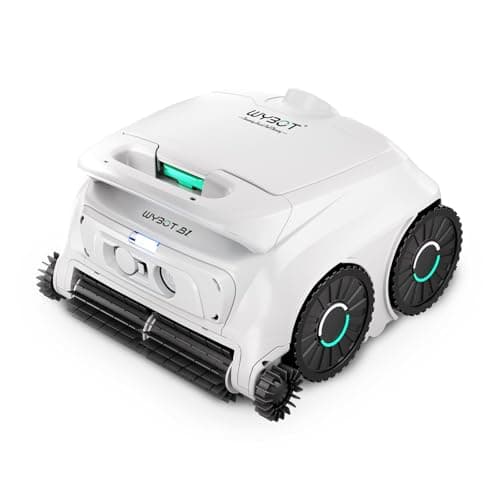 Wybot B1 Cordless Robotic Pool CleanerExplicitly rated for pools up to 1,150 sq ft, which is a more useful number than a runtime figure with no area attached. | Small pools | Rated by the maker for pools up to 1,150 sq ft, 120 min runtime, 180 micron filter |
The order things fail in
| Part | Typical life | Cost to replace | Ends the machine? |
|---|---|---|---|
| Filter cartridges or bags | A season or two | Low | No - consumable |
| Brushes and tracks | A few seasons | Low to moderate | No |
| Impeller or drive belt | Several seasons | Moderate | Sometimes, if unavailable |
| Power supply (corded) | Variable | Moderate | Sometimes |
| Battery (cordless) | Finite cycle count | High | Yes, if no longer sold |
| Motor | Long | High | Usually yes |
Why the battery is the real answer
Every lithium battery has a finite number of charge cycles, and a robot that runs three times a week is cycling its battery around 70 times a season. That is normal wear rather than a defect, and it is entirely predictable.
What is not predictable is whether the manufacturer still sells a replacement pack for your model when you need it. In a category where several brands are only a few years old and model names change annually, that is a genuine risk - and it is the difference between a machine that is repairable and one that is not.
What the makers commit to
Warranty is the only published number in this whole area, and it is worth reading rather than assuming. Wybot publishes 2 years on the S2 and 1 year on the B1 - a real difference between two products from the same brand, and one that tells you something about how each is positioned.
Check what the specific model you are looking at states, not what the brand states in general. We could not find published mean-time-to-failure or expected-lifespan figures from any maker in this roundup, and we are not going to invent one.
Maintenance that genuinely extends life
- **Rinse it with fresh water after every cycle.** Chlorinated water left to dry on seals, bearings and electrical contacts is the single largest avoidable cause of early failure.
- **Clean the filter every cycle, not every few.** A blocked filter makes the motor work harder against restricted flow, and that is a load it was not designed to carry continuously.
- **Store it out of direct sunlight.** UV degrades the plastics and the cable, and heat is hard on a battery.
- **Store a cordless unit at a partial charge, not empty and not full.** Both extremes shorten cycle life; a battery left flat over winter may not recover at all.
- **Do not leave it in the pool between cycles.** Continuous chemical exposure is exactly what shortens seal and bearing life.
- **Replace brushes when they are visibly worn**, rather than when the cleaning gets noticeably bad. A worn brush makes the drive work harder.
When to repair and when not to
- **Brushes, tracks, filters:** always repair. They are consumables and the cost is trivial.
- **Impeller, belt, power supply:** repair if the part is available and the machine is otherwise sound.
- **Battery:** repair if a genuine replacement is available at a sensible price. If it is not, the machine is finished regardless of its condition.
- **Motor:** rarely worth it on a residential unit. At that point the repair cost approaches the replacement cost.
What to check before you buy, with this in mind
- Does the maker sell replacement brushes, filters and - if cordless - batteries, today, for this model?
- How long has this specific model been on sale? A model that has existed for several seasons has a spares supply chain; a brand-new one has a promise.
- What does the warranty actually state for this model rather than the brand?
- Is it corded? If so, the battery question does not apply at all.
The picks
Top pick - In-ground pools up to 50 ft
Dolphin Nautilus CC Plus Wi-Fi Robotic Pool Vacuum
The corded default. Mains power means runtime is not a specification you have to think about.
The published figure
Corded, wall-climbing with waterline scrubbing, ultra-fine top-load filter cartridges
A corded robot has no battery to degrade and no runtime ceiling. That single fact removes the constraint every cordless unit on this page is designed around.
Wall climbing and waterline scrubbing are the two features that separate a robot from a floor vacuum, because the waterline is where the oily scum line forms and no floor-only unit touches it.
The cable is the cost: it tangles, and you have to lift a wet robot with a cord attached out of the pool.
What it does well
- No runtime limit and no battery to degrade
- Climbs walls and scrubs the waterline, not just the floor
- Top-load filter cartridges, which are the easiest kind to empty
What it costs you
- Cable tangling on pools with a lot of steps and features
- Heavier to lift out than a cordless unit
Skip it if your pool has no convenient power outlet, or you want to drop a cleaner in and walk away without managing a cord.
#ad · how this is funded · price as of October 18, 2026
Pick 2 - Small pools
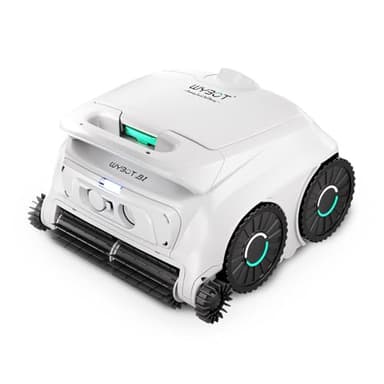
Wybot B1 Cordless Robotic Pool Cleaner
Explicitly rated for pools up to 1,150 sq ft, which is a more useful number than a runtime figure with no area attached.
The published figure
Rated by the maker for pools up to 1,150 sq ft, 120 min runtime, 180 micron filter
Wybot publishes a coverage area for this unit rather than leaving you to infer it. 1,150 sq ft is roughly a 16 x 32 pool including the walls.
Buying a unit rated well above your pool wastes money; buying one rated below it means the cycle ends before the pool is done. The published area is how you avoid both.
180 micron single-stage filtration here, not the dual stage of the C2. That is the trade at this size and price.
What it does well
- Coverage area published, so sizing is a decision rather than a guess
- Compact and light to lift out
- Quad roller brushes for edge work
What it costs you
- Single-stage 180 micron filter passes fine silt
- 120 minutes is short for anything above its rated area
Skip it if your pool is larger than about 1,150 sq ft. The maker's own rating is telling you not to.
#ad · how this is funded · price as of October 18, 2026
Questions people actually ask
How long do robotic pool cleaners last?
Can you replace the battery in a robotic pool cleaner?
What is the most common failure on a pool robot?
Should I leave my robot in the pool?
Sources
Every figure on this page traces to one of these. Where a number could not be sourced, the page says so rather than estimating.
- WYBOT S2 - maker's product page, up to 210 minutes of runtime and coverage up to 3,230 sq ft
- WYBOT B1 - maker's product page, rated for pools up to 1,150 sq ft with 120 minutes of runtime and 180 micron filtration
- Michigan EGLE, Maximum Disinfectant Residuals and Operational Ranges: Guidance for Michigan Licensed Pools (December 2025) - quotes CDC MAHC 5.7.3.1.1.5.0, the EPA FIFRA label rule and the NSF 10 ppm application ceiling
- Skim & Soak methodology - the constants, formulas and worked examples behind every dose on this site
Read next
What a Robotic Pool Cleaner Costs to Run
Electricity per cycle and per season, computed from published power draw, plus the consumables that cost more than the power does.
Top pick
Dolphin Nautilus CC Plus Wi-Fi Robotic Pool Vacuum
In-ground pools up to 50 ft
#ad · how this is funded · price as of October 18, 2026

Are Robotic Pool Cleaners Worth It?
The payback case, worked from hours saved and electricity used, plus the two situations where a robot is the wrong purchase.
Top pick
Dolphin Nautilus CC Plus Wi-Fi Robotic Pool Vacuum
In-ground pools up to 50 ft
#ad · how this is funded · price as of October 18, 2026
Best robotic cleaner
Best Robotic Pool Cleaners
Corded and cordless robots compared on coverage per cycle, micron rating and runtime, with the sizing rule that decides it.
Top pick
Dolphin Nautilus CC Plus Wi-Fi Robotic Pool Vacuum
In-ground pools up to 50 ft
#ad · how this is funded · price as of October 18, 2026
Best published specs
Wybot Pool Cleaners
The A1, B1, C1, C2, S2 and S3 compared on the figures Wybot publishes and most competitors do not.
Top pick
Wybot C2 Cordless Pool Vacuum for In-ground Pools
Finest published filtration
#ad · how this is funded · price as of October 18, 2026