Robotic Cleaners & Vacuums
What a Robotic Pool Cleaner Costs to Run
Every site in this category reviews robots. None of them publishes what one costs to run. Here is the calculation, and how to redo it with your own numbers.
We have not handled these products and we do not pretend to have. Here is what we did instead. Links to Amazon earn us a commission at no extra cost to you, and commission never decides a pick — disclosure.
| # | Product | Best for | The spec it turns on | Price |
|---|---|---|---|---|
| 1 | 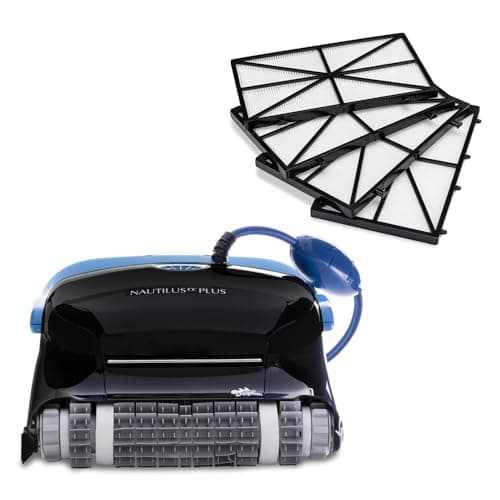 Dolphin Nautilus CC Plus Wi-Fi Robotic Pool VacuumTop pickThe corded default. Mains power means runtime is not a specification you have to think about. | In-ground pools up to 50 ft | Corded, wall-climbing with waterline scrubbing, ultra-fine top-load filter cartridges | |
| 2 | 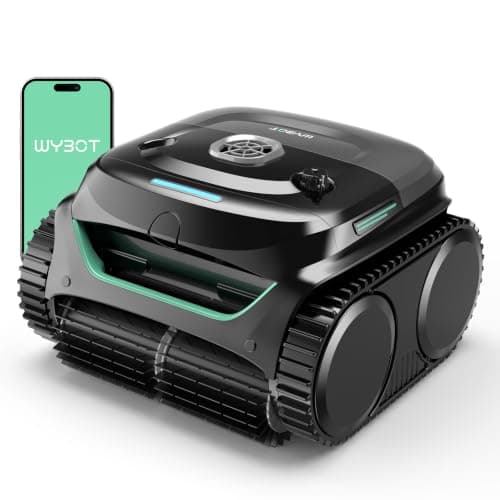 Wybot C2 Cordless Pool Vacuum for In-ground PoolsA 10 micron secondary filter is the finest figure published by any robot here, and it is the one that decides whether the water looks clean afterwards. | Finest published filtration | 180 min runtime, up to 2,152 sq ft per cycle, 10 micron ultra-fine plus 180 micron primary filter |
Why this page exists
We surveyed the sites that rank for robotic pool cleaner searches. Every one of them reviews the machines. Not one publishes what a machine costs to run, which is a strange gap given that people search for it directly.
It is also a gap we can fill without a test lab, because it is arithmetic on published figures plus a number off your own electricity bill. That is the whole of our contribution here, and it is checkable line by line.
The calculation
| Cycles per week | kWh per 24-week season | At $0.13/kWh | At $0.17/kWh | At $0.30/kWh |
|---|---|---|---|---|
| 2 | 25.9 | $3.37 | $4.41 | $7.78 |
| 3 | 38.9 | $5.05 | $6.61 | $11.66 |
| 5 | 64.8 | $8.42 | $11.02 | $19.44 |
| 7 | 90.7 | $11.79 | $15.42 | $27.22 |
The comparison that actually matters
A robot's power draw is trivial next to the pool pump it does not replace. A single-speed pump drawing 1,500 W for eight hours a day uses 12 kWh a day - more in one day than a robot uses in three weeks.
| Typical draw | Hours per season | kWh per season | |
|---|---|---|---|
| Robotic cleaner, 3 cycles a week | 180 W | 216 | 39 |
| Single-speed pump, 8 h/day | 1,500 W | 1,344 | 2,016 |
| Variable-speed pump, low speed | 250 W | 2,688 | 672 |
| Booster pump for a pressure-side cleaner, 3 h/day | 750 W | 504 | 378 |
That last row is the one worth noticing. A pressure-side cleaner needs a booster pump, and the booster pump alone uses roughly ten times the electricity of a robot doing the same job. That is the hidden cost in the cheap option - see robot vs manual vacuum, and the per-cycle floor for a 3/4 HP booster on the Polaris Vac-Sweep 280 review.
What actually costs money
- **Filter cartridges and bags.** Consumable, and the finer the filtration the more often they need replacing. A 10 micron secondary filter fills faster than a 180 micron primary by definition.
- **Brushes and tracks.** Wear items on every brand, typically every few seasons.
- **The battery, on a cordless unit.** The single largest ongoing cost and the one that eventually ends the machine's life, because a battery you cannot buy is a machine you cannot use.
- **Out-of-warranty repair.** Check what the maker states: Wybot publishes 2 years on the S2 and 1 year on the B1, which is a real difference between two products from the same brand.
Doing it for your own machine
- Find the power draw. It is on the unit's plate, on the power supply, or in the manual. If nowhere states it, use 180 W and treat the answer as approximate.
- Multiply by cycle length in hours, divide by 1,000, and you have kWh per cycle.
- Multiply by cycles per week and weeks in your season.
- Multiply by your own rate per kWh, from your bill.
- Add the consumables: filters per season, plus brushes amortized over their life, plus a battery amortized over the years you expect from it.
That last step is where the real number lives, and it is the one the electricity calculation tends to distract from.
The picks
Top pick - In-ground pools up to 50 ft
Dolphin Nautilus CC Plus Wi-Fi Robotic Pool Vacuum
The corded default. Mains power means runtime is not a specification you have to think about.
The published figure
Corded, wall-climbing with waterline scrubbing, ultra-fine top-load filter cartridges
A corded robot has no battery to degrade and no runtime ceiling. That single fact removes the constraint every cordless unit on this page is designed around.
Wall climbing and waterline scrubbing are the two features that separate a robot from a floor vacuum, because the waterline is where the oily scum line forms and no floor-only unit touches it.
The cable is the cost: it tangles, and you have to lift a wet robot with a cord attached out of the pool.
What it does well
- No runtime limit and no battery to degrade
- Climbs walls and scrubs the waterline, not just the floor
- Top-load filter cartridges, which are the easiest kind to empty
What it costs you
- Cable tangling on pools with a lot of steps and features
- Heavier to lift out than a cordless unit
Skip it if your pool has no convenient power outlet, or you want to drop a cleaner in and walk away without managing a cord.
#ad · how this is funded · price as of October 18, 2026
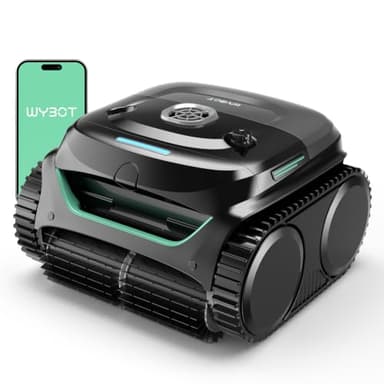
Pick 2 - Finest published filtration
Wybot C2 Cordless Pool Vacuum for In-ground Pools
A 10 micron secondary filter is the finest figure published by any robot here, and it is the one that decides whether the water looks clean afterwards.
The published figure
180 min runtime, up to 2,152 sq ft per cycle, 10 micron ultra-fine plus 180 micron primary filter
Wybot's own product page states a 10 micron ultra-fine filter behind a 180 micron primary. Most robots publish one number or none at all.
That matters because 180 micron catches leaves and grit while fine silt, pollen and dead algae pass straight through and go back into the water. The second stage is what stops that.
Wybot also publishes coverage per cycle — 2,152 sq ft — which is the honest way to compare against your own pool rather than against a runtime number in isolation.
What it does well
- 10 micron secondary filtration, the finest published figure in this roundup
- Coverage published per cycle, not just runtime
- Three brushless motors driving suction
What it costs you
- Fine filtration means more frequent filter cleaning
- 180 minutes is shorter than the longest-running units here
Skip it if your pool only ever collects leaves. You would be paying for filtration you never use.
#ad · how this is funded · price as of October 18, 2026
Questions people actually ask
How much electricity does a robotic pool cleaner use?
Is a robotic pool cleaner expensive to run?
Does a robotic cleaner use more power than the pool pump?
How much does a pressure-side cleaner cost to run?
Sources
Every figure on this page traces to one of these. Where a number could not be sourced, the page says so rather than estimating.
- WYBOT S2 - maker's product page, up to 210 minutes of runtime and coverage up to 3,230 sq ft
- WYBOT B1 - maker's product page, rated for pools up to 1,150 sq ft with 120 minutes of runtime and 180 micron filtration
- WYBOT C2 - maker's product page, 180 minute runtime, up to 2,152 sq ft per cycle, 10 micron ultra-fine plus 180 micron primary filtration
- Skim & Soak methodology - the constants, formulas and worked examples behind every dose on this site
Read next

Are Robotic Pool Cleaners Worth It?
The payback case, worked from hours saved and electricity used, plus the two situations where a robot is the wrong purchase.
Top pick
Dolphin Nautilus CC Plus Wi-Fi Robotic Pool Vacuum
In-ground pools up to 50 ft
#ad · how this is funded · price as of October 18, 2026
Robot vs Manual Pool Vacuum
Manual, suction-side, pressure-side and robotic compared on cost, filter load and what each one actually cleans.
Top pick
POOLWHALE Pool Vacuum Head and 36 ft Hose Kit
The complete manual kit

How Long Do Robotic Pool Cleaners Last?
What wears out and when, why the battery is the real lifespan limit, and the maintenance that genuinely extends it.
Top pick
Dolphin Nautilus CC Plus Wi-Fi Robotic Pool Vacuum
In-ground pools up to 50 ft
#ad · how this is funded · price as of October 18, 2026
Best robotic cleaner
Best Robotic Pool Cleaners
Corded and cordless robots compared on coverage per cycle, micron rating and runtime, with the sizing rule that decides it.
Top pick
Dolphin Nautilus CC Plus Wi-Fi Robotic Pool Vacuum
In-ground pools up to 50 ft
#ad · how this is funded · price as of October 18, 2026