Robotic Cleaners & Vacuums
Robot vs Manual Pool Vacuum
The cheap option is genuinely better at some things. Here is which things, before you spend ten times as much.

We have not handled these products and we do not pretend to have. Here is what we did instead. Links to Amazon earn us a commission at no extra cost to you, and commission never decides a pick — disclosure.
| # | Product | Best for | The spec it turns on | Price |
|---|---|---|---|---|
| 1 | 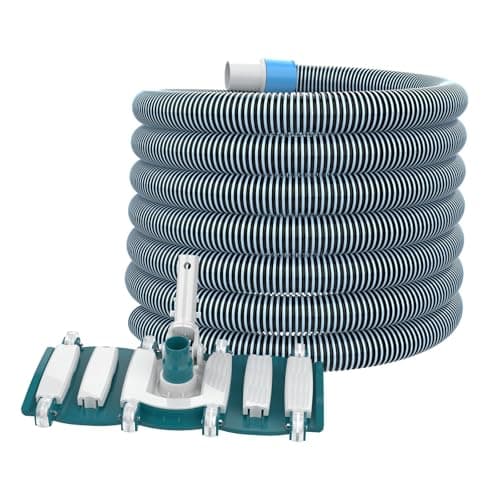 POOLWHALE Pool Vacuum Head and 36 ft Hose KitTop pickHead and hose together, which avoids the classic mistake of buying a head and discovering the hose is the expensive part. | The complete manual kit | Weighted vacuum head with wheels and 1.5 in x 36 ft hose | |
| 2 | 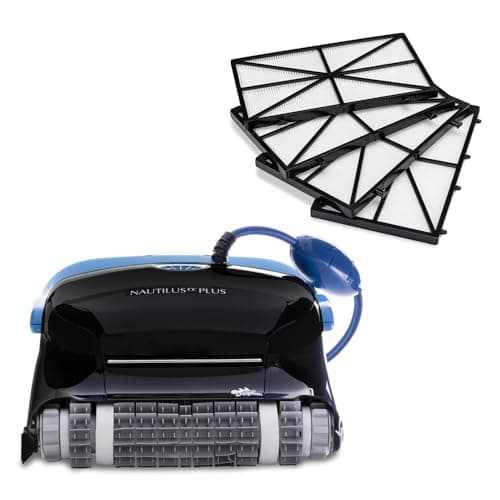 Dolphin Nautilus CC Plus Wi-Fi Robotic Pool VacuumThe corded default. Mains power means runtime is not a specification you have to think about. | In-ground pools up to 50 ft | Corded, wall-climbing with waterline scrubbing, ultra-fine top-load filter cartridges | |
| 3 | 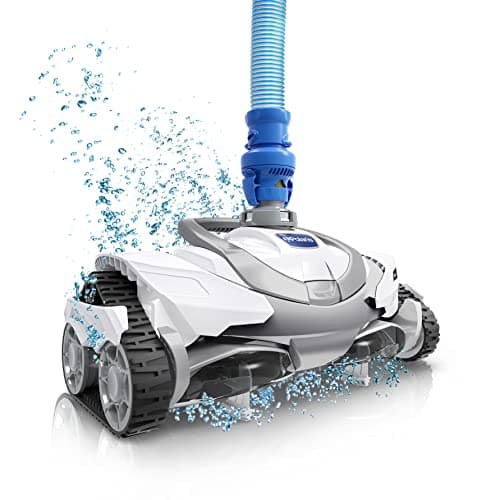 Polaris MAXX Premium Suction-Side Automatic Pool CleanerUses the pump you already have and sends every piece of debris through your filter, which is the whole trade. | Running off the existing skimmer line | Suction-side; stated to clean from the floor to the waterline with active scrubbing brushes; HALO debris clearance; functions at lower flow rates; Regulator Valve controls excess flow | |
| 4 | 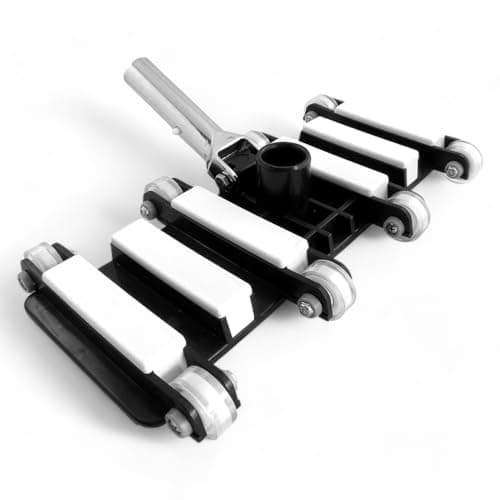 FibroPool Pool Vacuum Head, weighted flexible, 14.4 inThermoplastic body and urethane wheels, which is the combination that does not mark a vinyl liner. | Vinyl liners | 14.4 in thermoplastic head with urethane wheels and a 1.5 in hose port |
The four options, and where the debris goes
| Manual vacuum | Suction-side | Pressure-side | Robot | |
|---|---|---|---|---|
| Up-front cost | Lowest | Low | Low if you have a booster | Highest |
| Your time per clean | 30-60 min | Set and forget | Set and forget | Set and forget |
| Debris goes to | Pump basket and filter | Pump basket and filter | Its own bag | Its own filter |
| Cleans walls | If you do | Some models | No | Yes |
| Cleans waterline | If you do | A few models | No | Most models |
| Extra electricity | None | None | A booster pump | About 180 W while running |
| Precision | Total - you aim it | None | None | Pattern or mapped |
Four cases where manual wins outright
- **A small above-ground pool.** If a full vacuum takes ten minutes, no robot pays back on time saved, and the entry-level machines aimed at these pools do the least. The battery vacuums on best above-ground pool vacuum are the honest middle ground.
- **One stubborn area.** Nothing automatic clears a specific corner, a step, or the shaded patch behind the ladder as reliably as pointing a head at it.
- **After a flocculant treatment.** You must vacuum to waste, slowly, without stirring the settled layer. That is a manual job and no robot does it.
- **A pool you use twice a season.** Frequency is what the argument turns on, and low frequency settles it.
Where a robot wins
- **Frequency.** Past about once a week for several months, the hours add up in a way a purchase can justify - see are robotic pool cleaners worth it for the calculation.
- **Walls and waterline.** The honest argument for most owners is not that a robot saves them time, it is that it does jobs they were never going to do.
- **Filter load.** A robot filters independently, so its debris never loads your sand or cartridge. Manual and suction-side both send everything through your system.
- **Consistency.** A scheduled robot runs whether or not anyone feels like it, which is the difference between a pool that is clean and a pool that is clean on the weekends.
Two things a manual vacuum needs to work properly
- **A hose long enough to reach the far corner from the skimmer.** Measure and add a third. A short hose is the reason people conclude manual vacuuming is miserable.
- **A weighted head with wheels, matched to your surface.** Urethane wheels and a thermoplastic body will not mark a vinyl liner; a metal-framed head with hard wheels leaves gray scuff lines on a light liner.
The honest answer for most pools
Own both. A manual head and hose costs a fraction of a robot, and there will be a corner, a flocculant treatment or a filter-off day where you need one. A robot handles the routine; a manual head handles the exceptions.
The picks
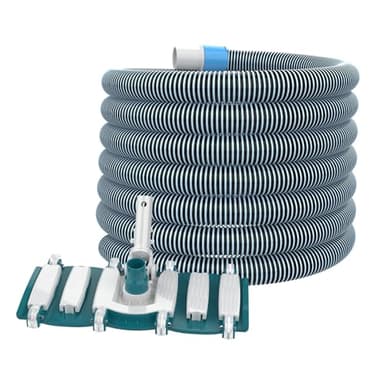
Top pick - The complete manual kit
POOLWHALE Pool Vacuum Head and 36 ft Hose Kit
Head and hose together, which avoids the classic mistake of buying a head and discovering the hose is the expensive part.
The published figure
Weighted vacuum head with wheels and 1.5 in x 36 ft hose
Manual vacuuming is slow, and it is also the only method that gets exactly where you point it. Nothing automatic clears one stubborn corner as reliably.
36 ft of hose covers most residential pools from a single skimmer. Measure from your skimmer to the far corner and add a third.
A weighted head with wheels stays down and rolls rather than skating, which is the difference between vacuuming and stirring.
What it does well
- Head and hose matched, so nothing else to buy
- Weighted with wheels, so it tracks rather than lifts
- Works with any standard telescopic pole
What it costs you
- Manual labor
- Debris goes through the pump basket and filter
Skip it if you already own a robot and only ever vacuum a small area — a handheld is enough.
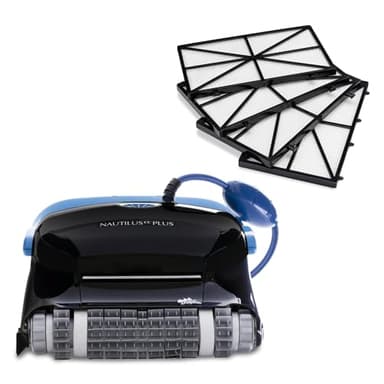
Pick 2 - In-ground pools up to 50 ft
Dolphin Nautilus CC Plus Wi-Fi Robotic Pool Vacuum
The corded default. Mains power means runtime is not a specification you have to think about.
The published figure
Corded, wall-climbing with waterline scrubbing, ultra-fine top-load filter cartridges
A corded robot has no battery to degrade and no runtime ceiling. That single fact removes the constraint every cordless unit on this page is designed around.
Wall climbing and waterline scrubbing are the two features that separate a robot from a floor vacuum, because the waterline is where the oily scum line forms and no floor-only unit touches it.
The cable is the cost: it tangles, and you have to lift a wet robot with a cord attached out of the pool.
What it does well
- No runtime limit and no battery to degrade
- Climbs walls and scrubs the waterline, not just the floor
- Top-load filter cartridges, which are the easiest kind to empty
What it costs you
- Cable tangling on pools with a lot of steps and features
- Heavier to lift out than a cordless unit
Skip it if your pool has no convenient power outlet, or you want to drop a cleaner in and walk away without managing a cord.
#ad · how this is funded · price as of October 18, 2026
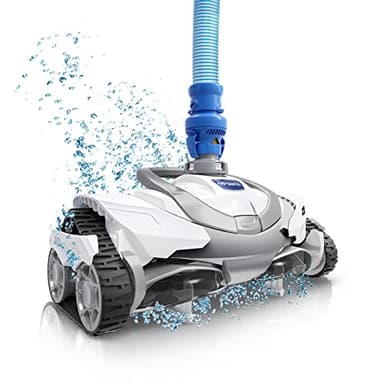
Pick 3 - Running off the existing skimmer line
Polaris MAXX Premium Suction-Side Automatic Pool Cleaner
Uses the pump you already have and sends every piece of debris through your filter, which is the whole trade.
The published figure
Suction-side; stated to clean from the floor to the waterline with active scrubbing brushes; HALO debris clearance; functions at lower flow rates; Regulator Valve controls excess flow
A suction-side cleaner needs no extra pump and no power outlet. It plugs into the skimmer and runs on the filtration you already pay to run.
Everything it picks up goes into the pump basket and the filter, so it shortens the interval between filter cleans considerably.
Polaris adds its own caveat: empty the pump and skimmer baskets and clean the filter regularly, because a restricted filter reduces cleaning power. That is the ongoing maintenance a suction cleaner asks for, stated by its maker.
What it does well
- No booster pump, no power outlet, no battery
- Stated to clean from the floor to the waterline, with active scrubbing brushes
What it costs you
- All debris passes through the pump basket and filter
- Reduces filtration flow while it runs
- Polaris states it is not for the first clean-up after construction, resurfacing or seasonal opening
Skip it if your pool collects a lot of leaves. Sending those through the filter is a worse problem than the one you were solving.
#ad · how this is funded · price as of October 18, 2026
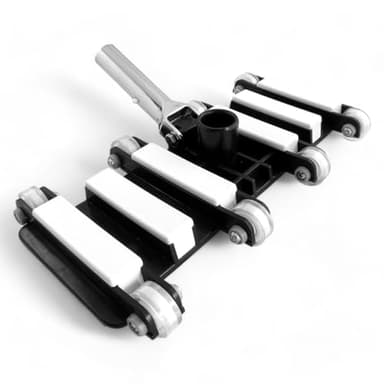
Pick 4 - Vinyl liners
FibroPool Pool Vacuum Head, weighted flexible, 14.4 in
Thermoplastic body and urethane wheels, which is the combination that does not mark a vinyl liner.
The published figure
14.4 in thermoplastic head with urethane wheels and a 1.5 in hose port
Metal-framed vacuum heads and hard plastic wheels are what put gray scuff lines on a light vinyl liner.
Urethane wheels are softer and do not transfer marks, which is why they cost more.
14.4 inches is narrower than the big kit heads, so it takes more passes but fits between steps and ladder legs.
What it does well
- Urethane wheels will not mark a vinyl liner
- Narrow enough for tight areas around steps
What it costs you
- Narrower means more passes on an open floor
- Hose sold separately
Skip it if you have a plaster pool and a wide open floor — a wider head is simply faster.
#ad · how this is funded · price as of October 18, 2026
Questions people actually ask
Is a robotic pool cleaner better than a manual vacuum?
Do I still need a manual vacuum if I have a robot?
Is a suction-side cleaner a good alternative to a robot?
What vacuum head do I need for a vinyl liner?
Sources
Every figure on this page traces to one of these. Where a number could not be sourced, the page says so rather than estimating.
Read next

Are Robotic Pool Cleaners Worth It?
The payback case, worked from hours saved and electricity used, plus the two situations where a robot is the wrong purchase.
Top pick
Dolphin Nautilus CC Plus Wi-Fi Robotic Pool Vacuum
In-ground pools up to 50 ft
#ad · how this is funded · price as of October 18, 2026

Best for heavy leaf loads
Best Pool Vacuum for Leaves
Garden-hose jet, battery, or the pool's own suction - each keeps a different part of your system out of the job.
Top pick
U.S. Pool Supply Professional Leaf Terminator Vacuum, 15 in
Heavy leaf loads on a garden hose
#ad · how this is funded · price as of October 18, 2026
What a Robotic Pool Cleaner Costs to Run
Electricity per cycle and per season, computed from published power draw, plus the consumables that cost more than the power does.
Top pick
Dolphin Nautilus CC Plus Wi-Fi Robotic Pool Vacuum
In-ground pools up to 50 ft
#ad · how this is funded · price as of October 18, 2026

Best for overnight clearing
Best Pool Flocculant
Four flocculants compared, plus the equipment check that decides whether you can use one at all.
Top pick
HTH Pool Care Drop Out Flocculant, 32 oz
Clearing a pool overnight
#ad · how this is funded · price as of October 18, 2026