Testing & Chemistry
Why Does My Pool Smell?
The smell everyone blames on too much chlorine is the smell of chlorine that has already been used up.

We have not handled these products and we do not pretend to have. Here is what we did instead. Links to Amazon earn us a commission at no extra cost to you, and commission never decides a pick — disclosure.
| # | Product | Best for | The spec it turns on | Price |
|---|---|---|---|---|
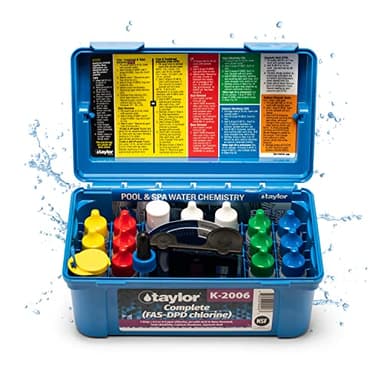
| 1 | 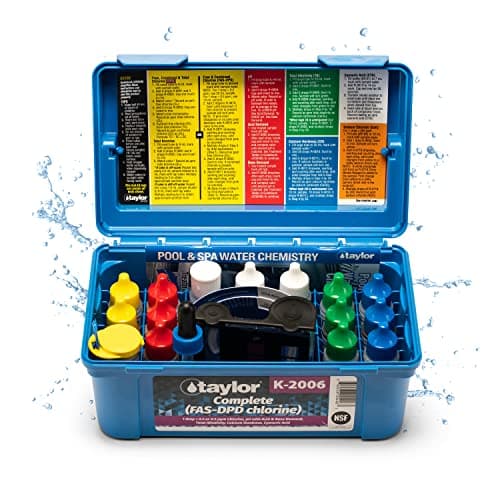 Taylor K-2006 Complete FAS-DPD Pool Test KitTop pickThe kit every pool forum names, and for once the consensus is right - because titration is the one chlorine method that does not saturate exactly when you need it. | The reference residential kit | FAS-DPD titration for free and combined chlorine, plus pH, acid and base demand, total alkalinity, calcium hardness and cyanuric acid; 3/4 oz reagents | |
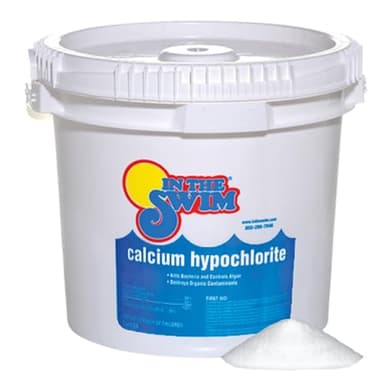
| 2 | 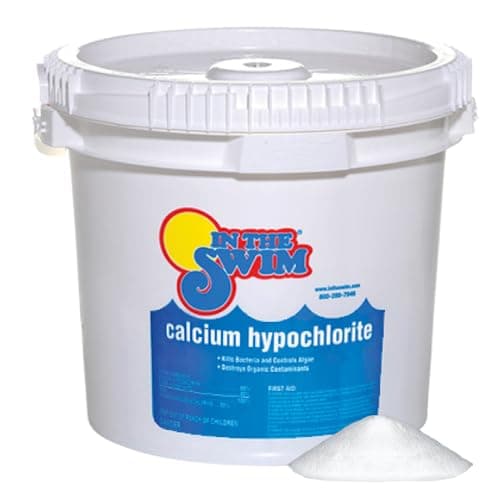 In The Swim Pool Shock, 68% Cal-Hypo Granular, 25 lbThe highest available-chlorine percentage in common retail cal-hypo, sold loose so you dose by weight instead of by packet. | Clearing an algae bloom | 68% available chlorine, calcium hypochlorite, sold loose by the pound | |
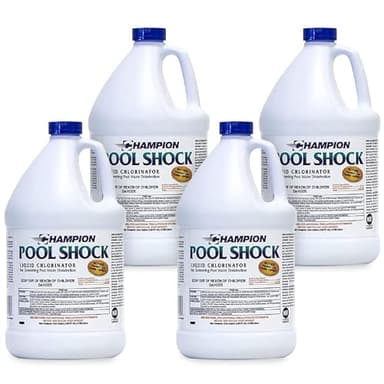
| 3 | 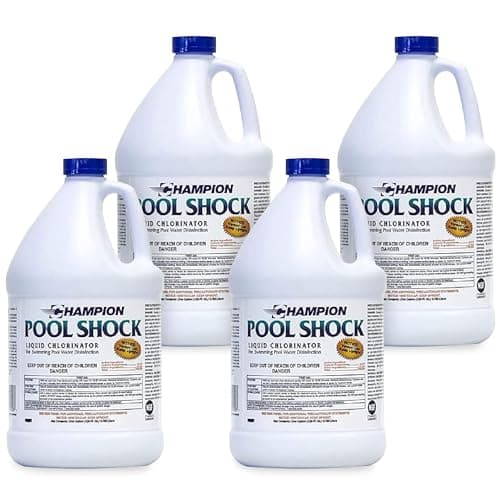 Champion Pool Shock Liquid Chlorine 12.5%, 1 gal, 4-packAdds nothing but chlorine and salt, which on a big bloom or a saltwater pool is exactly the point. | Large blooms and saltwater pools | 12.5% trade sodium hypochlorite, ready to use, no residue | |
| 4 |  In The Swim Chlorine-Free Pool Shock, 12 x 1 lb BagsAn oxidizer, not a sanitizer. It burns off the organic load that makes water dull without putting free chlorine where you then have to wait for it to fall. | Oxidizing between swims without raising free chlorine | Listing states a quick-dissolving chlorine-free shock-oxidizer that does not raise or alter pH, for standard chlorine, salt chlorinated, mineral and bromine pools, spas and hot tubs | |
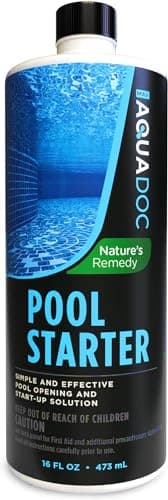
| 5 | 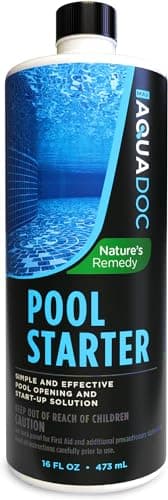 MAV AquaDoc Pool Opening Chemical, 16 oz enzymeNot a kit - one bottle that does the job shock does badly. Enzymes break down the oily film a closed pool grows, instead of burning chlorine on it. | The winter scum line a shock will not touch | Listing states a natural enzyme treatment for up to 15,000 gallons, compatible with cartridge, DE and sand filters and all sanitizers | |
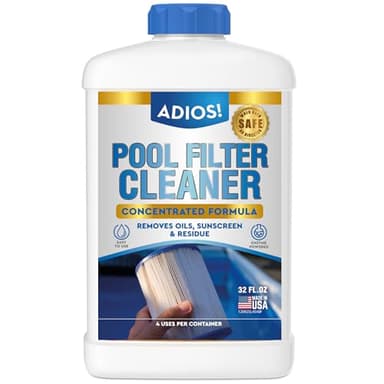
| 6 | 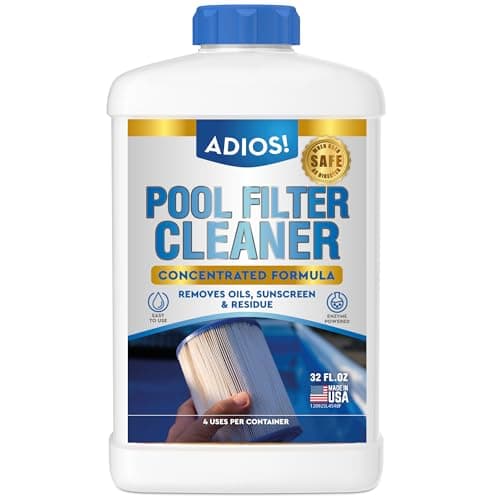 ADIOS! Pool Filter Cleaner, 4X Enzyme Soak, 32 ozThe small bottle of the same idea, for one cartridge rather than a season of them. | A single cartridge soak | 32 oz enzyme degreaser at 4X concentration, stated for cartridge, DE and sand media |
Two readings, not one
Most pool owners know one chlorine number. There are two, and the smell lives in the second one.
- Free chlorine is the chlorine still available to sanitize. This is the number you aim to keep between 1 and 4 ppm.
- Combined chlorine is chlorine that has already reacted with organic material - sweat, urine, sunscreen, skin oils. It is spent, it is a poor sanitizer, and it is what you can smell.
A pool with 1 ppm free chlorine and 1.5 ppm combined smells aggressive and sanitizes badly. A pool with 4 ppm free and almost no combined smells of almost nothing. That is the whole counterintuitive result, and it is why "there is too much chlorine in here" is usually the opposite of the truth.
What each smell points at
| What it smells like | Measure this first | Most likely cause | What addresses it |
|---|---|---|---|
| Sharp chlorine or bleach, stinging eyes | Combined chlorine | Chloramines from bather load | A shock dose, then holding free chlorine properly |
| Musty, earthy, pond-like | Free chlorine, then the filter | Organic load the filter is holding, or algae getting started | Clean the filter properly, shock, brush |
| Nothing much at all | Nothing - this is correct | Free chlorine holding, combined chlorine low | Keep doing what you are doing |
| Rotten eggs, sulfur, or anything metallic | Free chlorine, then the water at the hose | We could not source a pool-chemistry cause for this | See the section below - we are not going to invent one |
The chlorine smell, in detail
Chloramines form when free chlorine meets nitrogen compounds - which is most of what comes off a swimmer. The reaction is not a failure; it is chlorine doing its job. The problem is what is left behind: a compound that smells, irritates eyes, and no longer sanitizes.
The fix is a shock dose rather than a top-up. A small addition of chlorine to a pool full of chloramines makes more chloramine; a proper shock dose pushes past that and breaks them down. HTH's shock product page describes the result the way an owner experiences it - the product "kills bacteria, prevents algae, reduces chlorine odor, and restores clarity fast".
Work the dose out for your volume rather than by the bag - best pool shock carries the computed tables, and the same arithmetic in liquid form is on liquid chlorine vs granular shock. Then check how long before swimming, because a shock dose puts free chlorine above the safe swim range until it falls back.
One thing this page is not: an argument for a different sanitizer. Buying a mineral system or an ionizer to fix a smell caused by under-chlorination makes it worse, and chlorine alternatives covers why in full.
The musty smell, in detail
A musty or pond-like smell is a different animal: it points at organic material sitting somewhere the chlorine is not reaching, and the usual somewhere is the filter.
A cartridge loaded with body oil and sunscreen holds organic material in the one place every gallon of water passes through. Rinsing the pleats removes debris and leaves the oils; an enzyme soak removes the oils. That is the difference between a filter that looks clean and one that is clean - how to clean a pool filter runs through it.
If the smell comes with water that has lost its sparkle, treat it as early algae until proved otherwise: brush the walls, hold free chlorine at the top of the range for a few days, and read how to identify pool algae for what to look for in the shaded corners.
What we could not verify
Sulfur, rotten-egg, fishy and sweet smells are all discussed widely online with confident explanations attached. We could not find any of those explanations on a manufacturer label, in a published standard or in a government reference we were able to read, so we are not repeating them.
What we can say usefully: those reports almost always arrive alongside either a free chlorine reading of zero or fill water that has never been tested. Both are worth checking at the hose before anybody buys a product for a smell nobody can explain.
The picks
Top pick - The reference residential kit
Taylor K-2006 Complete FAS-DPD Pool Test Kit
The kit every pool forum names, and for once the consensus is right - because titration is the one chlorine method that does not saturate exactly when you need it.
The published figure
FAS-DPD titration for free and combined chlorine, plus pH, acid and base demand, total alkalinity, calcium hardness and cyanuric acid; 3/4 oz reagents
The chlorine test is FAS-DPD: you add reagent drop by drop until a pink sample turns clear, and count the drops. Each drop is a fixed amount of chlorine, so 20 ppm reads as more drops rather than as an impossible shade of pink. Every color-match method tops out around 5 ppm - the range you are in during a shock.
The other six tests are the same reagents as the cheaper K-2005. What you pay extra for is the chlorine method and nothing else.
The 3/4 oz reagent bottles are what separate it from the K-2006C. They run out in a season of frequent testing on one pool; the C's 2 oz bottles do not.
What it does well
- Reads chlorine accurately at shock levels, which no strip can
- Covers all seven residential parameters
- Reagents are sold individually, so the case lasts for years
What it costs you
- 3/4 oz bottles empty quickly if you test more than weekly
- A full run takes minutes rather than seconds
- Several times the price of a strip bottle
Skip it if you never shock and test once a week. A strip kit gets used, and this one might not.
#ad · how this is funded · price as of October 30, 2026
Pick 2 - Clearing an algae bloom
In The Swim Pool Shock, 68% Cal-Hypo Granular, 25 lb
The highest available-chlorine percentage in common retail cal-hypo, sold loose so you dose by weight instead of by packet.
The published figure
68% available chlorine, calcium hypochlorite, sold loose by the pound
68% available chlorine means 1 lb raises 10,000 gallons by about 8 ppm. A green pool typically needs 10 to 30 ppm depending on how far the bloom has gone, which is 1.2 to 3.7 lb per 10,000 gallons.
Loose granular is the format that lets you weigh a dose. Pre-measured 1 lb packets are convenient and fine for weekly maintenance, but they force you to round a shock dose to the nearest pound, which on a small pool is a 30% error.
Cal-hypo adds calcium hardness and no cyanuric acid. That is the right trade for a bloom and the wrong one for a pool that already sits above 400 ppm calcium.
What it does well
- 68% is the top of the common retail range, so you carry and store less product per ppm
- Loose granular lets you weigh an exact dose rather than round to a packet
- Adds no cyanuric acid, so shocking repeatedly does not drive you into chlorine lock
What it costs you
- Adds calcium hardness with every dose
- Must be pre-dissolved in a bucket for vinyl liners, which the label states
- A 25 lb bucket is more than a small pool will use in a season
Skip it if your fill water is already hard, or you own a small above-ground pool that will never work through 25 lb before the bucket cakes.
#ad · how this is funded · price as of October 30, 2026
Pick 3 - Large blooms and saltwater pools
Champion Pool Shock Liquid Chlorine 12.5%, 1 gal, 4-pack
Adds nothing but chlorine and salt, which on a big bloom or a saltwater pool is exactly the point.
The published figure
12.5% trade sodium hypochlorite, ready to use, no residue
12.5% trade means one gallon raises 10,000 gallons by 12.5 ppm. That identity makes it the easiest chemistry on this page to dose in your head, and it stops being easy the moment your pool is not 10,000 gallons — see the calculator below.
Liquid chlorine adds no calcium and no cyanuric acid. For a pool that is already hard, already stabilized, or salt-chlorinated, that is the whole argument.
It also degrades. Sodium hypochlorite loses strength in storage, faster when warm, so a jug that has sat in a hot garage since last summer is not 12.5% any more.
What it does well
- Adds no calcium and no cyanuric acid
- Dissolves instantly, no pre-mixing, no granules on the liner
- Cheapest route to a large ppm swing on a big pool
What it costs you
- Loses strength in storage, particularly in heat
- Heavy and awkward to handle at four gallons
- Raises pH, so expect to follow with acid
Skip it if you cannot store it cool and use it within a couple of months — you will be dosing an unknown percentage.

Pick 4 - Oxidizing between swims without raising free chlorine
In The Swim Chlorine-Free Pool Shock, 12 x 1 lb Bags
An oxidizer, not a sanitizer. It burns off the organic load that makes water dull without putting free chlorine where you then have to wait for it to fall.
The published figure
Listing states a quick-dissolving chlorine-free shock-oxidizer that does not raise or alter pH, for standard chlorine, salt chlorinated, mineral and bromine pools, spas and hot tubs
The useful property is in the name: no chlorine added means no wait for free chlorine to fall back into range before anyone swims.
It is not a substitute for chlorine. The listing calls it an oxidizer and says it enhances the effectiveness of the chlorine already in the pool, which is the correct framing.
Stated not to move pH, which matters because the common alternative, a cal-hypo shock, pushes pH up and needs an acid correction afterwards.
What it does well
- No free chlorine added, so no chlorine wait before swimming
- Stated not to raise or alter pH
- Pre-measured 1 lb bags, so dosing is by pool volume rather than by scoop
What it costs you
- Does not sanitize, and will not clear algae
- Not a substitute for the breakpoint chlorine dose that clears combined chlorine
- 12 bags is a season's commitment to a weekly habit
Skip it if the problem is a chlorine smell. That is combined chlorine, and the fix is more chlorine, not a chlorine-free oxidizer.
#ad · how this is funded · price as of October 30, 2026
Pick 5 - The winter scum line a shock will not touch
MAV AquaDoc Pool Opening Chemical, 16 oz enzyme
Not a kit - one bottle that does the job shock does badly. Enzymes break down the oily film a closed pool grows, instead of burning chlorine on it.
The published figure
Listing states a natural enzyme treatment for up to 15,000 gallons, compatible with cartridge, DE and sand filters and all sanitizers
AquaDoc states the product contains natural enzymes that break down non-living organic debris, and is sized for pools up to 15,000 gallons.
That is a genuinely different job from shocking. Chlorine will oxidize the oils and waterline film a covered pool accumulates over winter, but it spends a lot of itself doing it - which is why a pool can swallow shock at opening and still look dull.
It is stated to work with cartridge, DE and sand filters and with chlorine, bromine or saltwater sanitizing.
What it does well
- Targets the organic film rather than the chlorine demand
- Stated compatible with all three filter types and all sanitizers
- Cheapest single addition to an opening routine
What it costs you
- Not a kit - no shock, algaecide or sequestrant included
- Sized for 15,000 gallons per bottle
- Enzyme products publish no measurable result you can test for
Skip it if your pool was closed clean and covered tightly. There may be little organic film to break down.
#ad · how this is funded · price as of October 30, 2026
Pick 6 - A single cartridge soak
ADIOS! Pool Filter Cleaner, 4X Enzyme Soak, 32 oz
The small bottle of the same idea, for one cartridge rather than a season of them.
The published figure
32 oz enzyme degreaser at 4X concentration, stated for cartridge, DE and sand media
A single-element filter needs one soak at a time, and a 128 oz jug is a lot of shelf life to buy for that.
The concentration difference between the 4X and the 12X is exactly what it says, so compare on price per treatment rather than price per bottle.
Same limits as any enzyme soak: it dissolves oils, and it does nothing for torn pleats or a collapsed core.
What it does well
- Right size for a single-element housing
- Same enzyme chemistry as the larger bottle
What it costs you
- Worse value per treatment than the 12X if you have four elements
- Still an overnight job
Skip it if your housing takes four elements - buy the concentrate and save money per soak.
#ad · how this is funded · price as of October 30, 2026
Stopping it coming back
- Hold free chlorine in range continuously rather than catching up at weekends. Chloramine accumulates in the gap.
- Test combined chlorine monthly through the season, and after any heavy-use weekend.
- Shock after the pool has been busy, not on a fixed calendar date. The load is what creates the chloramine.
- Deep-clean the filter two or three times a season with an enzyme or degreasing cleaner, not just a hose rinse.
- Ask swimmers to shower first. Unglamorous, free, and it removes a surprising share of what becomes chloramine.
- Use a non-chlorine oxidizer between shocks if you want the organic load burned off without a chlorine level to wait out.
Questions people actually ask
Why does my pool smell like chlorine?
Does a strong chlorine smell mean too much chlorine?
How do I test for chloramines in a pool?
Will shocking the pool get rid of the smell?
My pool smells musty rather than of chlorine - what is that?
Can I swim in a pool that smells of chlorine?
Sources
Every figure on this page traces to one of these. Where a number could not be sourced, the page says so rather than estimating.
- Michigan EGLE, Maximum Disinfectant Residuals and Operational Ranges: Guidance for Michigan Licensed Pools (December 2025) - quotes CDC MAHC 5.7.3.1.1.5.0, the EPA FIFRA label rule and the NSF 10 ppm application ceiling
- HTH Pool Care Shock Advanced - product page, read 2026-10-30, states the product "kills bacteria, prevents algae, reduces chlorine odor, and restores clarity fast"
- Skim & Soak methodology - the constants, formulas and worked examples behind every dose on this site
- Taylor K-2006 FAS-DPD test kit - free and combined chlorine by titration - Amazon listing, read 2026-10-30
- In The Swim Chlorine-Free Pool Shock - oxidizer that adds no free chlorine - Amazon listing, read 2026-10-30
Read next

How Long After Adding Pool Chemicals Can You Swim?
Shock, algaecide, clarifier and oxidizer wait times taken from the labels themselves, plus the free chlorine figure that overrides all of them.
Top pick
Taylor K-2006 Complete FAS-DPD Pool Test Kit
The reference residential kit
#ad · how this is funded · price as of October 30, 2026

Best for green water
Best Pool Shock for a Green Pool
Cal-hypo, dichlor and liquid chlorine compared on available chlorine percentage, with a dose table computed for six pool sizes.
Top pick
In The Swim Pool Shock, 68% Cal-Hypo Granular, 25 lb
Clearing an algae bloom
#ad · how this is funded · price as of October 30, 2026

Best filter cleaners
How to Clean a Pool Filter
Debris and oils are two different problems needing two different treatments. Most people only ever do the first.
Top pick
ADIOS! Pool Filter Cleaner, 12X Enzyme Soak, 128 oz
Not buying a cartridge at all
#ad · how this is funded · price as of October 30, 2026

Best chlorine reducer
Chlorine Alternatives for Pools
Mineral systems, copper ionizers, UV and ozone compared on what each maker actually claims, including the asterisks, plus the copper staining risk nobody advertises.
Top pick
Nature2 Express Mineral Sanitization System
An in-line mineral system on an existing pool
#ad · how this is funded · price as of October 30, 2026

Best test kit
Best Pool Test Kits
Titration kits, color comparators, strips and a photometer compared on precision, speed and what each one cannot see.
Top pick
AquaChek Select Connect 7-Way Test Strips, complete kit
Weekly testing you will actually do
#ad · how this is funded · price as of October 30, 2026