Cloudy Water
Best Pool Filter Sand and Media
Your filter was designed around one grade of sand. Everything else sold to go in it is a substitution, and each one trades something.
We have not handled these products and we do not pretend to have. Here is what we did instead. Links to Amazon earn us a commission at no extra cost to you, and commission never decides a pick — disclosure.
| # | Product | Best for | The spec it turns on | Price |
|---|---|---|---|---|
| 1 | 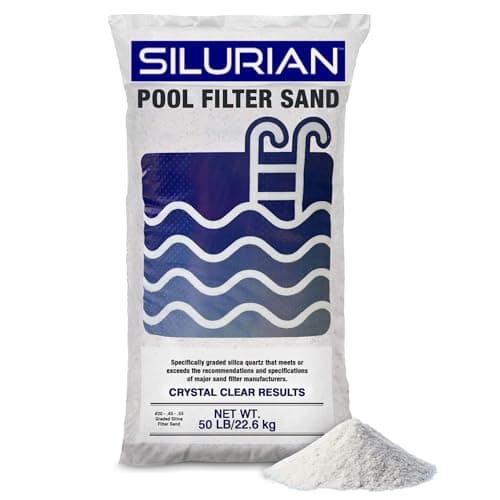 U.S. Silica Silurian 20 Grade Angular Pool Filter Sand, 50 lbTop pickThe only sand here that prints the number that matters. #20 grade at 0.40-0.55 mm is the standard every sand filter is designed around. | The one bag that publishes its grain size | Listing states 20-grade silica with 0.40-0.55 mm grains, precision-screened and angular | |
| 2 | 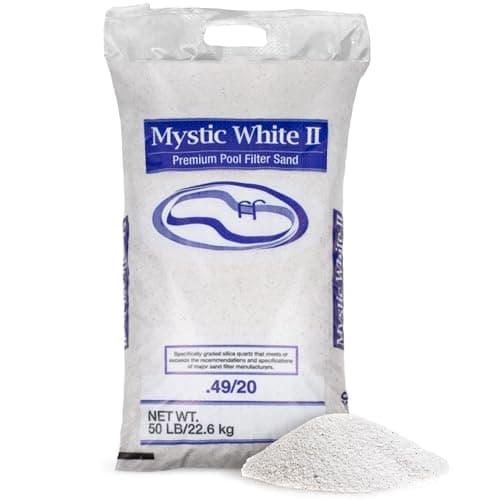 U.S. Silica Mystic White II Pool Filter Sand, 50 lbA named grade from a silica producer rather than a repackaged bag, which is the only quality signal available in this category. | A named, graded silica | 50 lb washed and screened silica, sold under a specific product grade rather than as generic sand | |
| 3 | 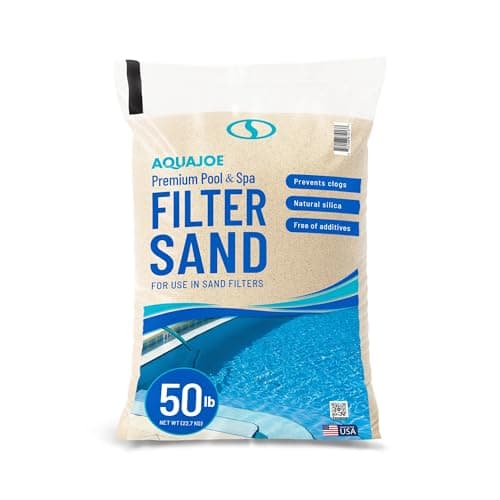 Aqua Joe Premium Pool & Spa Filter Sand, 50 lb, FLTSAND50Sand is the cheapest filter medium to run and the one most often left in far too long. | Recharging a sand filter | 50 lb bag of natural silica sand, stated for above-ground and in-ground filter systems | |
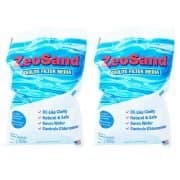
| 4 | 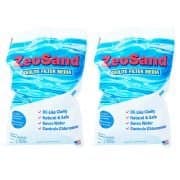 ZeoSand ZeoSand Filter Media, 50 lbZeolite with the clearest equivalence claim here: half the weight for the same filter. The trade is a price per bag well above silica. | Halving the weight of a media change | Listing states 50 lb replaces 100 lb of sand, lasts up to 5 years, and decreases backwash times | |
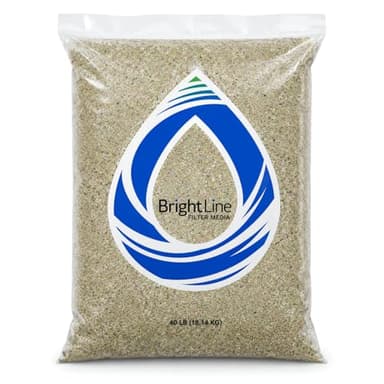
| 5 | 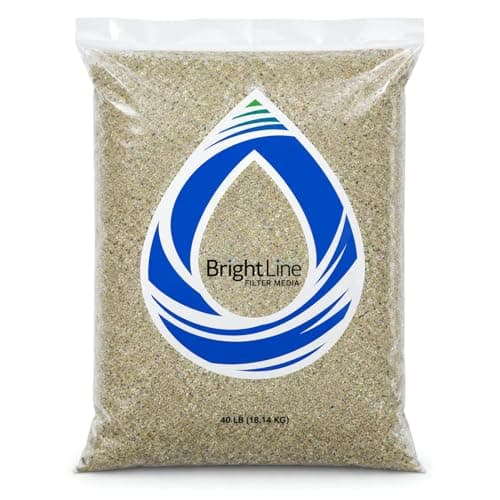 Harsco Metals & Minerals Filter Glass Media, 40 lbRecycled glass that goes into the same tank as sand and, per the listing, needs less of it by weight. The filtration claims are softer than the marketing around glass suggests. | Less weight in the tank than sand | Listing states 100% recycled glass and that it uses less material by weight than sand | |
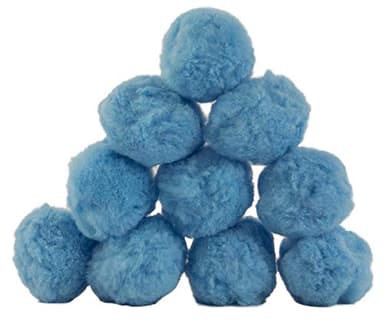
| 6 | 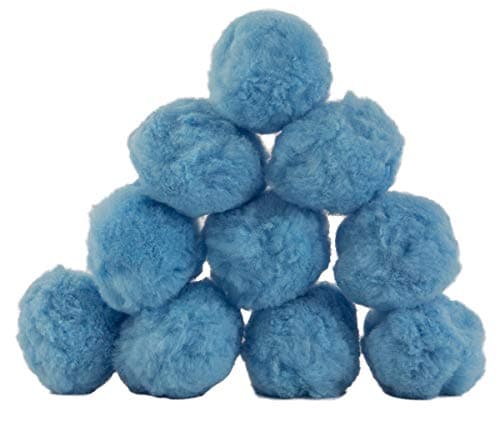 Rx Clear Blue Luster Filter MediaA box of polyethylene fibers that replaces a filter's worth of sand and publishes a 3-5 micron figure. The most interesting claim on this page, with the least independent confirmation. | The lightest media, and the finest published figure | Listing states 1.5 lb replaces 50 lb of sand, filters to 3-5 microns, 100% polyethylene, washable | |
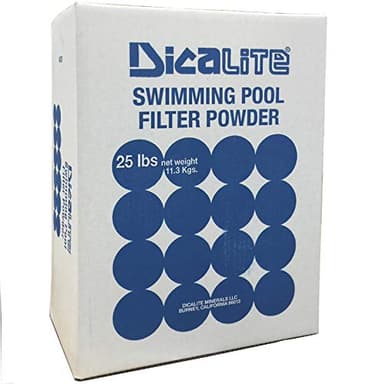
| 7 | 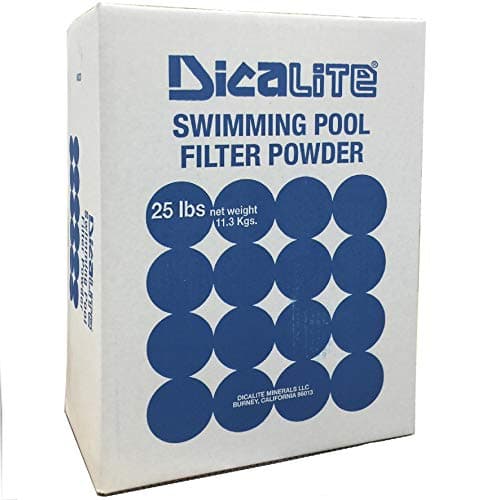 EasyGo Products Dicalite Minerals DE25BOX Diatomaceous Earth, 25 lbThe bulk box for a DE filter. If you own one, this is a consumable rather than a choice - you recharge after every backwash. | Recharging a DE filter | Listing states all-natural DE media for above-ground and inground DE filter systems, 25 lb | |
| 8 | 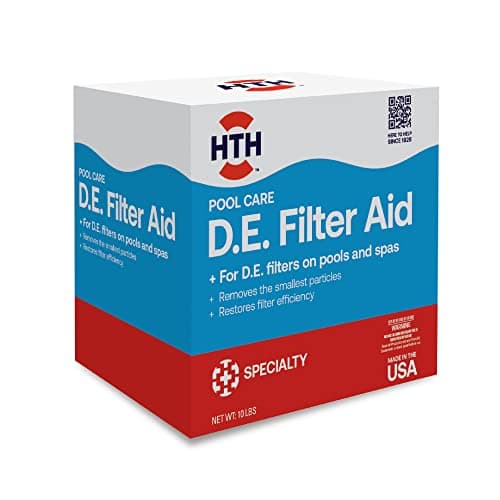 HTH Pool Care D.E. Filter Aid, 10 lbThe only media on this page with a micron range from a major brand: 2 to 6 microns. It is also usable as a filter aid in a sand filter, not only in a DE unit. | A published micron figure | Listing states removal of particles as small as 2-6 microns and compatibility with saltwater systems |
The grade is the specification, and most bags hide it
Sand filters work because water forced through a bed of angular grains has to take a twisting path, and dirt gets caught in the turns. The size of those grains decides both how fine the filtration is and how freely water moves. Too coarse and dirt passes; too fine and flow collapses and the filter channels.
The industry answer is #20 silica, and U.S. Silica's Silurian bag is the only one on this page that prints what that means: 0.40 to 0.55 mm grains, precision-screened. Every other sand bag here describes itself as premium, pre-washed or high-purity without publishing the one number the filter cares about.
How we compared them
- What the listing publishes. Grain size, micron rating or an equivalence claim against sand - anything that can be checked rather than felt.
- What it costs you to install. Media is sold by weight and you carry every pound of it. A media that needs half the weight is a genuinely different job.
- What it does to backwashing. Every backwash sends heated, chemically balanced water down the drain, so a media that needs fewer of them saves more than water.
- Whether your filter can take it. Sand, glass, zeolite and fiber media all go in a sand tank. DE does not - it needs a DE filter with grids.
We have not run comparative filtration tests, and nobody selling media at this price has published one either. Where a maker states a figure we quote it and name the maker; where nothing is published we say so rather than repeating the folklore.
What each bag states
| Media | What the listing states | Filter type | Equivalence |
|---|---|---|---|
| U.S. Silica Silurian 20 | 0.40-0.55 mm grains, angular, chemically inert | Sand | - |
| U.S. Silica Mystic White II | High-purity white silica, consistent grain, angular | Sand | - |
| Aqua Joe Premium | Pre-washed, kiln-dried natural silica | Sand | - |
| ZeoSand | Lasts up to 5 years, decreases backwash times | Sand tank | 50 lb replaces 100 lb of sand |
| Harsco Filter Glass | 100% recycled glass, helps capture fine debris | Sand tank | Uses less material by weight |
| Rx Clear Blue Luster | Filters to 3-5 microns, machine washable | Sand tank | 1.5 lb replaces 50 lb of sand |
| Dicalite DE | All-natural DE media, no clumping | DE only | - |
| HTH D.E. Filter Aid | Removes particles as small as 2-6 microns | DE, or as an aid | - |
Read the equivalence column and the physical work of a media change separates the group immediately. A filter that takes 300 lb of sand takes six bags; the same tank on zeolite takes three, and on fiber media a couple of boxes you carry in one hand.
What sand actually filters, and what that means for clarity
Sand catches down to roughly 20 to 40 microns. A cartridge filter reaches about 10 to 20, and DE about 5. That ranking is why a sand-filtered pool is the one most likely to look faintly hazy after a bloom, and why clarifiers exist - they clump fine particles into something a sand bed can hold.
It also sets expectations for the fine media on this page. Rx Clear states 3 to 5 microns for its fiber media, which would put a sand tank in DE territory. That is the maker's own figure with no standard behind it, and fiber media is measured inconsistently across the category - so treat it as a claim worth trying rather than a specification you can bank.
If haze rather than debris is your actual complaint, the fix may not be media at all: why is my pool cloudy works through the causes in order, and best pool clarifier covers the chemical route.
How much media your filter needs
Filters state their sand charge in pounds, and it is printed on the label or in the manual. If yours is missing, the tank diameter is the usual guide - but the manual figure always wins, because it accounts for the freeboard the backwash needs.
The weight difference is not a trivia point. Replacing 300 lb of wet sand means scooping it out of a tank by hand, usually with a plastic cup, and every pound you take out is a pound you carry to the curb.
Glass and zeolite: what actually changes
Both are drop-in substitutes for sand in the same filter, and both are sold on being better than sand. Read the listings closely and the claims are narrower than the marketing around them.
- Glass. Harsco states 100% recycled glass, compatible with most standard sand tanks, and that it uses less material by weight. On filtration the wording is hedged - 'engineered to help capture fine debris' and 'may require less frequent replacement'. No micron figure is published.
- Zeolite. ZeoSand states 50 lb replaces 100 lb of sand, lasts up to five years, catches more particulate than sand and decreases backwash times. The equivalence and the backwash claim are the concrete parts; 'more particulate' is not quantified.
- Fiber media. Rx Clear states 3-5 microns, 1.5 lb per 50 lb of sand, washable and reusable for several seasons. The boldest claim and the lightest product.
None of the three asks you to change equipment, which is their real appeal. If your sand is due for replacement anyway, the incremental cost of trying glass or zeolite is the price difference per bag, not the price of a filter.
DE is not an upgrade you pour in
Diatomaceous earth filters finest of the three common types, and both DE products here are consumables for a DE filter rather than media for a sand one. A DE filter coats its grids with powder; every backwash strips that coating and the filter has to be recharged.
HTH's filter aid is the exception worth knowing about: it states removal of particles as small as 2 to 6 microns and is sold as an aid, which is also how a small dose is sometimes used to sharpen a sand filter temporarily. Whether that suits your filter is a question for its manual, not for us - some makers explicitly rule it out.
The three filter types and what each is good at are compared in full on sand filter vs cartridge.
The picks
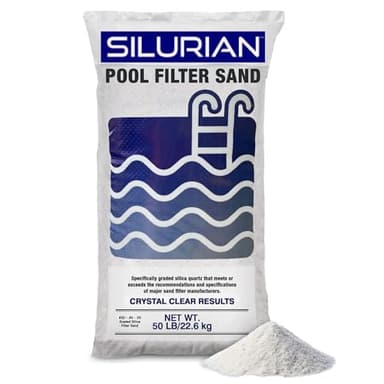
Top pick - The one bag that publishes its grain size
U.S. Silica Silurian 20 Grade Angular Pool Filter Sand, 50 lb
The only sand here that prints the number that matters. #20 grade at 0.40-0.55 mm is the standard every sand filter is designed around.
The published figure
Listing states 20-grade silica with 0.40-0.55 mm grains, precision-screened and angular
U.S. Silica states 0.40 to 0.55 mm grains, precision-screened and angular. That range is what a sand filter's laterals and flow rates assume, and it is the one specification worth checking before you buy 300 lb of anything.
The listing states the angular particles create a dense bed that reduces channeling - water cutting a path through the media instead of filtering through it, which is what makes an old bed stop working.
It also states the media is chemically inert and will not affect water chemistry or sanitizer performance. That matters when you are comparing it against glass and zeolite, both of which make stronger claims.
What it does well
- States the grain size, 0.40-0.55 mm, which nothing else here does
- Angular grain stated to reduce channeling
- Stated chemically inert, so it changes no other reading
What it costs you
- Sand filters down to roughly 20-40 microns, coarser than DE or a fiber media
- 50 lb bags are heavy and most filters need several
- Needs replacing every few years as grains round off
Skip it if your filter is a cartridge or DE unit. Sand only goes in a sand filter.
#ad · how this is funded · price as of October 9, 2026
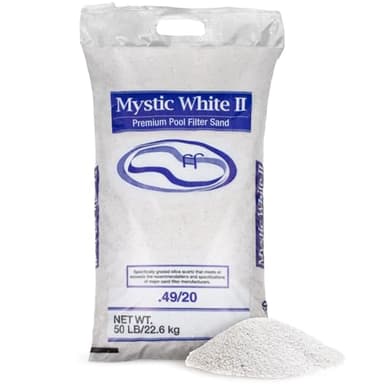
Pick 2 - A named, graded silica
U.S. Silica Mystic White II Pool Filter Sand, 50 lb
A named grade from a silica producer rather than a repackaged bag, which is the only quality signal available in this category.
The published figure
50 lb washed and screened silica, sold under a specific product grade rather than as generic sand
Grain size and consistency are what decide how well sand filters, and almost nobody publishes either. Buying a named grade from a company whose actual business is silica is the closest thing to a specification here.
Washed and screened matters: unwashed sand releases fines into the pool for days after a change, which reads as a filter that made the water worse.
Same capacity check as any sand - read the figure on your housing label before ordering.
What it does well
- Named product grade from a silica producer, not generic repackaging
- Washed and screened, so far less fines carryover on start-up
What it costs you
- Costs more than a commodity bag
- Same 20-40 micron ceiling as all sand
Skip it if you are on a budget and changing a large filter - the commodity bags filter the same.
#ad · how this is funded · price as of October 9, 2026
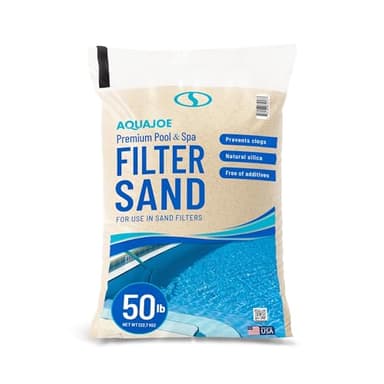
Pick 3 - Recharging a sand filter
Aqua Joe Premium Pool & Spa Filter Sand, 50 lb, FLTSAND50
Sand is the cheapest filter medium to run and the one most often left in far too long.
The published figure
50 lb bag of natural silica sand, stated for above-ground and in-ground filter systems
Sand filters work because the grains have sharp edges that trap debris. Over three to five years those edges round off and channel, so water runs through the same worn paths and filtration quality falls without the pressure gauge changing much.
That slow, invisible decline is why a sand pool can be chemically perfect and still hazy. Replacing the sand is the fix, and it costs less than a season of clarifier.
Check your filter's stated sand capacity before ordering - it is on the housing label, and it is usually between 100 and 350 lb, so one bag is rarely the whole job.
What it does well
- Cheapest filter medium per season by a wide margin
- Natural silica, which is what the great majority of sand filters specify
- Nothing to fit - it pours in
What it costs you
- Only filters to roughly 20-40 micron, the coarsest of the three filter types
- Heavy, and changing it is a genuinely unpleasant job
- One bag rarely fills a housing - check the stated capacity
Skip it if your filter takes cartridges or DE grids. Sand is not interchangeable with either.
#ad · how this is funded · price as of October 9, 2026
Pick 4 - Halving the weight of a media change
ZeoSand ZeoSand Filter Media, 50 lb
Zeolite with the clearest equivalence claim here: half the weight for the same filter. The trade is a price per bag well above silica.
The published figure
Listing states 50 lb replaces 100 lb of sand, lasts up to 5 years, and decreases backwash times
ZeoSand states that 50 lb of its media is equivalent to 100 lb of sand, which halves both the bags you carry and the bags you buy for a given filter.
It also states the media lasts up to five years, catches more particulate than sand, and decreases backwash times. Less backwashing is water and heat you do not throw away.
The listing publishes no micron rating, so 'catches more particulate than sand' is a comparison without a number attached.
What it does well
- Stated 1:2 equivalence against sand by weight
- Stated up to five years of service life
- Stated to reduce backwash times
What it costs you
- No micron figure published
- Costs noticeably more per bag than silica
- Sold through a third-party pool retailer, so delivery times vary
Skip it if you replace media rarely and buy on price. Silica sand does the same job for less.
#ad · how this is funded · price as of October 9, 2026
Pick 5 - Less weight in the tank than sand
Harsco Metals & Minerals Filter Glass Media, 40 lb
Recycled glass that goes into the same tank as sand and, per the listing, needs less of it by weight. The filtration claims are softer than the marketing around glass suggests.
The published figure
Listing states 100% recycled glass and that it uses less material by weight than sand
Harsco states 100% recycled glass, compatible with most standard sand filter tanks, and that it uses less material by weight than traditional sand - which is the practical win, because it is fewer heavy bags to carry and lift.
On filtration the listing is carefully worded: it is 'engineered to help capture fine debris and suspended particles' and 'may require less frequent replacement' than sand. Those are hedged claims, not published micron figures, and we are not going to sharpen them up on Harsco's behalf.
Glass media is a drop-in swap for sand in the same filter, so this is a change of media rather than a change of equipment.
What it does well
- Stated 100% recycled glass
- Stated to need less material by weight than sand
- Drop-in replacement for sand in the same tank
What it costs you
- No micron rating published, only hedged 'helps capture' language
- Costs more per bag than silica sand
- 40 lb bags, so the math against a sand-rated filter needs doing
Skip it if you want a published filtration figure. Nothing on this listing gives one.
#ad · how this is funded · price as of October 9, 2026
Pick 6 - The lightest media, and the finest published figure
Rx Clear Blue Luster Filter Media
A box of polyethylene fibers that replaces a filter's worth of sand and publishes a 3-5 micron figure. The most interesting claim on this page, with the least independent confirmation.
The published figure
Listing states 1.5 lb replaces 50 lb of sand, filters to 3-5 microns, 100% polyethylene, washable
Rx Clear states one 1.5 lb box equals 50 lb of sand and filters down to 3 to 5 microns. If that holds in your filter it is finer than sand and in DE territory, from a box you can lift with one hand.
The listing states the fibers are machine washable and reusable for several seasons, and that they require less backwashing than sand because they do not clog the same way.
Treat the micron figure as the maker's claim. Fiber media is measured differently by different sellers, and nothing here is independently tested.
What it does well
- States a 3-5 micron filtration figure
- 1.5 lb replaces a stated 50 lb of sand
- Machine washable and reusable
What it costs you
- Micron claim is the maker's own, with no standard behind it
- Fiber media can compact and need rinsing more often than expected
- Not what your filter's manual assumes
Skip it if you want the media your filter was designed around. That is graded silica sand.
#ad · how this is funded · price as of October 9, 2026
Pick 7 - Recharging a DE filter
EasyGo Products Dicalite Minerals DE25BOX Diatomaceous Earth, 25 lb
The bulk box for a DE filter. If you own one, this is a consumable rather than a choice - you recharge after every backwash.
The published figure
Listing states all-natural DE media for above-ground and inground DE filter systems, 25 lb
The listing states all-natural filtering media for DE swimming pool filters, above ground or inground, and that it leaves water clear without clumping.
A DE filter is the finest of the three common filter types, and the reason is the media: DE coats the grids and traps particles far smaller than sand catches.
Buying in a 25 lb box matters because DE is not a one-time fill. Every backwash washes the coating out and the filter needs recharging.
What it does well
- 25 lb box suits a filter that is recharged all season
- Stated for both above-ground and inground DE systems
- Sold and shipped by Amazon, so it arrives predictably
What it costs you
- Only usable in a DE filter
- DE dust needs care when handling and mixing
- Recharging after every backwash is an ongoing job sand does not have
Skip it if your filter is sand or cartridge. DE has nowhere to go in either.
#ad · how this is funded · price as of October 9, 2026
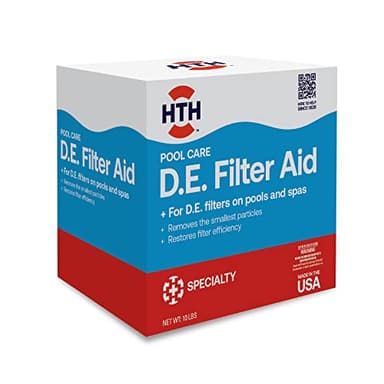
Pick 8 - A published micron figure
HTH Pool Care D.E. Filter Aid, 10 lb
The only media on this page with a micron range from a major brand: 2 to 6 microns. It is also usable as a filter aid in a sand filter, not only in a DE unit.
The published figure
Listing states removal of particles as small as 2-6 microns and compatibility with saltwater systems
HTH states it removes particles as small as 2 to 6 microns and restores filter efficiency. That is the finest published figure here, and it explains why DE is the filter type people reach for after an algae bloom.
The listing states it suits all DE filters on pools and spas and is compatible with saltwater systems.
It is sold as a filter aid, which is also how a small dose is used to sharpen a sand filter temporarily. Check your filter's manual before adding anything a sand filter was not designed for.
What it does well
- States a 2-6 micron removal range
- Stated compatible with saltwater systems
- 10 lb is a sensible size for occasional use
What it costs you
- Costs far more per pound than bulk DE
- Still a consumable that washes out on every backwash
- Adding it to a sand filter is a manual-dependent decision
Skip it if you run a DE filter all season. Buy the 25 lb box and save the difference.
#ad · how this is funded · price as of October 9, 2026
Changing media without making it worse
- Backwash, then switch the pump off at the breaker and release the pressure at the air relief valve before opening anything.
- Tape over the standpipe. Sand poured down the open pipe lands in the laterals and ends up in the pool, which is the single most common way a media change goes wrong.
- Scoop the old media out, and inspect the laterals at the bottom while the tank is empty. A cracked lateral sends media into the pool no matter what you fill it with.
- Half-fill the tank with water first, then add media slowly. Water cushions the fall and protects the laterals.
- Fill to the level the manual states, not to the top. The space above the bed is what lets the media lift and clean itself on a backwash.
- Backwash the new media until the sight glass runs clear before you filter to the pool. New sand carries fines that will otherwise end up in the water.
When to replace rather than clean
Sand grains wear round over years of backwashing, and rounded grains filter worse and channel more. The usual signs are a filter that needs backwashing constantly, a pressure gauge that climbs again within days, or water that will not clear even with the chemistry right.
Before replacing media, rule out the cheaper causes: a dirty filter that needs a deep clean rather than a backwash, or a chemistry problem wearing the mask of a filtration one. How to clean a pool filter covers the first, and the dose tables on how to balance pool water cover the second.
Questions people actually ask
What kind of sand goes in a pool filter?
How much sand does a pool filter take?
Is glass filter media better than sand?
How often should pool filter sand be replaced?
Can I put DE in a sand filter?
What micron does a sand filter catch?
Sources
Every figure on this page traces to one of these. Where a number could not be sourced, the page says so rather than estimating.
- Skim & Soak methodology - the constants, formulas and worked examples behind every dose on this site
- U.S. Silica Silurian 20 Grade Angular Pool Filter Sand, 0.40-0.55 mm, 50 lb - Amazon listing, read 2026-09-20
- U.S. Silica Mystic White II Premium Pool Filter Sand, 50 lb - Amazon listing, read 2026-09-20
- Aqua Joe Premium Pool & Spa Filter Sand, pre-washed and kiln-dried, 50 lb - Amazon listing, read 2026-09-20
- ZeoSand Filter Media, 50 lb stated to replace 100 lb of sand - Amazon listing, read 2026-09-20
- Harsco Filter Glass, 100% recycled glass media, 40 lb - Amazon listing, read 2026-09-20
- Rx Clear Blue Luster Filter Media, stated 3-5 micron, 1.5 lb per 50 lb of sand - Amazon listing, read 2026-09-20
- Dicalite Minerals DE25BOX Diatomaceous Earth Pool Filter DE, 25 lb - Amazon listing, read 2026-09-20
- HTH D.E. Filter Aid, stated 2-6 micron removal, 10 lb - Amazon listing, read 2026-09-20
Read next
Sand Filter vs Cartridge Filter
Sand backwashes and filters coarse; cartridge filters fine and needs hand cleaning. Water cost and effort decide it.
Top pick
POOLPURE CCP420 Pool Filter Cartridge, 4-pack
Pentair Clean & Clear Plus 420
Best filter cleaners
How to Clean a Pool Filter
Debris and oils are two different problems needing two different treatments. Most people only ever do the first.
Top pick
ADIOS! Pool Filter Cleaner, 12X Enzyme Soak, 128 oz
Not buying a cartridge at all
#ad · how this is funded · price as of October 9, 2026
Best filter cartridges
Best Pool Filter Cartridges
Cartridges compared by part number, element count and filter area, plus the soak that often replaces the purchase.
Top pick
POOLPURE CCP420 Pool Filter Cartridge, 4-pack
Pentair Clean & Clear Plus 420
Why Is My Pool Cloudy?
Check filtration, then chemistry, then everything else. Two of the six causes get worse if you add a chemical first.
Best for cloudy water
Best Pool Clarifier
Polymer clarifiers for silt and dead algae, chitosan for oils and sunscreen, matched to sand and cartridge filters.
Top pick
Clorox Pool&Spa Super Water Clarifier, 1 quart
Sand filters