Cloudy Water
Sand Filter vs Cartridge Filter
One filters twice as fine. The other cleans itself in two minutes. That is genuinely the whole trade.
We have not handled these products and we do not pretend to have. Here is what we did instead. Links to Amazon earn us a commission at no extra cost to you, and commission never decides a pick — disclosure.
| # | Product | Best for | The spec it turns on | Price |
|---|---|---|---|---|
| 1 | 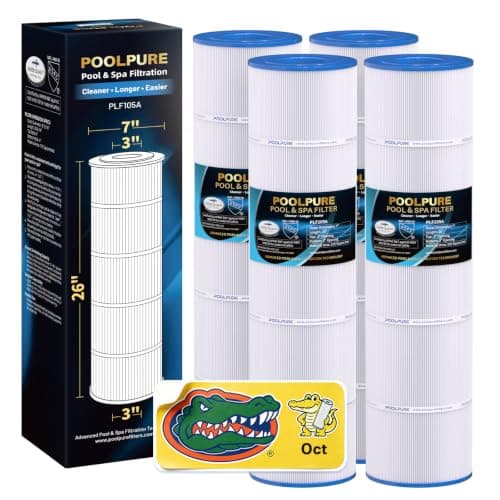 POOLPURE CCP420 Pool Filter Cartridge, 4-packTop pickA full four-cartridge set for a common in-ground filter, at a fraction of the price of the branded originals. | Pentair Clean & Clear Plus 420 | Four-cartridge set for the Pentair CCP420, replacing R173576 and PCC105 | |
| 2 | 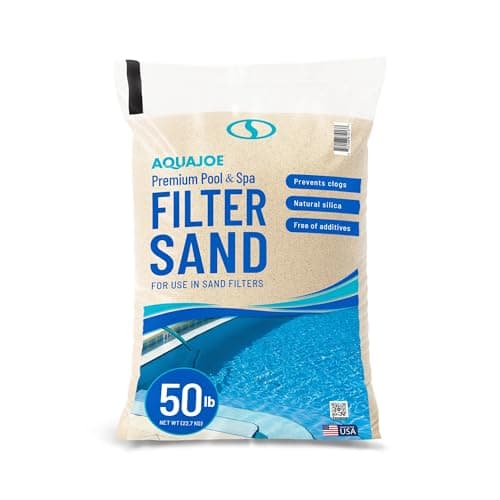 Aqua Joe Premium Pool & Spa Filter Sand, 50 lb, FLTSAND50Sand is the cheapest filter medium to run and the one most often left in far too long. | Recharging a sand filter | 50 lb bag of natural silica sand, stated for above-ground and in-ground filter systems | |
| 3 | 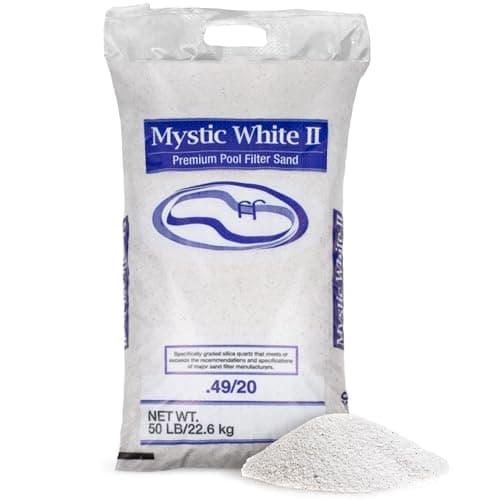 U.S. Silica Mystic White II Pool Filter Sand, 50 lbA named grade from a silica producer rather than a repackaged bag, which is the only quality signal available in this category. | A named, graded silica | 50 lb washed and screened silica, sold under a specific product grade rather than as generic sand | |
| 4 | 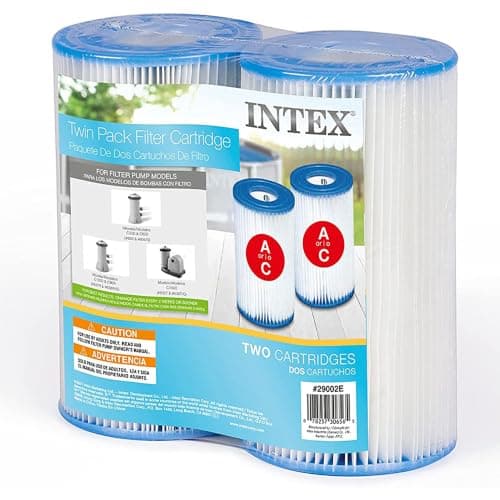 INTEX 29002E Type A Pool Filter CartridgeThe consumable that decides whether an above-ground pool ever clears, and the one people run for far too long. | Above-ground filter pumps | Dacron paper cartridge for Intex filter pumps | |
| 5 | 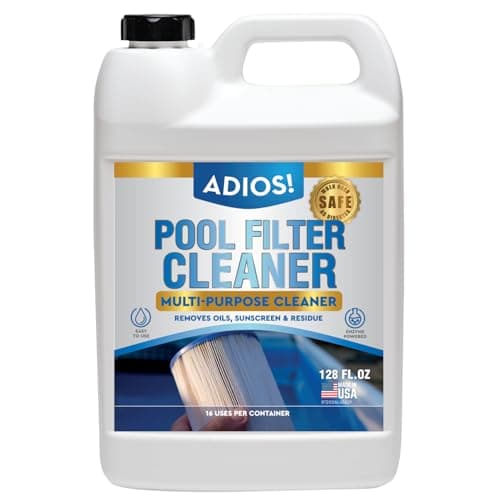 ADIOS! Pool Filter Cleaner, 12X Enzyme Soak, 128 ozOften the correct purchase instead of a cartridge, because the most common reason a cartridge stops working is grease rather than wear. | Not buying a cartridge at all | Liquid enzyme degreaser soak, stated by the maker for cartridge, DE and sand media |
The comparison
| Sand | Cartridge | |
|---|---|---|
| Filters down to | Roughly 20-40 micron | Roughly 10-20 micron |
| Cleaning | Backwash, about two minutes | Remove, rinse, sometimes soak, by hand |
| Water lost per clean | Hundreds of gallons | None |
| Consumable | Sand, every 3-5 years | Elements, every 1-3 seasons |
| Consumable cost | Low | Moderate to high |
| Up-front cost | Usually lower | Usually higher |
| Pressure at which you clean | 8-10 psi over clean | 8-10 psi over clean |
| Effort per season | Least | More, and it is hands-on |
| Needs a multiport valve | Yes | No |
| Can vacuum to waste | Yes | Usually not |
The micron difference, and what it buys
Sand traps particles because the grains have sharp edges and irregular gaps - which is why the grade matters, and why the media you refill with is worth choosing rather than grabbing. That gets you to roughly 20 to 40 micron. A pleated cartridge is a physical barrier with a defined pore size, which gets to roughly 10 to 20.
Doubling the fineness matters in one specific way: it decides how much a clarifier has to do. A clarifier's job is to clump fine particles until they cross your filter's threshold, so a coarser filter needs more help more often. Sand pools use clarifier routinely; cartridge pools often never buy it.
The water cost nobody puts in the comparison
Backwashing a sand filter sends hundreds of gallons of pool water to the drain, and you refill and rebalance what you sent away. Do that every few weeks through a season and it is a real number on a metered supply - plus the chemicals to rebalance the fresh water.
A cartridge filter loses nothing. You rinse it with a hose, which uses far less than a backwash cycle, and the pool level never drops.
In a region with water restrictions this is frequently the deciding factor, and it rarely appears in the sales conversation.
The effort cost nobody puts in it either
Backwashing is turning a handle for two minutes. Cleaning a cartridge is shutting the pump down, opening a housing, lifting out wet elements, rinsing each one between the pleats, and reassembling - and on a four-element filter that is a genuine job.
Honest framing: sand asks less of you and delivers less; cartridge asks more and delivers more. People who choose cartridge and then do not clean it end up with worse water than a sand pool, because a neglected cartridge bypasses at the seal and filters almost nothing.
What about DE?
There is a third option this comparison leaves out. DE filters use diatomaceous earth over grids and reach roughly 3 to 5 micron - finer than either of these, and the reason a DE pool can look almost distilled. (A sand filter has one failure mode neither of the others shares: a cracked lateral pumps its own sand into the pool, diagnosed on best pool vacuum for sand.)
The costs are proportionate: powder to recharge after every backwash, powder to handle and dispose of, and the most maintenance of the three. We do not have a DE page yet and are not going to summarize one in a paragraph.
Choose sand if
- You want the lowest-effort option and will accept a clarifier now and then
- Water is cheap where you are and backwashing is not a cost you feel
- You want to be able to vacuum to waste, which needs the multiport valve sand filters come with
- Your pool collects a lot of debris - sand tolerates heavy loading better than pleats do
Choose cartridge if
- You pay for water, or live somewhere with restrictions
- Your pool clouds easily and you are tired of buying clarifier
- You do not mind a hands-on clean every few weeks
- Space is tight - cartridge housings are smaller and need no backwash line
The picks
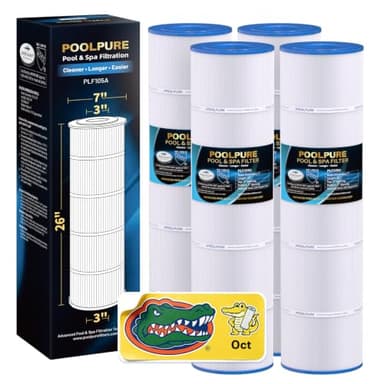
Top pick - Pentair Clean & Clear Plus 420
POOLPURE CCP420 Pool Filter Cartridge, 4-pack
A full four-cartridge set for a common in-ground filter, at a fraction of the price of the branded originals.
The published figure
Four-cartridge set for the Pentair CCP420, replacing R173576 and PCC105
Large cartridge filters use a set of four elements, and replacing one at a time creates uneven flow through the housing. Buy the set.
Compatibility is by part number, not by model name. Check the number molded into your existing cartridge against the listing before ordering.
A tired cartridge set is one of the most common reasons a chemically balanced pool still looks hazy.
What it does well
- Complete set, so the housing loads evenly
- Substantially cheaper than the original-brand equivalents
- Cross-references the original part numbers
What it costs you
- Fitment is by part number and mistakes are easy to make
- Aftermarket media life varies by batch
Skip it if your part number does not match. A near-fit cartridge bypasses water around its edge.
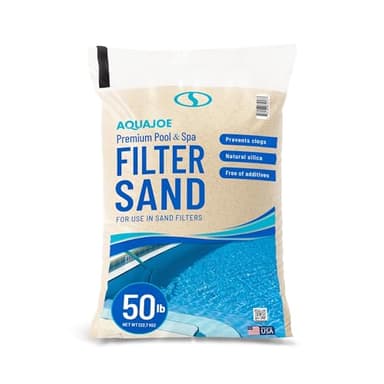
Pick 2 - Recharging a sand filter
Aqua Joe Premium Pool & Spa Filter Sand, 50 lb, FLTSAND50
Sand is the cheapest filter medium to run and the one most often left in far too long.
The published figure
50 lb bag of natural silica sand, stated for above-ground and in-ground filter systems
Sand filters work because the grains have sharp edges that trap debris. Over three to five years those edges round off and channel, so water runs through the same worn paths and filtration quality falls without the pressure gauge changing much.
That slow, invisible decline is why a sand pool can be chemically perfect and still hazy. Replacing the sand is the fix, and it costs less than a season of clarifier.
Check your filter's stated sand capacity before ordering - it is on the housing label, and it is usually between 100 and 350 lb, so one bag is rarely the whole job.
What it does well
- Cheapest filter medium per season by a wide margin
- Natural silica, which is what the great majority of sand filters specify
- Nothing to fit - it pours in
What it costs you
- Only filters to roughly 20-40 micron, the coarsest of the three filter types
- Heavy, and changing it is a genuinely unpleasant job
- One bag rarely fills a housing - check the stated capacity
Skip it if your filter takes cartridges or DE grids. Sand is not interchangeable with either.
#ad · how this is funded · price as of October 9, 2026
Pick 3 - A named, graded silica
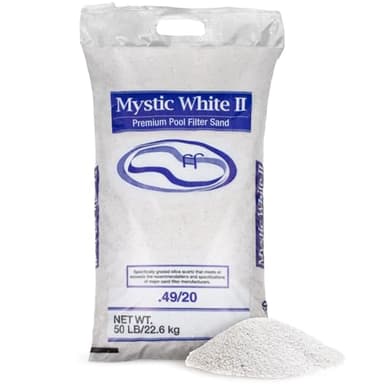
U.S. Silica Mystic White II Pool Filter Sand, 50 lb
A named grade from a silica producer rather than a repackaged bag, which is the only quality signal available in this category.
The published figure
50 lb washed and screened silica, sold under a specific product grade rather than as generic sand
Grain size and consistency are what decide how well sand filters, and almost nobody publishes either. Buying a named grade from a company whose actual business is silica is the closest thing to a specification here.
Washed and screened matters: unwashed sand releases fines into the pool for days after a change, which reads as a filter that made the water worse.
Same capacity check as any sand - read the figure on your housing label before ordering.
What it does well
- Named product grade from a silica producer, not generic repackaging
- Washed and screened, so far less fines carryover on start-up
What it costs you
- Costs more than a commodity bag
- Same 20-40 micron ceiling as all sand
Skip it if you are on a budget and changing a large filter - the commodity bags filter the same.
#ad · how this is funded · price as of October 9, 2026
Pick 4 - Above-ground filter pumps
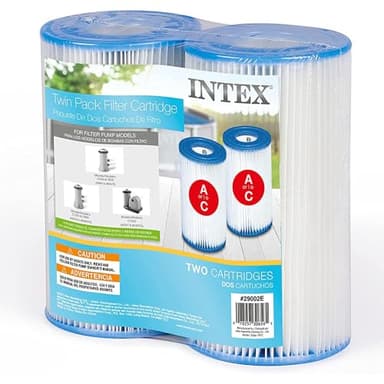
INTEX 29002E Type A Pool Filter Cartridge
The consumable that decides whether an above-ground pool ever clears, and the one people run for far too long.
The published figure
Dacron paper cartridge for Intex filter pumps
A cartridge that is loaded past its capacity passes water around the pleats rather than through them. The pump still runs and the water stops clearing, which reads as a chemistry problem.
Rinsing extends life; it does not restore it. Pleated paper media compacts permanently.
On an above-ground pool with a small pump, cartridge condition matters more to water clarity than any chemical on this site.
What it does well
- The cheapest fix for a pool that will not clear
- Direct fit for the most common above-ground pump family
What it costs you
- Genuinely consumable — weeks, not seasons
- Rinsing only delays replacement
Skip it if you own a sand or DE filter. This is not the same part.
#ad · how this is funded · price as of October 9, 2026
Pick 5 - Not buying a cartridge at all
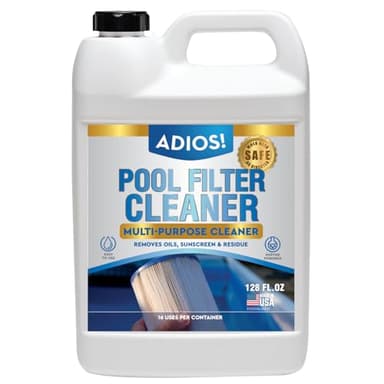
ADIOS! Pool Filter Cleaner, 12X Enzyme Soak, 128 oz
Often the correct purchase instead of a cartridge, because the most common reason a cartridge stops working is grease rather than wear.
The published figure
Liquid enzyme degreaser soak, stated by the maker for cartridge, DE and sand media
A garden hose rinses debris off the pleats and does nothing at all to the oils bound into them. Sunscreen, body oil and lotion glaze the fabric, and a glazed cartridge passes water around the pleats while looking clean.
An enzyme soak breaks that layer down, which restores flow on a cartridge that has been rinsed to death but is not physically worn. If your pressure drops back to near its clean reading afterwards, the cartridge had life left in it.
It does not repair torn pleats, collapsed cores or compacted media. Those are wear, and wear needs a new element.
What it does well
- Cheaper than a cartridge set and often does the same job
- Works on cartridge, DE and sand media rather than one type
- Directly targets the oils a hose rinse cannot touch
What it costs you
- Needs an overnight soak and somewhere to do it
- Cannot fix physical wear - torn pleats or a soft core still mean replacement
Skip it if your pleats are torn or the element has gone soft in the middle. No soak restores a cartridge that has physically failed.
#ad · how this is funded · price as of October 9, 2026
Getting the most from whichever you have
- **Record the clean pressure.** Every cleaning threshold on this site is relative to it, and most people never take the reading.
- **Sand: do not over-backwash.** A slightly dirty sand bed filters better than a freshly backwashed one, because the trapped debris is itself part of the filtering. Backwash on pressure, not on a schedule.
- **Cartridge: soak, do not just rinse.** Oils glaze the fabric and a hose does not touch them - see best pool filter cartridges.
- **Both: run the pump longer before buying anything.** Circulation hours are the cheapest clarity you can buy.
- **Sand: replace the media every three to five years.** Grains round off and channel, and the decline is invisible on the gauge.
Questions people actually ask
Is a sand filter or cartridge filter better for a pool?
Do cartridge filters clean better than sand?
How much water does backwashing a sand filter use?
Can I switch from sand to a cartridge filter?
Which filter needs a multiport valve?
Sources
Every figure on this page traces to one of these. Where a number could not be sourced, the page says so rather than estimating.
- HTH Pool Care Clarifier Advanced - product page, states clarity within 24 hours and no effect on pH
- Skim & Soak methodology - the constants, formulas and worked examples behind every dose on this site
- Aqua Joe Premium Pool Filter Sand, 50 lb - Amazon listing, read 2026-09-02
- U.S. Silica Mystic White II Pool Filter Sand - Amazon listing, read 2026-09-02
- POOLPURE CCP420 Pool Filter, 4-pack - Amazon listing, read 2026-09-02
Read next
Best filter cartridges
Best Pool Filter Cartridges
Cartridges compared by part number, element count and filter area, plus the soak that often replaces the purchase.
Top pick
POOLPURE CCP420 Pool Filter Cartridge, 4-pack
Pentair Clean & Clear Plus 420
Best filter cleaners
How to Clean a Pool Filter
Debris and oils are two different problems needing two different treatments. Most people only ever do the first.
Top pick
ADIOS! Pool Filter Cleaner, 12X Enzyme Soak, 128 oz
Not buying a cartridge at all
#ad · how this is funded · price as of October 9, 2026
Best for cloudy water
Best Pool Clarifier
Polymer clarifiers for silt and dead algae, chitosan for oils and sunscreen, matched to sand and cartridge filters.
Top pick
Clorox Pool&Spa Super Water Clarifier, 1 quart
Sand filters
Why Is My Pool Cloudy?
Check filtration, then chemistry, then everything else. Two of the six causes get worse if you add a chemical first.