Cloudy Water
Pollen in a Pool
Yellow dust on the surface in spring is a filtration problem wearing an algae costume.

We have not handled these products and we do not pretend to have. Here is what we did instead. Links to Amazon earn us a commission at no extra cost to you, and commission never decides a pick — disclosure.
| # | Product | Best for | The spec it turns on | Price |
|---|---|---|---|---|
| 1 | 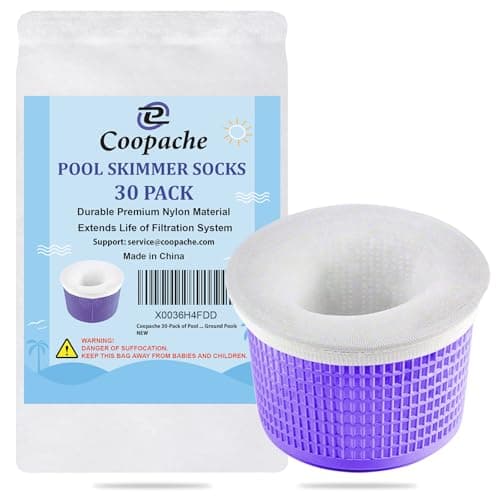 Coopache Pool Skimmer Socks, 30-packTop pickA few dollars of fine mesh over the skimmer basket removes more fine debris than any chemical on this site. | Catching what the net misses | Fine-mesh elastic liners for the skimmer basket, 30 per pack | |
| 2 |  GLB Super Blue Pool Clarifier, 64 ozA concentrate sold in a size that suits a pool you clarify more than once a season. | Cartridge filters | Concentrated clarifier, 64 oz bottle | |
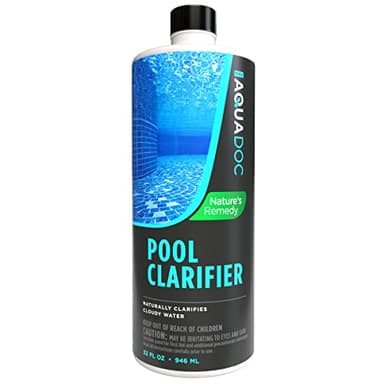
| 3 |  AquaDoc Natural Pool Clarifier, chitosan, 32 ozDifferent chemistry to the rest of this page: chitosan binds oils, which is the cause polymer clarifiers handle worst. | Oils and sunscreen | Chitosan-based clarifier, a shellfish-derived polymer | |
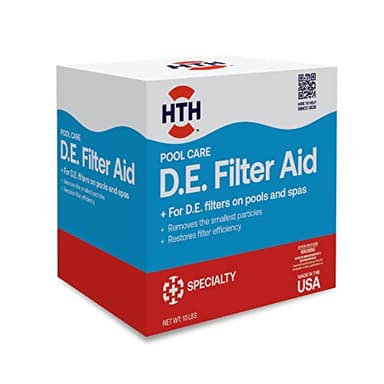
| 4 |  HTH Pool Care D.E. Filter Aid, 10 lbThe only media on this page with a micron range from a major brand: 2 to 6 microns. It is also usable as a filter aid in a sand filter, not only in a DE unit. | A published micron figure | Listing states removal of particles as small as 2-6 microns and compatibility with saltwater systems | |
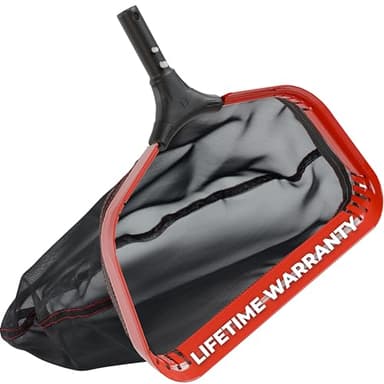
| 5 | 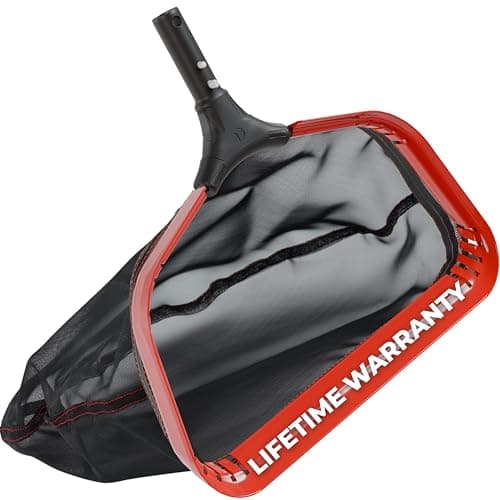 ProTuff 490 Promise Pro Pool Leaf Rake, 19.5 inA wide frame and a deep bag, which is the combination that decides how many passes a leaf drop takes. | Heavy leaf fall | 19.5 in frame with a deep bag; the widest opening in this roundup | |
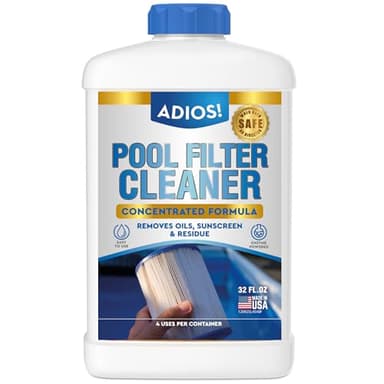
| 6 | 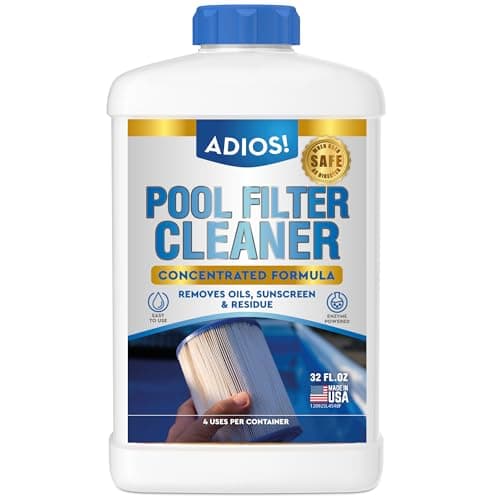 ADIOS! Pool Filter Cleaner, 4X Enzyme Soak, 32 ozThe small bottle of the same idea, for one cartridge rather than a season of them. | A single cartridge soak | 32 oz enzyme degreaser at 4X concentration, stated for cartridge, DE and sand media |
Why this gets mistaken for algae every spring
Both are yellow, both show up on the floor and in shaded corners, and both make the water look dull. That is where the resemblance ends, but it is enough to send a lot of people to buy shock for a problem chlorine cannot solve.
The distinction is worth getting right in both directions. Treating pollen as algae wastes a bag of shock and a weekend. Treating mustard algae as pollen leaves a bloom to get established in exactly the shaded spots it likes - our how to get rid of mustard algae page covers what that costs.
| Pollen | Mustard algae | Silt and fine dirt | |
|---|---|---|---|
| Where it appears first | On the surface, as a film | On shaded walls and the floor | On the floor, lowest points |
| Color | Yellow to greenish-yellow | Yellow to tan | Gray to brown |
| Texture when brushed | Lifts into a cloud and drifts | Powdery, lifts and resettles nearby | Billows and resettles |
| After brushing and a day of filtering | Gone, and stays gone | Back in the same places | Gone if the filter can catch it |
| Responds to chlorine | No | Yes, with brushing and a high residual | No |
| Season | Spring, in bursts with the wind | Warm water, any time | After wind or storms |
Why shocking does not clear it
Chlorine oxidizes organic material and kills living organisms. Pollen is a particle: it is already inert, and oxidizing it does not make it disappear from the water any faster than the filter can catch it.
What a heavy pollen load does do is consume chlorine, because it is organic material and chlorine works on it like it works on leaves and lotion. So a pollen-loaded pool often reads low on free chlorine, which is worth correcting on its own terms - just do not expect the correction to clear the water.
The useful frame is the one why is my pool cloudy uses: particulate below your filter's micron rating circulates past the filter as many times as you pump it. Sand catches down to roughly 20 to 40 microns, cartridges to about 10 to 20, DE to around 5. Clearing fine particulate means changing that number, not changing the chemistry.
The three ways to change the number
- Catch it before the filter. A fine-mesh sock over the skimmer basket intercepts pollen, grit and hair on the way in. It is the cheapest intervention on this whole site, it costs pennies per season, and on a pollen week it is the one that does the most.
- Clump what is already suspended. A clarifier coagulates fine particles into aggregates large enough for the filter to catch. Polymer clarifiers suit sand filters well; a chitosan clarifier is the one to reach for when the load is oily as well as dusty.
- Filter finer. A DE filter aid coats a sand filter's media and takes it into a far finer range - HTH states removal of particles as small as 2 to 6 microns. It is the biggest single change you can make to a sand filter without replacing it.
Those three stack, and the order matters: sock first because it stops new material, then clarifier or filter aid for what is already in the water.
Skim the film before it sinks
Pollen arrives on the surface and stays there for a while, held up by surface tension. That window is the easiest removal you will get: a flat net pass takes off a visible film in a couple of minutes, where the same material on the floor an hour later is a vacuum job.
Run the pump through the heavy days rather than on the usual schedule. Surface debris reaches the skimmer by circulation, and a pool that is only circulating four hours a day in pollen season is collecting it for the other twenty.
The filter will load up, and that is the point
All three measures above work by putting more material into the filter, which means the filter fills faster. A cartridge that normally gets cleaned monthly may need it twice in a pollen week, and a sand filter will want backwashing sooner.
Pressure is the signal, not the calendar: clean when pressure rises 8 to 10 psi over the clean-filter reading. And clean it properly - a hose rinse removes debris from the pleats and leaves the oils behind, which is what how to clean a pool filter is about.
The picks
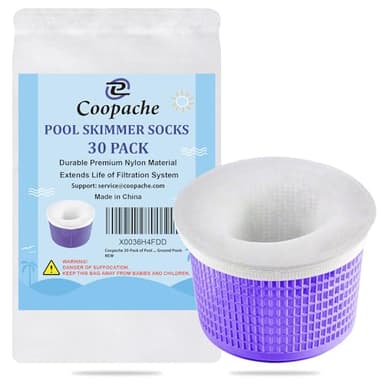
Top pick - Catching what the net misses
Coopache Pool Skimmer Socks, 30-pack
A few dollars of fine mesh over the skimmer basket removes more fine debris than any chemical on this site.
The published figure
Fine-mesh elastic liners for the skimmer basket, 30 per pack
A skimmer basket catches leaves. Everything smaller goes through it and into the pump, then into the filter, where it is your filter's problem.
A sock over the basket takes pollen, hair, insects and grit out before any of that happens, and it is the single cheapest upgrade to a pool's water clarity.
They restrict flow as they load. Check them at the same time you check the basket, not weekly.
What it does well
- Removes the fine debris that otherwise loads the filter
- Costs less per season than a single bottle of clarifier
- Extends the interval between filter cleans
What it costs you
- Restricts flow noticeably once loaded, and needs checking often
- Disposable, so there is a small ongoing cost
Skip it if your pump already runs at marginal flow. A loaded sock will starve it.
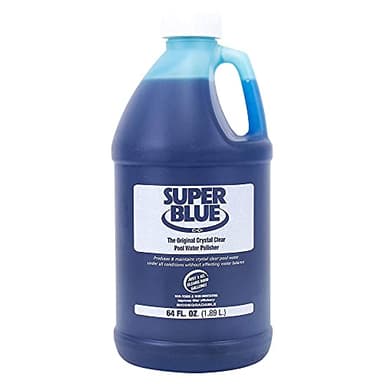
Pick 2 - Cartridge filters
GLB Super Blue Pool Clarifier, 64 oz
A concentrate sold in a size that suits a pool you clarify more than once a season.
The published figure
Concentrated clarifier, 64 oz bottle
Cartridge filters catch finer particles than sand, so they need less help from a clarifier — but they also clog faster once the clarifier does its job.
Expect to clean the cartridge shortly after dosing. That is the product working, not failing.
64 oz is the size that stops being annoying if cloudiness is a recurring problem rather than a one-off.
What it does well
- Bulk size for pools that need it repeatedly
- Long-established formulation in this category
What it costs you
- Will clog a cartridge quickly once it starts working
- Overkill for a pool that clouds once a year
Skip it if this is a one-off haze. Buy the quart and keep the shelf space.
Pick 3 - Oils and sunscreen
AquaDoc Natural Pool Clarifier, chitosan, 32 oz
Different chemistry to the rest of this page: chitosan binds oils, which is the cause polymer clarifiers handle worst.
The published figure
Chitosan-based clarifier, a shellfish-derived polymer
Chitosan is derived from crustacean shells and binds organic material — body oils, sunscreen, lotion — more readily than the synthetic polymers do.
That makes it the specific answer to a pool that goes cloudy after a busy weekend rather than after a storm, which is a distinction almost nobody makes on the shelf.
It is also the one to avoid if anyone using the pool has a shellfish allergy, for obvious reasons.
What it does well
- Binds oils and lotions better than synthetic polymer clarifiers
- Biodegradable active ingredient
What it costs you
- Shellfish-derived, which is a real consideration for some households
- Less effective than a polymer on mineral and dead-algae haze
Skip it if your cloudiness followed a storm or a shock rather than a pool party — the cause is mineral or dead algae and a polymer clarifier suits it better.
Pick 4 - A published micron figure
HTH Pool Care D.E. Filter Aid, 10 lb
The only media on this page with a micron range from a major brand: 2 to 6 microns. It is also usable as a filter aid in a sand filter, not only in a DE unit.
The published figure
Listing states removal of particles as small as 2-6 microns and compatibility with saltwater systems
HTH states it removes particles as small as 2 to 6 microns and restores filter efficiency. That is the finest published figure here, and it explains why DE is the filter type people reach for after an algae bloom.
The listing states it suits all DE filters on pools and spas and is compatible with saltwater systems.
It is sold as a filter aid, which is also how a small dose is used to sharpen a sand filter temporarily. Check your filter's manual before adding anything a sand filter was not designed for.
What it does well
- States a 2-6 micron removal range
- Stated compatible with saltwater systems
- 10 lb is a sensible size for occasional use
What it costs you
- Costs far more per pound than bulk DE
- Still a consumable that washes out on every backwash
- Adding it to a sand filter is a manual-dependent decision
Skip it if you run a DE filter all season. Buy the 25 lb box and save the difference.
#ad · how this is funded · price as of October 30, 2026
Pick 5 - Heavy leaf fall
ProTuff 490 Promise Pro Pool Leaf Rake, 19.5 in
A wide frame and a deep bag, which is the combination that decides how many passes a leaf drop takes.
The published figure
19.5 in frame with a deep bag; the widest opening in this roundup
Two numbers decide a leaf rake: the width of the opening and the depth of the bag. Width sets how much surface you sweep per pass; depth sets how much you can hold before you stop to empty it.
At 19.5 inches this is at the wide end of what fits comfortably down a standard skimmer throat and around a ladder.
A deep bag is what separates a leaf rake from a flat skimmer net. If you are scooping a heavy autumn drop, depth is the specification that matters.
What it does well
- Wide opening covers more surface per pass
- Deep bag holds a full sweep without emptying
- Reinforced frame, which is where cheap nets fail first
What it costs you
- A full deep bag is heavy on a long pole
- Too bulky for skimming a few surface leaves
Skip it if your daily job is a handful of floating leaves. A flat net is faster and lighter for that.
#ad · how this is funded · price as of October 30, 2026
Pick 6 - A single cartridge soak
ADIOS! Pool Filter Cleaner, 4X Enzyme Soak, 32 oz
The small bottle of the same idea, for one cartridge rather than a season of them.
The published figure
32 oz enzyme degreaser at 4X concentration, stated for cartridge, DE and sand media
A single-element filter needs one soak at a time, and a 128 oz jug is a lot of shelf life to buy for that.
The concentration difference between the 4X and the 12X is exactly what it says, so compare on price per treatment rather than price per bottle.
Same limits as any enzyme soak: it dissolves oils, and it does nothing for torn pleats or a collapsed core.
What it does well
- Right size for a single-element housing
- Same enzyme chemistry as the larger bottle
What it costs you
- Worse value per treatment than the 12X if you have four elements
- Still an overnight job
Skip it if your housing takes four elements - buy the concentrate and save money per soak.
#ad · how this is funded · price as of October 30, 2026
What does not work
- Shocking it. Chlorine does not remove particles, and a shock dose aimed at pollen is a bag of product and a day out of the pool for nothing.
- Algaecide. Same reason - there is nothing living to kill.
- Flocculant, usually. It will drop pollen to the floor, but it has to be vacuumed to waste rather than through the filter, which is a lot of work for a problem a skimmer sock largely prevents. Clarifier vs flocculant covers when the heavier option is worth it.
- Waiting it out while the pump runs four hours a day. Pollen keeps arriving for weeks, and under-circulating is what lets each day's load reach the floor.
- Ignoring the chlorine reading. Pollen is organic load, so it eats into your residual even though removing it is a filtration job.
Questions people actually ask
Is the yellow stuff in my pool pollen or algae?
Will shocking the pool get rid of pollen?
How do I get pollen out of a pool?
Does pollen cause algae in a pool?
Will a skimmer sock catch pollen?
Can I swim in a pool with pollen in it?
Sources
Every figure on this page traces to one of these. Where a number could not be sourced, the page says so rather than estimating.
- Skim & Soak methodology - the constants, formulas and worked examples behind every dose on this site
- HTH Pool Care D.E. Filter Aid, 10 lb - states removal of particles as small as 2-6 microns - Amazon listing, read 2026-10-30
- Coopache pool skimmer socks, 30-pack - fine-mesh elastic liners for the skimmer basket - Amazon listing, read 2026-10-30
- AquaDoc natural pool clarifier, 32 oz - chitosan-based coagulant - Amazon listing, read 2026-10-30
Read next

Why Is My Pool Cloudy?
Check filtration, then chemistry, then everything else. Two of the six causes get worse if you add a chemical first.

Best for cloudy water
Best Pool Clarifier
Polymer clarifiers for silt and dead algae, chitosan for oils and sunscreen, matched to sand and cartridge filters.
Top pick
Clorox Pool&Spa Super Water Clarifier, 1 quart
Sand filters

Best for mustard algae
How to Get Rid of Mustard Algae
Yellow, powdery, shade-loving and chlorine-tolerant. Treating the water without treating the equipment gives you a two-week cycle.
Top pick
United Chemicals YellowTreat Mustard Algaecide, 2 lb
Mustard algae specifically
#ad · how this is funded · price as of October 30, 2026

Best filter cleaners
How to Clean a Pool Filter
Debris and oils are two different problems needing two different treatments. Most people only ever do the first.
Top pick
ADIOS! Pool Filter Cleaner, 12X Enzyme Soak, 128 oz
Not buying a cartridge at all
#ad · how this is funded · price as of October 30, 2026

Best pool skimmer basket
Best Pool Skimmer Basket
Inground and above-ground skimmer baskets compared on stated fit, weighting and capacity, with the measurements to check before ordering.
Top pick
Swimables 8" Weighted Pool Skimmer Basket for In-Ground Pools
Hayward SPX1070E and Pentair U-3 skimmers
#ad · how this is funded · price as of October 30, 2026