Green Water & Algae
Can You Use Bleach in a Pool?
Chemically yes, and that is the easy half of the question. The hard half is that the bottle will not tell you how strong it is.

We have not handled these products and we do not pretend to have. Here is what we did instead. Links to Amazon earn us a commission at no extra cost to you, and commission never decides a pick — disclosure.
| # | Product | Best for | The spec it turns on | Price |
|---|---|---|---|---|
| 1 | 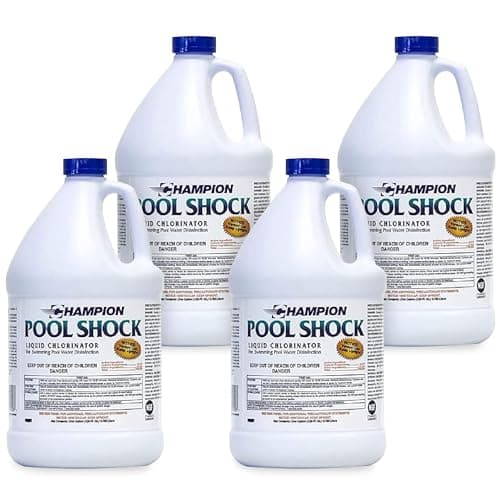 Champion Pool Shock Liquid Chlorine 12.5%, 1 gal, 4-packTop pickAdds nothing but chlorine and salt, which on a big bloom or a saltwater pool is exactly the point. | Large blooms and saltwater pools | 12.5% trade sodium hypochlorite, ready to use, no residue | |
| 2 | 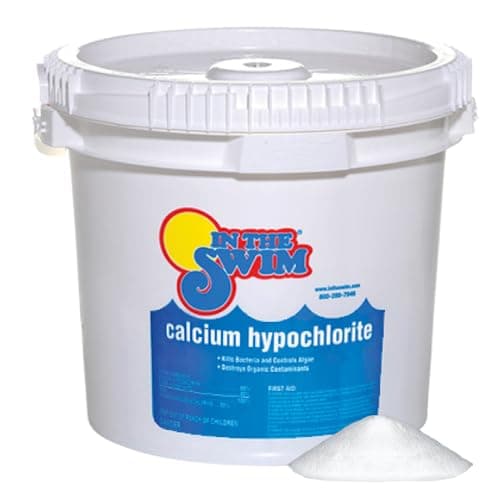 In The Swim Pool Shock, 68% Cal-Hypo Granular, 25 lbThe highest available-chlorine percentage in common retail cal-hypo, sold loose so you dose by weight instead of by packet. | Clearing an algae bloom | 68% available chlorine, calcium hypochlorite, sold loose by the pound | |
| 3 | 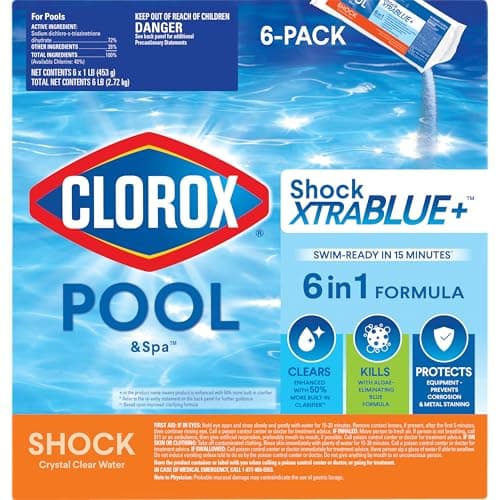 Clorox Pool&Spa Shock XtraBlue PlusDichlor, which dissolves fast and is pH neutral, at the cost of adding cyanuric acid with every dose. | Swimming again the same afternoon | Stabilized dichlor shock; label states swim-ready in 15 minutes | |
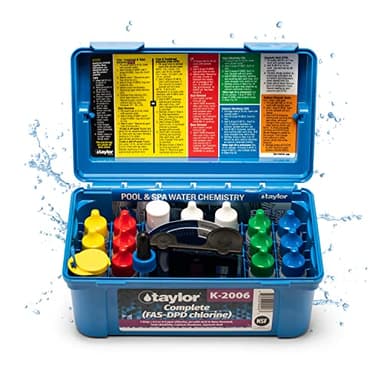
| 4 | 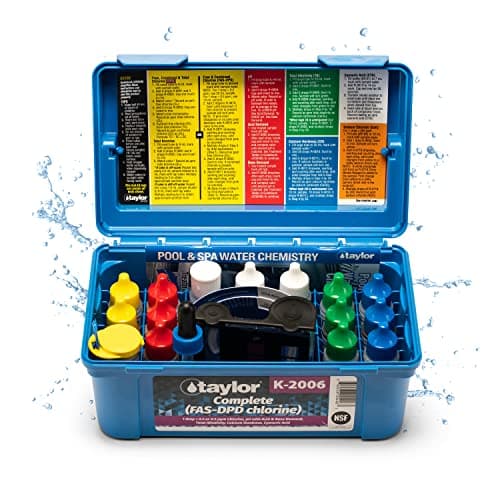 Taylor K-2006 Complete FAS-DPD Pool Test KitThe kit every pool forum names, and for once the consensus is right - because titration is the one chlorine method that does not saturate exactly when you need it. | The reference residential kit | FAS-DPD titration for free and combined chlorine, plus pH, acid and base demand, total alkalinity, calcium hardness and cyanuric acid; 3/4 oz reagents | |
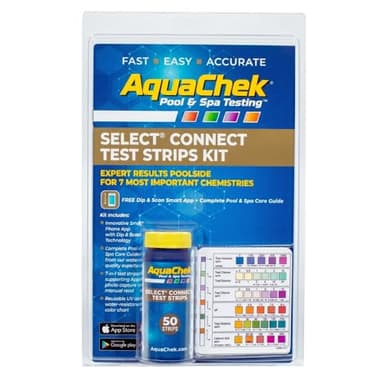
| 5 | 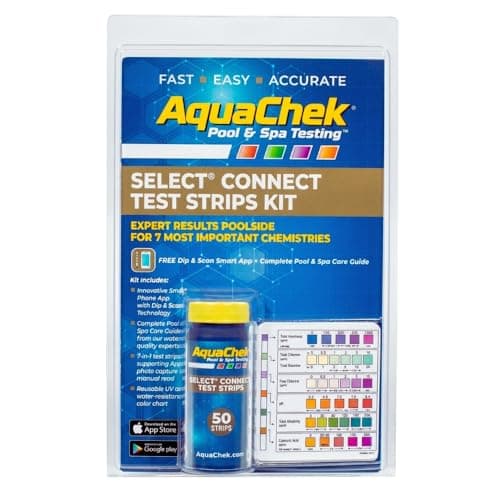 AquaChek Select Connect 7-Way Test Strips, complete kitThe kit that gets used. Seven readings in fifteen seconds beats a laboratory-grade kit that stays in the shed. | Weekly testing you will actually do | Seven parameters per strip: pH, total and free chlorine, bromine, alkalinity, hardness, cyanuric acid |
The two questions people are actually asking
"Can I use bleach" is usually two questions wearing one coat. The first is whether the chemistry works. The second is whether it is a good idea. They have different answers, which is why the internet argues about this permanently.
The chemistry works. Sodium hypochlorite is sodium hypochlorite. Pour it in and it dissociates into hypochlorous acid exactly as the pool jug does, kills exactly the same things, and leaves exactly the same salt behind.
Whether it is a good idea comes down to a single number that one bottle prints and the other does not.
How we judged it
- Does the label state a strength? Everything else depends on it. A dose is a calculation, and the calculation has a percentage in it.
- What else goes in with the chlorine? Some chlorine sources add cyanuric acid or calcium, and those accumulate where chlorine does not.
- Is the product labeled for the use? In the US a pesticide label is a legal document, not packaging copy, and the Michigan guidance below quotes the federal rule directly.
- What does it cost per ppm, rather than per bottle? A weaker liquid at a lower price is not automatically cheaper.
- Can you store it? Every hypochlorite solution loses strength on the shelf, and the weaker it starts the sooner it stops being worth carrying.
The comparison
| Household bleach | Pool chlorinating liquid | Cal-hypo shock | Dichlor shock | |
|---|---|---|---|---|
| Chemistry | Sodium hypochlorite | Sodium hypochlorite | Calcium hypochlorite | Sodium dichlor |
| Strength stated on the label | Not on any we could read | Yes - 12.5% trade on the Champion jug | Yes - 68% on the In The Swim bag | Yes - 56% class |
| Adds cyanuric acid | No | No | No | Yes |
| Adds calcium hardness | No | No | Yes | No |
| Effect on pH | Raises it | Raises it | Raises it | Lowers it slightly |
| Labeled for pool use | No | Yes | Yes | Yes |
| Dose you can actually compute | No | Yes | Yes | Yes |
Read the row that says "strength stated on the label" twice. It is the entire argument. Every other difference on this page is a preference; that one is a dead end.
What the dose calculation needs
Liquid chlorine is sold by trade percent, which is grams of available chlorine per 100 mL. Put the percentage in the formula below and you get gallons. Leave it out and you get nothing - there is no "roughly" that survives a factor of two.
| Pool volume | How much |
|---|---|
| 5,000 gal | 10 fl oz |
| 10,000 gal | 20 fl oz |
| 15,000 gal | 31 fl oz |
| 20,000 gal | 41 fl oz |
| 25,000 gal | 51 fl oz |
| 30,000 gal | 61 fl oz |
What we could not verify
We went looking for a household bleach label that states its sodium hypochlorite concentration, because if one exists the dose arithmetic works and the rest of this page is academic.
Clorox's own product page for its regular disinfecting bleach says the product is "made with sodium hypochlorite" and gives no percentage. We then read the ten highest-ranking retail bleach listings on Amazon, including the germicidal and concentrated variants: none of them states a percentage either. Several are scented, thickened or "no splash" formulations, which are different products again.
The label is a legal document, not packaging
In the US, chlorine products sold to sanitize pool water are pesticides, and their labels are approved under federal law. The Michigan EGLE guidance cited below quotes the EPA rule that a product must be used in accordance with its labeling, alongside the CDC Model Aquatic Health Code residual limits and the NSF 10 ppm application ceiling.
Household bleach is labeled for laundry and hard surfaces. Nobody is going to knock on your door about a backyard pool, and we are not going to pretend otherwise - but "the label does not cover this" is also why no manufacturer will help you work out a dose, and why there is no dose on the bottle to begin with.
Where bleach is genuinely the wrong tool
- A green pool. Clearing a bloom needs a known jump of 10 to 30 ppm, which is exactly the calculation an unknown percentage breaks. See how to clear a green pool fast.
- Any pool where somebody will swim soon. Overshooting means waiting for the level to fall, and you cannot overshoot carefully with an unknown strength.
- A pool that needs its chlorine to last. Neither bleach nor pool liquid chlorine carries stabilizer - see cyanuric acid for what that costs you in full sun.
- Scented, thickened or splashless bleach, under any circumstances. Those contain things that are not sodium hypochlorite and have no business in a pool.
What to buy instead
If what you liked about bleach was the chemistry - no calcium, no cyanuric acid, nothing accumulating - then pool chlorinating liquid is the same thing with the number printed on it. That is the top pick here.
If what you liked was the price, compare per ppm rather than per bottle using the formula above, and remember that the pool product is roughly twice the strength, so a gallon goes twice as far. Liquid chlorine vs granular shock runs that comparison properly, and cal-hypo vs dichlor vs trichlor covers what each granular type adds besides chlorine.
The picks
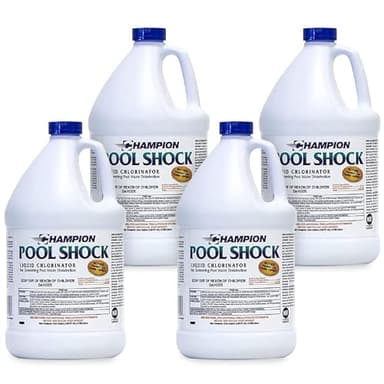
Top pick - Large blooms and saltwater pools
Champion Pool Shock Liquid Chlorine 12.5%, 1 gal, 4-pack
Adds nothing but chlorine and salt, which on a big bloom or a saltwater pool is exactly the point.
The published figure
12.5% trade sodium hypochlorite, ready to use, no residue
12.5% trade means one gallon raises 10,000 gallons by 12.5 ppm. That identity makes it the easiest chemistry on this page to dose in your head, and it stops being easy the moment your pool is not 10,000 gallons — see the calculator below.
Liquid chlorine adds no calcium and no cyanuric acid. For a pool that is already hard, already stabilized, or salt-chlorinated, that is the whole argument.
It also degrades. Sodium hypochlorite loses strength in storage, faster when warm, so a jug that has sat in a hot garage since last summer is not 12.5% any more.
What it does well
- Adds no calcium and no cyanuric acid
- Dissolves instantly, no pre-mixing, no granules on the liner
- Cheapest route to a large ppm swing on a big pool
What it costs you
- Loses strength in storage, particularly in heat
- Heavy and awkward to handle at four gallons
- Raises pH, so expect to follow with acid
Skip it if you cannot store it cool and use it within a couple of months — you will be dosing an unknown percentage.
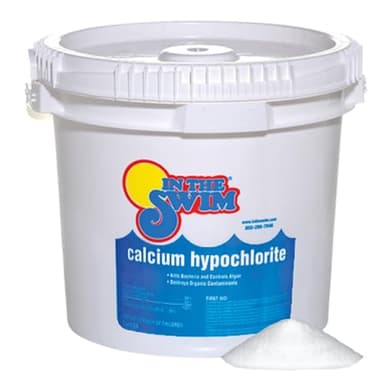
Pick 2 - Clearing an algae bloom
In The Swim Pool Shock, 68% Cal-Hypo Granular, 25 lb
The highest available-chlorine percentage in common retail cal-hypo, sold loose so you dose by weight instead of by packet.
The published figure
68% available chlorine, calcium hypochlorite, sold loose by the pound
68% available chlorine means 1 lb raises 10,000 gallons by about 8 ppm. A green pool typically needs 10 to 30 ppm depending on how far the bloom has gone, which is 1.2 to 3.7 lb per 10,000 gallons.
Loose granular is the format that lets you weigh a dose. Pre-measured 1 lb packets are convenient and fine for weekly maintenance, but they force you to round a shock dose to the nearest pound, which on a small pool is a 30% error.
Cal-hypo adds calcium hardness and no cyanuric acid. That is the right trade for a bloom and the wrong one for a pool that already sits above 400 ppm calcium.
What it does well
- 68% is the top of the common retail range, so you carry and store less product per ppm
- Loose granular lets you weigh an exact dose rather than round to a packet
- Adds no cyanuric acid, so shocking repeatedly does not drive you into chlorine lock
What it costs you
- Adds calcium hardness with every dose
- Must be pre-dissolved in a bucket for vinyl liners, which the label states
- A 25 lb bucket is more than a small pool will use in a season
Skip it if your fill water is already hard, or you own a small above-ground pool that will never work through 25 lb before the bucket cakes.
#ad · how this is funded · price as of October 30, 2026
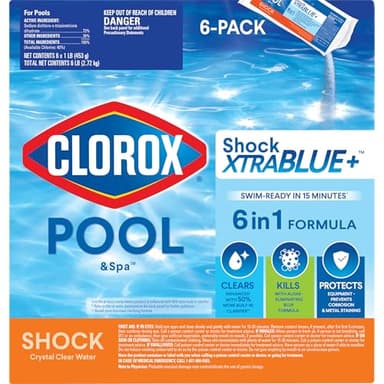
Pick 3 - Swimming again the same afternoon
Clorox Pool&Spa Shock XtraBlue Plus
Dichlor, which dissolves fast and is pH neutral, at the cost of adding cyanuric acid with every dose.
The published figure
Stabilized dichlor shock; label states swim-ready in 15 minutes
Sodium dichlor is roughly 56% available chlorine and dissolves without pre-mixing, which is why the label can promise a 15-minute swim window.
The catch is structural, not a flaw in this product: dichlor is stabilized, so every dose adds cyanuric acid. Roughly 0.6 ppm of CYA rides along with each 1 ppm of chlorine. Shock a pool ten times in a season and you have added enough stabilizer to blunt the chlorine you are adding.
That makes dichlor a genuinely good occasional shock and a bad weekly habit.
What it does well
- Dissolves without pre-dissolving, so it is liner-safe straight from the bag
- pH neutral, so it does not drag pH up the way cal-hypo does
- Short swim-wait window stated on the label
What it costs you
- Every dose adds cyanuric acid, which accumulates and cannot be filtered out
- Lower available chlorine than cal-hypo, so you carry more product per ppm
Skip it if your cyanuric acid is already at or above 50 ppm — you would be making the next problem while solving this one.
Pick 4 - The reference residential kit
Taylor K-2006 Complete FAS-DPD Pool Test Kit
The kit every pool forum names, and for once the consensus is right - because titration is the one chlorine method that does not saturate exactly when you need it.
The published figure
FAS-DPD titration for free and combined chlorine, plus pH, acid and base demand, total alkalinity, calcium hardness and cyanuric acid; 3/4 oz reagents
The chlorine test is FAS-DPD: you add reagent drop by drop until a pink sample turns clear, and count the drops. Each drop is a fixed amount of chlorine, so 20 ppm reads as more drops rather than as an impossible shade of pink. Every color-match method tops out around 5 ppm - the range you are in during a shock.
The other six tests are the same reagents as the cheaper K-2005. What you pay extra for is the chlorine method and nothing else.
The 3/4 oz reagent bottles are what separate it from the K-2006C. They run out in a season of frequent testing on one pool; the C's 2 oz bottles do not.
What it does well
- Reads chlorine accurately at shock levels, which no strip can
- Covers all seven residential parameters
- Reagents are sold individually, so the case lasts for years
What it costs you
- 3/4 oz bottles empty quickly if you test more than weekly
- A full run takes minutes rather than seconds
- Several times the price of a strip bottle
Skip it if you never shock and test once a week. A strip kit gets used, and this one might not.
#ad · how this is funded · price as of October 30, 2026
Pick 5 - Weekly testing you will actually do
AquaChek Select Connect 7-Way Test Strips, complete kit
The kit that gets used. Seven readings in fifteen seconds beats a laboratory-grade kit that stays in the shed.
The published figure
Seven parameters per strip: pH, total and free chlorine, bromine, alkalinity, hardness, cyanuric acid
The best test kit is the one you run. A strip takes fifteen seconds, which is the difference between testing weekly and testing when something looks wrong.
Seven parameters on one strip includes cyanuric acid, which most cheaper strips omit and which is the reading that explains chlorine that will not hold.
Strips are less precise than either Taylor kit and they degrade once the bottle has been opened. Note the date you opened it on the lid.
What it does well
- Fast enough that weekly testing actually happens
- Includes cyanuric acid, unlike most cheap strips
- No reagents to mix or spill
What it costs you
- Less precise than a drop kit, particularly on alkalinity
- Degrades after the bottle is opened, especially in humidity
Skip it if you are diagnosing a problem rather than monitoring. Precision matters when you are about to dose.
#ad · how this is funded · price as of October 30, 2026
Either way, you need to be able to read the level
Whatever you pour in, the thing that makes it safe is measuring what came out the other end. Strips saturate above roughly 5 ppm free chlorine, which is precisely the range a shock dose puts you in, so a strip that reads "high" is telling you the color ran out rather than giving you a number. A FAS-DPD titration counts drops instead, and it keeps counting - see best pool test kits.
Questions people actually ask
Is pool chlorine the same thing as bleach?
How much bleach do I add per 10,000 gallons?
Will bleach damage a vinyl liner?
Can I use scented or splashless bleach in a pool?
Is bleach cheaper than liquid chlorine for a pool?
Does bleach add cyanuric acid or calcium to my pool?
Sources
Every figure on this page traces to one of these. Where a number could not be sourced, the page says so rather than estimating.
- Michigan EGLE, Maximum Disinfectant Residuals and Operational Ranges: Guidance for Michigan Licensed Pools (December 2025) - quotes CDC MAHC 5.7.3.1.1.5.0, the EPA FIFRA label rule and the NSF 10 ppm application ceiling
- Skim & Soak methodology - the constants, formulas and worked examples behind every dose on this site
- Champion Pool Shock liquid chlorine, 12.5% trade sodium hypochlorite, 1 gal - Amazon listing, read 2026-10-30
- In The Swim 68% cal-hypo pool shock, 25 lb - the published available-chlorine figure - Amazon listing, read 2026-10-30
- Clorox Disinfecting Bleach, Concentrated Regular - maker's product page, read 2026-10-30, states the product is "made with sodium hypochlorite" and publishes no concentration
Read next

Liquid Chlorine vs Granular Shock
Liquid adds only salt; granular cal-hypo adds calcium; dichlor adds stabilizer. Which matters depends on your water, not your budget.
Top pick
Champion Pool Shock Liquid Chlorine 12.5%, 1 gal, 4-pack
Large blooms and saltwater pools

Cal-Hypo vs Dichlor vs Trichlor
Calcium, cyanuric acid or acid - every chlorine product adds something besides chlorine, and knowing which decides your season.
Top pick
In The Swim Pool Shock, 68% Cal-Hypo Granular, 25 lb
Clearing an algae bloom
#ad · how this is funded · price as of October 30, 2026
Best for green water
Best Pool Shock for a Green Pool
Cal-hypo, dichlor and liquid chlorine compared on available chlorine percentage, with a dose table computed for six pool sizes.
Top pick
In The Swim Pool Shock, 68% Cal-Hypo Granular, 25 lb
Clearing an algae bloom
#ad · how this is funded · price as of October 30, 2026
Cyanuric Acid: Stabilizer, and Its Limit
How stabilizer works, the targets HTH publishes, and why the only way down is dilution.
Top pick
In The Swim Pool Stabilizer, 100% Cyanuric Acid, 25 lb
Stabilizing a liquid-chlorine or salt pool
#ad · how this is funded · price as of October 30, 2026

How Long After Adding Pool Chemicals Can You Swim?
Shock, algaecide, clarifier and oxidizer wait times taken from the labels themselves, plus the free chlorine figure that overrides all of them.
Top pick
Taylor K-2006 Complete FAS-DPD Pool Test Kit
The reference residential kit
#ad · how this is funded · price as of October 30, 2026