Robotic Cleaners & Vacuums
Aiper Scuba V3 Review
The finest published filtration in this category, attached to the two numbers Aiper chose not to print.

We have not handled these products and we do not pretend to have. Here is what we did instead. Links to Amazon earn us a commission at no extra cost to you, and commission never decides a pick — disclosure.
| # | Product | Best for | The spec it turns on | Price |
|---|---|---|---|---|
| 1 | 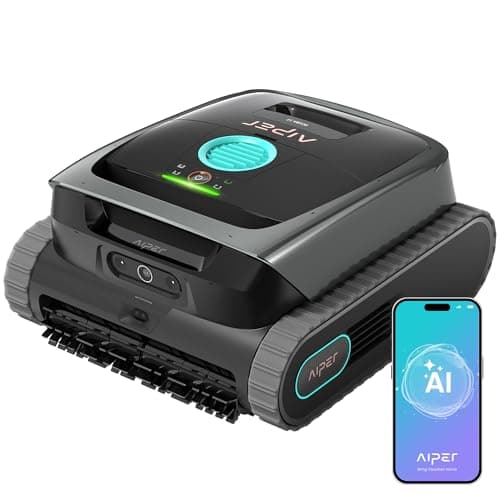 Aiper Scuba V3 AI Vision Cordless Robotic Pool CleanerTop pickA published 3 micron filter, which is the finest figure any robot on this site states and finer than most DE filters. | The finest published filtration | 3 micron MicroMesh filter, smart waterline parking, wireless charging dock, floor/wall/waterline cleaning | |
| 2 | 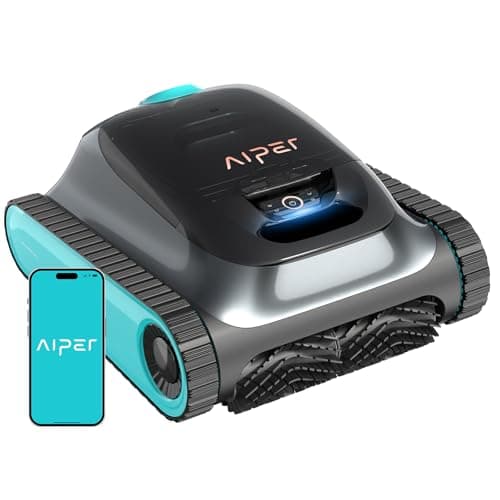 Aiper Scuba S1 Robotic Pool CleanerThe longest published runtime in this roundup, which is the specification that decides whether a cordless unit finishes a large pool in one charge. | Longest published runtime | Up to 270 minutes in Eco mode and up to 180 in Auto, Floor, Wall and Scheduled; floor, wall, waterline and shallow areas above 12 in; 180 plus 3 micron dual filtration | |
| 3 | 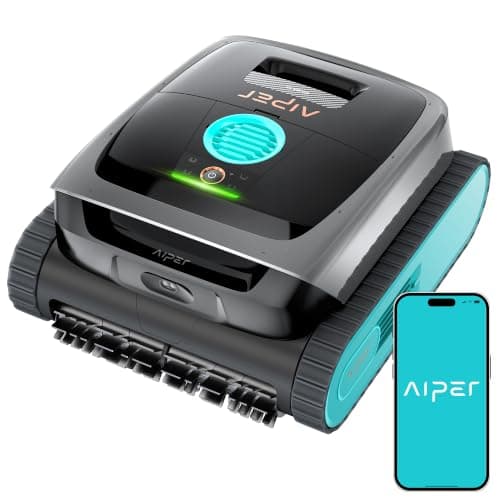 Aiper Scuba S3 Robotic Pool CleanerThe current flagship of the range: route planning from the pool's own contours rather than a fixed pattern, lateral waterline scrubbing, and a dual-stage filter down to 3 micron. | In-ground pools with an app | Up to 240 minutes in Eco mode, a 180 micron mesh plus a replaceable 3 micron ultra-fine insert, lateral waterline scrubbing to 2 in above the water, auto-docking at the waterline with a phone alert, 18 lbs | |
| 4 | 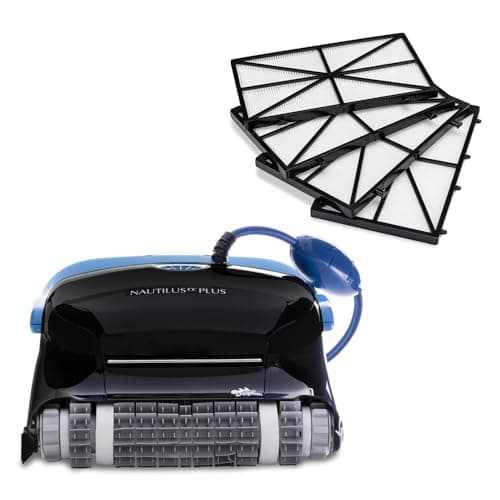 Dolphin Nautilus CC Plus Wi-Fi Robotic Pool VacuumThe corded default. Mains power means runtime is not a specification you have to think about. | In-ground pools up to 50 ft | Corded, wall-climbing with waterline scrubbing, ultra-fine top-load filter cartridges | |
| 5 | 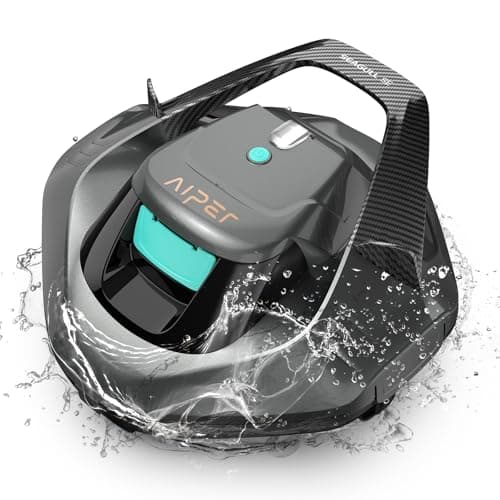 Aiper Seagull SE Cordless Robotic Pool VacuumPublishes suction, runtime and a coverage area together, which is the full sizing check most of this category makes impossible. | Above-ground pools | 1,320 GPH suction, 100 minute runtime, rated by the maker for above-ground pools up to 860 sq ft |
What this review is
We have not run a Scuba V3. There is no test pool here and no fleet. What follows is Aiper's published specification, read off the live listing on 2026-09-27, compared against the four numbers this site uses for every robot: filtration micron rating, coverage area per cycle, runtime and debris capacity.
On one of those four the V3 is the best-documented machine on the site. On two of them Aiper publishes nothing at all.
The published figures
| Specification | Aiper's published figure |
|---|---|
| Filtration | MicroMesh multi-layer: 180 micron debris filter plus a 3 micron ultra-fine layer |
| Navigation | Single front-facing AI camera, stated to detect over 20 debris types |
| Autonomy | Navium mode, stated to build weekly cleaning plans from pool size, weather and history |
| Retrieval | Returns to the waterline at the end of a cycle and stays 10 minutes, with an app notification |
| Charging | Wireless dock, no exposed connectors, no setup stated |
| Weight | 8.2 kg |
| Cleans | Floor, walls and waterline |
| Runtime | Not stated |
| Coverage area per charge | Not stated |
| Debris capacity | Not stated |
Read the last three rows together. Aiper publishes runtime on the Scuba S1 - 270 minutes - and publishes coverage, suction and runtime together on the Seagull SE. On its most expensive robot it publishes none of them.
The 3 micron claim, and why it matters
Filtration micron rating is the specification that decides whether a pool comes out leaf-free or actually clear. Most robot listings publish 180 micron or nothing. 180 micron catches leaves and grit while letting silt, pollen and fine dead algae straight back into the water.
Aiper states a 3 micron layer behind the 180 micron primary. For comparison, this site's filter pages put sand at roughly 20 to 40 micron, cartridges at 10 to 20, and DE at around 5. A 3 micron claim is finer than all three.
Treat the figure as the maker's own. Nobody independently tests robot filter media, and a fine layer that blinds quickly in service performs differently from one measured clean on a bench.
The AI camera, and what it replaces
Aiper states a single front-facing camera that detects over 20 debris types and navigates to debris directly, which it describes as cleaning up to ten times faster than traditional methods.
That comparison has no stated baseline - ten times faster than what, measured how, is not on the listing - so treat the multiplier as marketing and the camera as the feature. What a camera genuinely changes is navigation: a robot that drives to debris covers a dirty floor differently from one running a fixed pattern.
Navium mode is the autonomy layer on top: Aiper states it builds weekly cleaning plans from pool size, weather and cleaning history, and runs without intervention. Useful on a pool you do not watch daily; irrelevant if you run the robot when you see it needs it.
Retrieval, and the weight
Two of the V3's stated features address the thing owners actually complain about, which is getting the machine out of the water.
- Waterline parking. Aiper states the robot returns to the waterline after cleaning and stays there for 10 minutes, with an app notification - so you lift it from the edge rather than fishing the deep end with a pole.
- Weight. 8.2 kg is stated, which is a real number where most brands publish none. A robot full of water weighs considerably more coming out than its dry weight suggests.
- Wireless dock. Stated to charge with no exposed connectors and no setup, which removes the corroded-contact failure that plagues cheap cordless units.
Against the rest of the Aiper range
| Scuba V3 | Scuba S1 | Seagull SE | |
|---|---|---|---|
| Filtration | 180 micron plus 3 micron layer | Not published | Not published |
| Runtime | Not stated | 270 minutes | 100 minutes |
| Coverage | Not stated | Not stated | 860 sq ft, above-ground |
| Suction | Not stated | Not stated | 1,320 GPH |
| Cleans | Floor, walls, waterline | Floor, walls, waterline, shallow areas | Above-ground floor |
| Retrieval | Waterline parking, 10 min | Waterline parking | Not stated |
The range is oddly inconsistent about what it publishes, and the V3 inherits the gaps. If you need to size a robot against a specific pool area, the Seagull SE is the only Aiper here that lets you - see Aiper pool cleaners for the full range.
Against a corded Dolphin
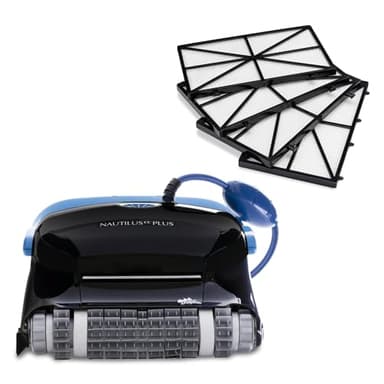
The obvious alternative at this money is a corded robot. Dolphin's Nautilus CC Plus is rated for in-ground pools to 50 ft, runs on mains power with no runtime limit and no battery to degrade, and describes its filter panels as ultra-fine without publishing a micron figure.
So the choice is unusually clean: the V3 gives you a published 3 micron layer, no cord and self-retrieval, with a battery that will age and no published runtime. The Dolphin gives you unlimited runtime and a component list that does not wear out on a charge cycle, with no filtration number to check. The full argument is on Aiper vs Dolphin.
The picks
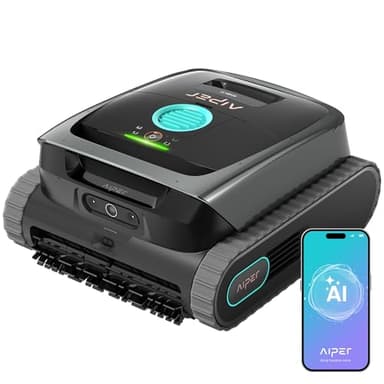
Top pick - The finest published filtration
Aiper Scuba V3 AI Vision Cordless Robotic Pool Cleaner
A published 3 micron filter, which is the finest figure any robot on this site states and finer than most DE filters.
The published figure
3 micron MicroMesh filter, smart waterline parking, wireless charging dock, floor/wall/waterline cleaning
3 micron is a genuinely unusual claim in this category. Most robots publish 180 micron or nothing at all, and 180 micron catches leaves while letting silt, pollen and fine dead algae straight back into the pool.
If your complaint is that the pool is leaf-free and still hazy, this is the specification that addresses it - and it is the same argument as choosing a DE filter over sand.
The cost is maintenance. A 3 micron filter fills faster than a coarse one by definition, because it is now catching material that used to pass through.
What it does well
- 3 micron published filtration, the finest of any robot on this site
- Wireless charging dock, so no cable to seat by hand
- Waterline parking as well as waterline cleaning
What it costs you
- Fine filtration means noticeably more frequent filter cleaning
- No published coverage-area figure, so sizing against your pool is guesswork
Skip it if your pool only ever collects leaves. You would be paying for filtration you never use and cleaning it more often.
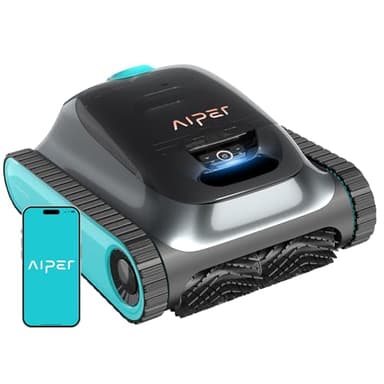
Pick 2 - Longest published runtime
Aiper Scuba S1 Robotic Pool Cleaner
The longest published runtime in this roundup, which is the specification that decides whether a cordless unit finishes a large pool in one charge.
The published figure
Up to 270 minutes in Eco mode and up to 180 in Auto, Floor, Wall and Scheduled; floor, wall, waterline and shallow areas above 12 in; 180 plus 3 micron dual filtration
Runtime is the whole cordless argument. A 90-minute unit in a large pool means two cycles and a recharge between them, which is not what anyone buys a robot for.
270 minutes in Eco mode is at the top of the published range across the brands here. Compare it against your pool's area, not against other robots in the abstract.
Cordless means the battery is the wear part. Every cordless robot on this page will need a battery before it needs anything else.
What it does well
- 270 minutes in Eco mode is the longest published runtime of the cordless units here
- Covers floor, walls and waterline rather than floor only
- No cord to tangle or lift
What it costs you
- Battery is a consumable with a finite cycle life
- Recharge time between cycles on very large pools
Skip it if you have mains power at the pool edge and no cord objection — a corded unit removes the runtime question entirely.
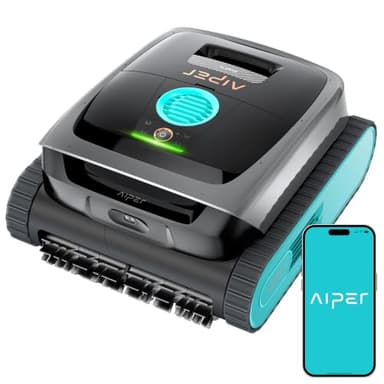
Pick 3 - In-ground pools with an app
Aiper Scuba S3 Robotic Pool Cleaner
The current flagship of the range: route planning from the pool's own contours rather than a fixed pattern, lateral waterline scrubbing, and a dual-stage filter down to 3 micron.
The published figure
Up to 240 minutes in Eco mode, a 180 micron mesh plus a replaceable 3 micron ultra-fine insert, lateral waterline scrubbing to 2 in above the water, auto-docking at the waterline with a phone alert, 18 lbs
Path planning is what separates a robot that covers a pool from one that covers a pool eventually. A machine running a fixed zig-zag in an irregular pool misses the same areas every cycle.
Auto-docking matters more than it sounds. This one ascends to the waterline when the cycle ends, waits ten minutes and sends a phone alert. A cordless robot that finishes in the middle of the deep end is a robot you retrieve with a hook.
The 2026 listing states what the earlier one did not: a 180 micron mesh with a replaceable 3 micron ultra-fine insert behind it. That is the same pair of figures Aiper states on the Scuba V3 and S1, so filtration is no longer the specification that separates them.
What it does well
- Route planning built from the pool's own contours rather than a fixed pattern
- Lateral waterline scrubbing to 2 in above the water, where the scum line forms
- Docks at the waterline and sends an alert, so retrieval is not a hunt
What it costs you
- No square-foot coverage figure, so it cannot be sized to a pool the way the Seagull SE can
- Cordless, so the battery is the wear part and eventually the limit
Skip it if you only need the floor cleaned. The waterline scrubbing and the docking behavior are what this model charges for, and the cheaper Scuba S1 states the same 3 micron filter layer.
Pick 4 - In-ground pools up to 50 ft
Dolphin Nautilus CC Plus Wi-Fi Robotic Pool Vacuum
The corded default. Mains power means runtime is not a specification you have to think about.
The published figure
Corded, wall-climbing with waterline scrubbing, ultra-fine top-load filter cartridges
A corded robot has no battery to degrade and no runtime ceiling. That single fact removes the constraint every cordless unit on this page is designed around.
Wall climbing and waterline scrubbing are the two features that separate a robot from a floor vacuum, because the waterline is where the oily scum line forms and no floor-only unit touches it.
The cable is the cost: it tangles, and you have to lift a wet robot with a cord attached out of the pool.
What it does well
- No runtime limit and no battery to degrade
- Climbs walls and scrubs the waterline, not just the floor
- Top-load filter cartridges, which are the easiest kind to empty
What it costs you
- Cable tangling on pools with a lot of steps and features
- Heavier to lift out than a cordless unit
Skip it if your pool has no convenient power outlet, or you want to drop a cleaner in and walk away without managing a cord.
#ad · how this is funded · price as of October 9, 2026
Pick 5 - Above-ground pools
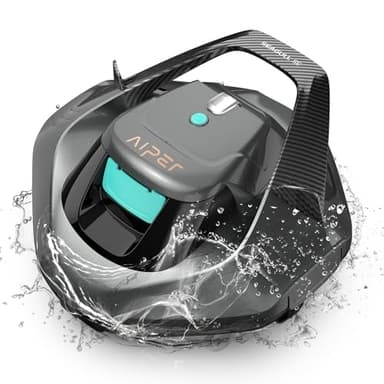
Aiper Seagull SE Cordless Robotic Pool Vacuum
Publishes suction, runtime and a coverage area together, which is the full sizing check most of this category makes impossible.
The published figure
1,320 GPH suction, 100 minute runtime, rated by the maker for above-ground pools up to 860 sq ft
860 sq ft is a real number you can check. A 24 ft round above-ground pool has about 452 sq ft of floor, so this covers it with a wide margin - and that is the arithmetic a coverage figure exists to let you do.
1,320 GPH is the suction figure. It is lower than the in-ground models in the range, which is appropriate: an above-ground pool is a flat floor with no walls to climb and no deep end to work.
100 minutes is short by in-ground standards and ample for the area it is rated to.
What it does well
- Suction, runtime and coverage area all published together
- Sized and priced for the pool it is actually for
- Self-parking, so retrieval is not a chore
What it costs you
- Does not climb walls, by design
- Wrong machine for an in-ground pool of any size
Skip it if you own an in-ground pool. You would be giving up wall and waterline cleaning entirely.
Who should buy it
- A pool that is chemically correct and still looks dull. The 3 micron layer is the only published answer to that on this site.
- An owner who dislikes the cord. Cordless removes the outlet, the cable in the water and the tangle on a pool with steps and benches.
- Anyone who has struggled to retrieve a robot. Waterline parking and a stated 8.2 kg are a genuine improvement on fishing a machine off the floor.
Who should not
- Anyone sizing a robot to a large pool. With no published runtime or coverage, you cannot check it will finish - the Seagull SE publishes both, at a fraction of the price, for above-ground pools.
- A leaf-heavy pool. Fine filtration is irrelevant when the limit is how much a basket holds, and Aiper publishes no debris capacity either.
- Anyone who runs a robot several times a week for years. A corded Dolphin has no battery to replace and the arithmetic is on how long do robotic pool cleaners last.
- Anyone buying on the ten-times-faster claim. It has no stated baseline and should not be part of the decision.
What we could not verify
Runtime, coverage area per charge, debris capacity, suction, and any independent measurement of the 3 micron layer. Battery replacement availability and cost are also unpublished, which is the one consumable every cordless robot eventually needs.
Questions people actually ask
Is the Aiper Scuba V3 worth it?
What micron is the Aiper Scuba V3 filter?
How long does the Aiper Scuba V3 run for?
Does the Scuba V3 come out of the pool by itself?
Scuba V3 or Scuba S1?
Sources
Every figure on this page traces to one of these. Where a number could not be sourced, the page says so rather than estimating.
- Skim & Soak methodology - the constants, formulas and worked examples behind every dose on this site
- AIPER Scuba V3 AI Vision Cordless Robotic Pool Cleaner, 180 micron plus 3 micron MicroMesh, 8.2 kg - Amazon listing, read 2026-09-27
- AIPER Scuba S1 Robotic Pool Cleaner, 270 minute runtime in Eco mode - Amazon listing, read 2026-10-03
- Dolphin Nautilus CC Plus Wi-Fi Robotic Pool Vacuum, rated to 50 ft - Amazon listing, read 2026-09-27
Read next
Finest published filtration
Aiper Pool Cleaners
Scuba S1, S3, V3, Seagull SE and the EcoSurfer skimmer, compared on what Aiper actually publishes for each.
Top pick
Aiper Scuba V3 AI Vision Cordless Robotic Pool Cleaner
The finest published filtration
Aiper vs Dolphin
Cordless Aiper against corded Dolphin on the specs each publishes - filtration, runtime, coverage and what happens when the battery is done.
Top pick
Dolphin Nautilus CC Plus Wi-Fi Robotic Pool Vacuum
In-ground pools up to 50 ft
#ad · how this is funded · price as of October 9, 2026
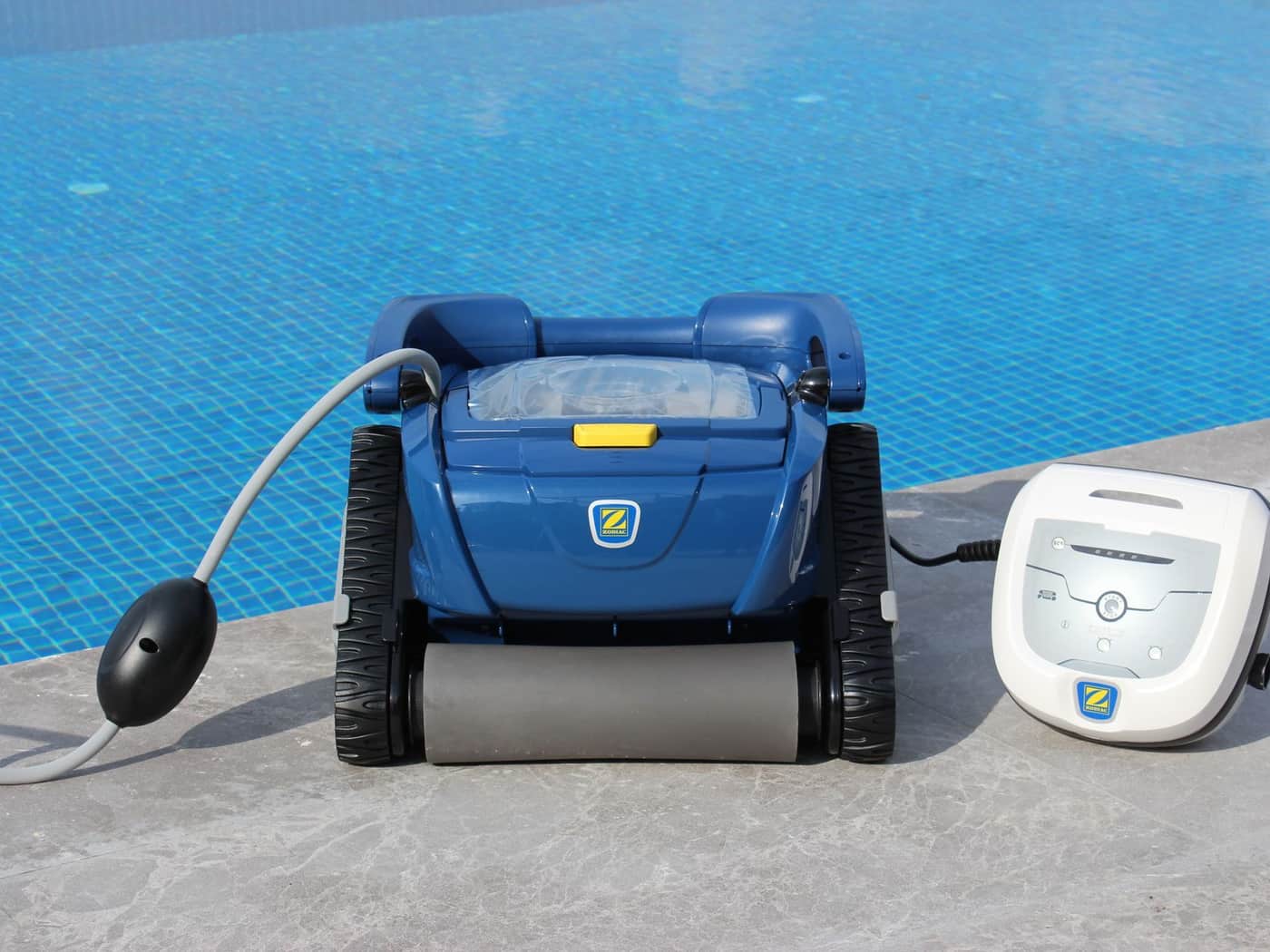
Aiper Scuba S1 Review
Aiper's mid-range cordless robot read off its own published figures: 270 minutes in Eco, 180 in the full modes, a 3 micron filter layer, four cleaning zones and no coverage rating.
Top pick
Aiper Scuba S1 Robotic Pool Cleaner
Longest published runtime
Best robotic cleaner
Best Robotic Pool Cleaners
Corded and cordless robots compared on coverage per cycle, micron rating and runtime, with the sizing rule that decides it.
Top pick
Dolphin Nautilus CC Plus Wi-Fi Robotic Pool Vacuum
In-ground pools up to 50 ft
#ad · how this is funded · price as of October 9, 2026
Why Is My Pool Cloudy?
Check filtration, then chemistry, then everything else. Two of the six causes get worse if you add a chemical first.