Robotic Cleaners & Vacuums
Aiper Scuba S1 Review
Judged on what Aiper publishes and on what it leaves out. We have not run one.
We have not handled these products and we do not pretend to have. Here is what we did instead. Links to Amazon earn us a commission at no extra cost to you, and commission never decides a pick — disclosure.
| # | Product | Best for | The spec it turns on | Price |
|---|---|---|---|---|
| 1 | 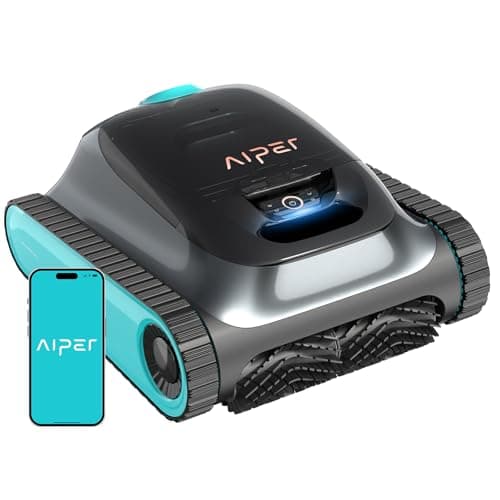 Aiper Scuba S1 Robotic Pool CleanerTop pickThe longest published runtime in this roundup, which is the specification that decides whether a cordless unit finishes a large pool in one charge. | Longest published runtime | Up to 270 minutes in Eco mode and up to 180 in Auto, Floor, Wall and Scheduled; floor, wall, waterline and shallow areas above 12 in; 180 plus 3 micron dual filtration | |
| 2 | 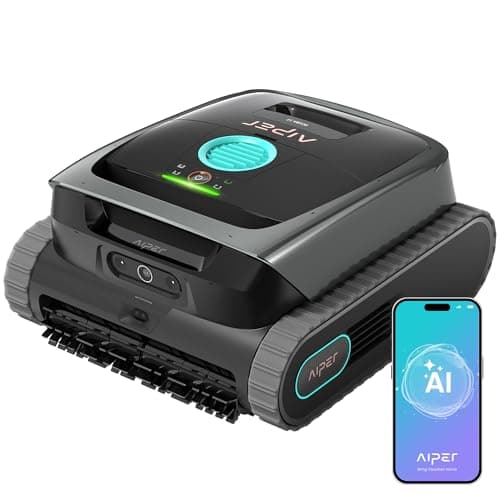 Aiper Scuba V3 AI Vision Cordless Robotic Pool CleanerA published 3 micron filter, which is the finest figure any robot on this site states and finer than most DE filters. | The finest published filtration | 3 micron MicroMesh filter, smart waterline parking, wireless charging dock, floor/wall/waterline cleaning | |
| 3 | 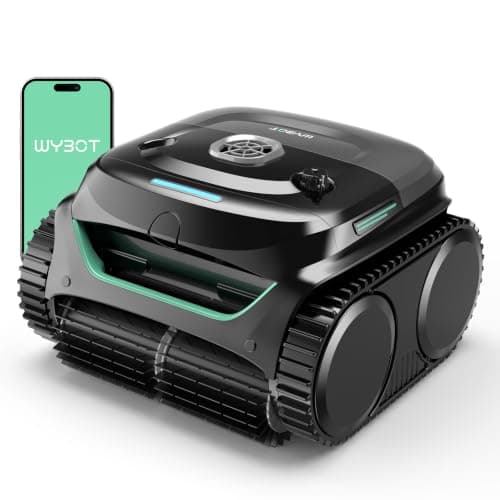 Wybot C2 Cordless Pool Vacuum for In-ground PoolsA 10 micron secondary filter is the finest figure published by any robot here, and it is the one that decides whether the water looks clean afterwards. | Finest published filtration | 180 min runtime, up to 2,152 sq ft per cycle, 10 micron ultra-fine plus 180 micron primary filter |
What this review is
Skim & Soak has never handled a Scuba S1, or any robot. What follows is the published specification read carefully, compared against the machines it competes with, and checked for what is missing. That is less than a hands-on test and considerably more than a review that restates the marketing and adds a star rating.
The published figures
| Specification | Aiper's published figure |
|---|---|
| Runtime, Eco mode | Up to 270 minutes |
| Runtime, Auto / Floor / Wall / Scheduled | Up to 180 minutes |
| Filtration | Dual layer: replaceable 3 micron ultra-fine behind a 180 micron standard |
| Cleaning zones | Floor, walls, waterline, shallow areas above 12 in |
| Navigation | 11 sensors, dual-path algorithm, WavePath pattern |
| Drive | Caterpillar treads |
| Scheduling | Weekly custom plan through the app |
| Warranty | 2 years |
| Coverage in sq ft | Not stated |
| Suction in GPH | Not stated |
| Basket capacity | Not stated |
The two numbers the listing leads with are the two most people buy on. The three it omits are the three that would let you size it to your own pool. That pattern is most of this review.
Runtime: 270 minutes, with a condition
270 minutes is the longest published runtime of any cordless robot on this site, and it is why the S1 leads our best robotic pool cleaners roundup on that specification. Read the listing closely, though: 270 is Eco mode, which Aiper describes as being for daily maintenance. Auto, Floor, Wall and Scheduled - the modes that actually climb walls - are stated at up to 180 minutes.
180 minutes is still a full cycle on a large residential pool, so this is not a complaint. But if you are buying for the 270 figure, understand that you get it on the lighter, floor-focused setting.
Filtration: the 3 micron claim, and where it matters
Aiper states a dual-layer filter: a 180 micron standard layer with a replaceable 3 micron ultra-fine layer behind it. On this site that figure matters for exactly one job - vacuuming dead algae and fine silt, which pass straight through a 180 micron basket and out of the robot's exhaust. Silt runs from about 4 to 62 microns; a 3 micron layer holds all of it and a 180 micron basket holds none of it.
The word replaceable is doing work in that sentence. An ultra-fine filter loads fast on a dirty pool, and Aiper is telling you it is a consumable. Budget for it the way you budget for any robot's running costs.
Four zones, and what 'shallow areas' means
Floor, walls and waterline are the standard three claims for a mid-range robot. The fourth - shallow areas above 12 inches - is Aiper's stated capability for tanning ledges and top steps, where most robots either will not go or beach themselves trying. Twelve inches is the stated minimum depth; anything shallower than that is still yours to brush.
Caterpillar treads are the drive. Treads grip a slick tile floor and a sloped wall better than wheels do, and every maker that fits them says so. None of them publishes a climbing angle, and Aiper does not either.
What it does not publish, and why that matters
No coverage figure. The Seagull SE, its own stablemate, publishes 860 sq ft; Wybot publishes 2,152 sq ft on the C2 and 1,150 on the B1. A coverage figure lets you do the one calculation that decides whether a robot finishes your pool - total area against area per cycle. Without it you are inferring from runtime, and runtime without a speed is not a distance.
No suction figure and no basket capacity either. Neither omission is unusual; most robot listings skip both. But the Seagull SE publishes 1,320 GPH, so Aiper clearly measures suction and chose not to state it here.
Against the alternatives
Aiper Scuba V3
The same 3 micron MicroMesh claim, plus a front camera Aiper states detects debris and navigates to it, an automatic return to the waterline for retrieval, and a wireless charging dock. It costs more and publishes even less about coverage. Buy it for the retrieval and the dock, not for cleaner water - the filtration claim is identical.
Wybot C2
Publishes 180 minutes, 2,152 sq ft per cycle and 10 micron secondary filtration on the maker's own page. The S1 has the finer filter and the longer Eco runtime; the C2 has the coverage figure. On a large pool, a number you can check beats a number you cannot.
Dolphin Nautilus CC Plus
Corded, which means no battery to age and no runtime limit at all, and Dolphin rates it for pools up to 50 ft in length. It also means a cable in the water and a power supply on the deck. The two designs are compared in full in our Nautilus CC Plus review.
The picks
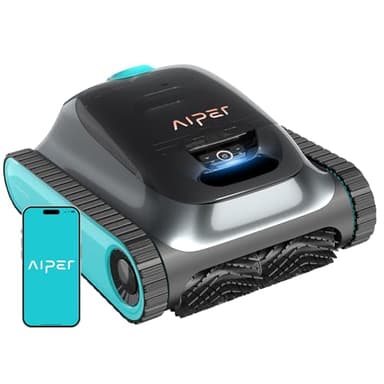
Top pick - Longest published runtime
Aiper Scuba S1 Robotic Pool Cleaner
The longest published runtime in this roundup, which is the specification that decides whether a cordless unit finishes a large pool in one charge.
The published figure
Up to 270 minutes in Eco mode and up to 180 in Auto, Floor, Wall and Scheduled; floor, wall, waterline and shallow areas above 12 in; 180 plus 3 micron dual filtration
Runtime is the whole cordless argument. A 90-minute unit in a large pool means two cycles and a recharge between them, which is not what anyone buys a robot for.
270 minutes in Eco mode is at the top of the published range across the brands here. Compare it against your pool's area, not against other robots in the abstract.
Cordless means the battery is the wear part. Every cordless robot on this page will need a battery before it needs anything else.
What it does well
- 270 minutes in Eco mode is the longest published runtime of the cordless units here
- Covers floor, walls and waterline rather than floor only
- No cord to tangle or lift
What it costs you
- Battery is a consumable with a finite cycle life
- Recharge time between cycles on very large pools
Skip it if you have mains power at the pool edge and no cord objection — a corded unit removes the runtime question entirely.
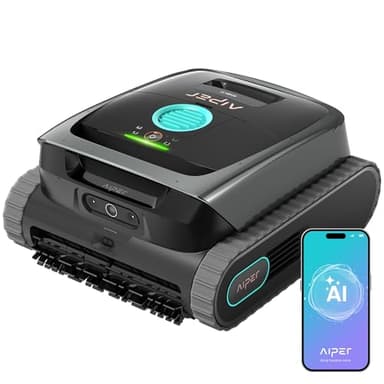
Pick 2 - The finest published filtration
Aiper Scuba V3 AI Vision Cordless Robotic Pool Cleaner
A published 3 micron filter, which is the finest figure any robot on this site states and finer than most DE filters.
The published figure
3 micron MicroMesh filter, smart waterline parking, wireless charging dock, floor/wall/waterline cleaning
3 micron is a genuinely unusual claim in this category. Most robots publish 180 micron or nothing at all, and 180 micron catches leaves while letting silt, pollen and fine dead algae straight back into the pool.
If your complaint is that the pool is leaf-free and still hazy, this is the specification that addresses it - and it is the same argument as choosing a DE filter over sand.
The cost is maintenance. A 3 micron filter fills faster than a coarse one by definition, because it is now catching material that used to pass through.
What it does well
- 3 micron published filtration, the finest of any robot on this site
- Wireless charging dock, so no cable to seat by hand
- Waterline parking as well as waterline cleaning
What it costs you
- Fine filtration means noticeably more frequent filter cleaning
- No published coverage-area figure, so sizing against your pool is guesswork
Skip it if your pool only ever collects leaves. You would be paying for filtration you never use and cleaning it more often.
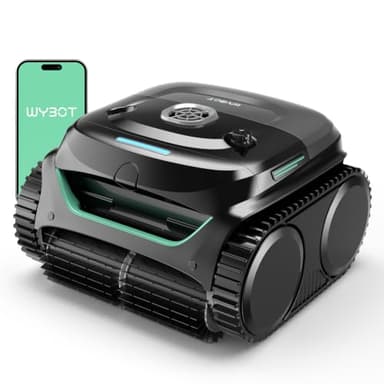
Pick 3 - Finest published filtration
Wybot C2 Cordless Pool Vacuum for In-ground Pools
A 10 micron secondary filter is the finest figure published by any robot here, and it is the one that decides whether the water looks clean afterwards.
The published figure
180 min runtime, up to 2,152 sq ft per cycle, 10 micron ultra-fine plus 180 micron primary filter
Wybot's own product page states a 10 micron ultra-fine filter behind a 180 micron primary. Most robots publish one number or none at all.
That matters because 180 micron catches leaves and grit while fine silt, pollen and dead algae pass straight through and go back into the water. The second stage is what stops that.
Wybot also publishes coverage per cycle — 2,152 sq ft — which is the honest way to compare against your own pool rather than against a runtime number in isolation.
What it does well
- 10 micron secondary filtration, the finest published figure in this roundup
- Coverage published per cycle, not just runtime
- Three brushless motors driving suction
What it costs you
- Fine filtration means more frequent filter cleaning
- 180 minutes is shorter than the longest-running units here
Skip it if your pool only ever collects leaves. You would be paying for filtration you never use.
Who should buy it
- **A residential inground pool up to roughly 40 ft** with walls and a waterline you want cleaned, and no convenient outlet for a corded machine. The published runtime and zones fit that pool well.
- **A pool that goes gray after a shock.** The 3 micron layer is the specification for dead algae, and this is the cheapest robot on this site that states one.
- **A pool with a tanning ledge deeper than 12 inches.** The shallow-area claim is specific to exactly that geometry.
Who should not
- **A very large or free-form pool.** With no coverage figure you cannot establish that it finishes. Buy the C2, or a Dolphin with a stated length rating.
- **An above-ground pool.** Aiper's own Seagull SE is built and rated for that, publishes its coverage, and costs less - see best above-ground pool vacuum.
- **Anyone expecting 270 minutes of wall cleaning.** That figure is Eco mode, on the floor.
Questions people actually ask
Is the Aiper Scuba S1 worth it?
How long does the Aiper Scuba S1 run?
Does the Scuba S1 clean walls and the waterline?
What is the difference between the Scuba S1 and the Scuba V3?
Does the Scuba S1 pick up fine sand and dead algae?
How big a pool does the Scuba S1 cover?
Sources
Every figure on this page traces to one of these. Where a number could not be sourced, the page says so rather than estimating.
- Skim & Soak methodology - the constants, formulas and worked examples behind every dose on this site
- WYBOT C2 - maker's product page, 180 minute runtime, up to 2,152 sq ft per cycle, 10 micron ultra-fine plus 180 micron primary filtration
- Aiper Scuba S1, 2026, 270 min Eco and 180 min Auto, 3 micron ultra-fine filter - Amazon listing, read 2026-10-03
- AIPER Scuba V3 AI Vision Cordless Robotic Pool Cleaner, 3 micron MicroMesh - Amazon listing, read 2026-09-12
- Aiper Seagull SE Cordless Robotic Pool Vacuum, 1,320 GPH, 860 sq ft - Amazon listing, read 2026-09-12
Read next
Finest published filtration
Aiper Pool Cleaners
Scuba S1, S3, V3, Seagull SE and the EcoSurfer skimmer, compared on what Aiper actually publishes for each.
Top pick
Aiper Scuba V3 AI Vision Cordless Robotic Pool Cleaner
The finest published filtration
Best robotic cleaner
Best Robotic Pool Cleaners
Corded and cordless robots compared on coverage per cycle, micron rating and runtime, with the sizing rule that decides it.
Top pick
Dolphin Nautilus CC Plus Wi-Fi Robotic Pool Vacuum
In-ground pools up to 50 ft
#ad · how this is funded · price as of October 9, 2026
Dolphin Nautilus CC Plus Review
Dolphin's best-known robot judged on what Maytronics publishes: a 50 ft length rating, a 2-hour cycle, ultra-fine filter panels and Wi-Fi - and CC vs CC Plus in one table.
Top pick
Dolphin Nautilus CC Plus Wi-Fi Robotic Pool Vacuum
In-ground pools up to 50 ft
#ad · how this is funded · price as of October 9, 2026
What a Robotic Pool Cleaner Costs to Run
Electricity per cycle and per season, computed from published power draw, plus the consumables that cost more than the power does.
Top pick
Dolphin Nautilus CC Plus Wi-Fi Robotic Pool Vacuum
In-ground pools up to 50 ft
#ad · how this is funded · price as of October 9, 2026
Best for vacuuming algae
Best Pool Vacuum for Algae
Dead algae is far finer than leaves. What matters is where it ends up, not how hard the vacuum pulls.
Top pick
POOLWHALE Pool Vacuum Head and 36 ft Hose Kit
The complete manual kit
#ad · how this is funded · price as of October 9, 2026