Robotic Cleaners & Vacuums
Aiper Pool Cleaners
Three models in this range publish the finest filtration figure on this site. Another publishes none at all. That inconsistency is the buying guide.
We have not handled these products and we do not pretend to have. Here is what we did instead. Links to Amazon earn us a commission at no extra cost to you, and commission never decides a pick — disclosure.
| # | Product | Best for | The spec it turns on | Price |
|---|---|---|---|---|
| 1 | 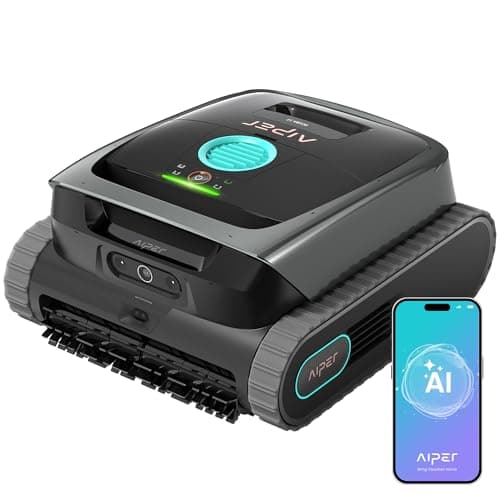 Aiper Scuba V3 AI Vision Cordless Robotic Pool CleanerTop pickA published 3 micron filter, which is the finest figure any robot on this site states and finer than most DE filters. | The finest published filtration | 3 micron MicroMesh filter, smart waterline parking, wireless charging dock, floor/wall/waterline cleaning | |
| 2 | 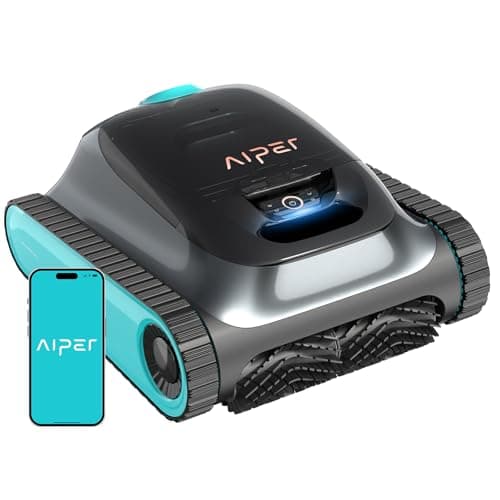 Aiper Scuba S1 Robotic Pool CleanerThe longest published runtime in this roundup, which is the specification that decides whether a cordless unit finishes a large pool in one charge. | Longest published runtime | Up to 270 minutes in Eco mode and up to 180 in Auto, Floor, Wall and Scheduled; floor, wall, waterline and shallow areas above 12 in; 180 plus 3 micron dual filtration | |
| 3 | 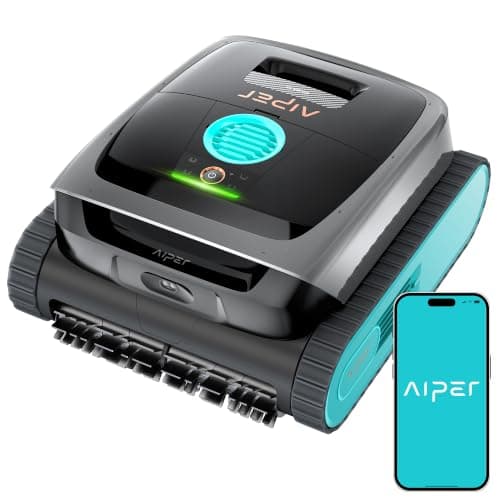 Aiper Scuba S3 Robotic Pool CleanerThe current flagship of the range: route planning from the pool's own contours rather than a fixed pattern, lateral waterline scrubbing, and a dual-stage filter down to 3 micron. | In-ground pools with an app | Up to 240 minutes in Eco mode, a 180 micron mesh plus a replaceable 3 micron ultra-fine insert, lateral waterline scrubbing to 2 in above the water, auto-docking at the waterline with a phone alert, 18 lbs | |
| 4 | 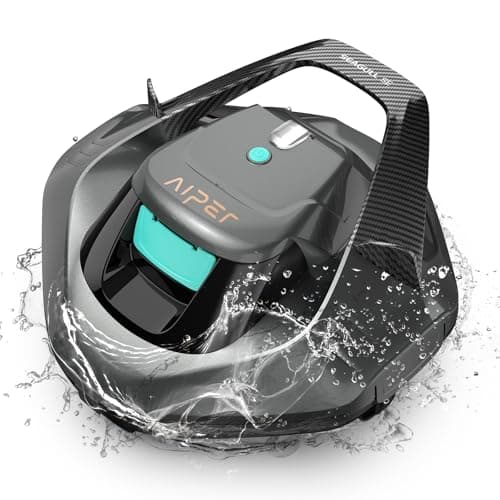 Aiper Seagull SE Cordless Robotic Pool VacuumPublishes suction, runtime and a coverage area together, which is the full sizing check most of this category makes impossible. | Above-ground pools | 1,320 GPH suction, 100 minute runtime, rated by the maker for above-ground pools up to 860 sq ft | |
| 5 | 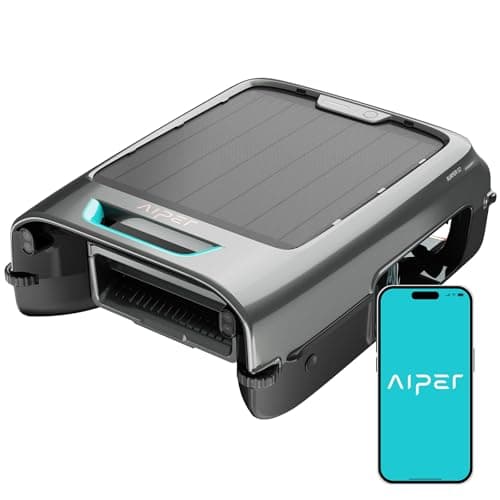 Aiper EcoSurfer S2 Solar Pool Skimmer RobotA different machine entirely - it works the surface, not the floor, which is where leaves are cheapest to catch. | Surface debris, continuously | Solar-charged surface skimmer, 150 micron filtration, app support, obstacle avoidance |
Why the range is worth reading spec by spec
Most brands in this category publish one figure consistently or none at all. Aiper does something more unusual: different models publish different things, and the gaps are as informative as the numbers.
A brand that states 3 micron on three machines and nothing at all on a fourth is telling you something about the fourth machine. Not that it is bad - but that if fine filtration is what you are buying, you should buy one of the models that committed to a number.
The range, on Aiper's own published figures
| Model | Filtration | Runtime | Coverage | Cleans |
|---|---|---|---|---|
| Scuba V3 | 3 micron MicroMesh | Not published | Not published | Floor, wall, waterline |
| Scuba S1 | 3 micron ultra-fine layer, per the 2026 listing | 270 min Eco, 180 min Auto | Not published | Floor, wall, waterline, shallow area |
| Scuba S3 | 180 micron plus replaceable 3 micron, per the 2026 listing | Up to 240 min Eco | Not published | Floor, wall, waterline |
| Seagull SE | Not published | 100 min | Up to 860 sq ft | Floor, above-ground |
| EcoSurfer S2 | 150 micron | Solar, continuous | Not published | Surface only |
Every cell there is what we found published or genuinely absent. Where a cell says not published, that is the finding rather than a gap we chose not to fill.
The 3 micron claim, and when it matters
3 micron is finer than a DE filter, which reaches roughly 3 to 5, and vastly finer than the 180 micron most robots publish. It is the finest figure any manufacturer states across every robot on this site.
It matters in exactly one situation, and not at all otherwise. If your pool is leaf-free and still hazy, the haze is silt, pollen or fine dead algae passing through coarse filtration and returning to the water. That is what a 3 micron filter addresses - and it is the same reasoning behind vacuuming algae with fine filtration.
The Seagull SE and why its spec sheet is the best of the range
It is the cheapest and simplest machine here, and it is the only one you can size against your own pool with confidence, because it publishes suction, runtime and coverage area together.
An above-ground pool is a flat floor at uniform depth with walls a robot has no business climbing. The Seagull SE is simpler because that job is simpler, not because it is a lesser machine - the same reasoning as choosing a robot by pool type.
The EcoSurfer is not a floor robot
Worth stating plainly, because it sits in the same range and does something entirely different. It is a solar-powered surface skimmer: it runs on the surface collecting debris before it sinks, and it never goes near the floor or the walls.
The argument for it is the one behind our whole leaves section: a floating leaf is trivial to remove, and the same leaf on the floor two days later is a vacuum cycle that has begun releasing phosphate. Solar charging means it can work continuously through daylight rather than in cycles, which is what makes prevention practical.
150 micron filtration is coarse and correctly so - it is catching leaves and insects, not silt. It complements a floor robot; it does not replace one.
The picks
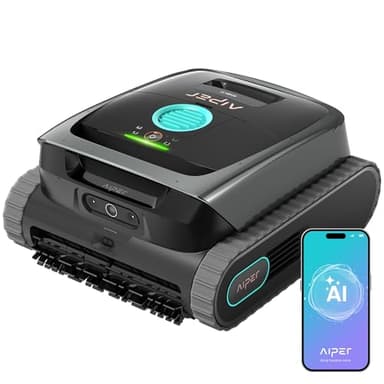
Top pick - The finest published filtration
Aiper Scuba V3 AI Vision Cordless Robotic Pool Cleaner
A published 3 micron filter, which is the finest figure any robot on this site states and finer than most DE filters.
The published figure
3 micron MicroMesh filter, smart waterline parking, wireless charging dock, floor/wall/waterline cleaning
3 micron is a genuinely unusual claim in this category. Most robots publish 180 micron or nothing at all, and 180 micron catches leaves while letting silt, pollen and fine dead algae straight back into the pool.
If your complaint is that the pool is leaf-free and still hazy, this is the specification that addresses it - and it is the same argument as choosing a DE filter over sand.
The cost is maintenance. A 3 micron filter fills faster than a coarse one by definition, because it is now catching material that used to pass through.
What it does well
- 3 micron published filtration, the finest of any robot on this site
- Wireless charging dock, so no cable to seat by hand
- Waterline parking as well as waterline cleaning
What it costs you
- Fine filtration means noticeably more frequent filter cleaning
- No published coverage-area figure, so sizing against your pool is guesswork
Skip it if your pool only ever collects leaves. You would be paying for filtration you never use and cleaning it more often.
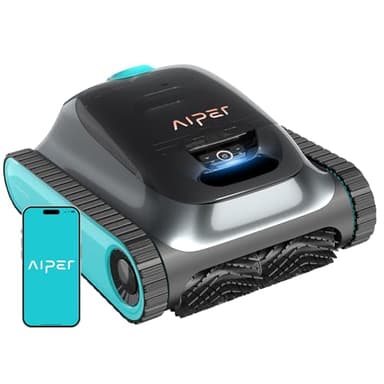
Pick 2 - Longest published runtime
Aiper Scuba S1 Robotic Pool Cleaner
The longest published runtime in this roundup, which is the specification that decides whether a cordless unit finishes a large pool in one charge.
The published figure
Up to 270 minutes in Eco mode and up to 180 in Auto, Floor, Wall and Scheduled; floor, wall, waterline and shallow areas above 12 in; 180 plus 3 micron dual filtration
Runtime is the whole cordless argument. A 90-minute unit in a large pool means two cycles and a recharge between them, which is not what anyone buys a robot for.
270 minutes in Eco mode is at the top of the published range across the brands here. Compare it against your pool's area, not against other robots in the abstract.
Cordless means the battery is the wear part. Every cordless robot on this page will need a battery before it needs anything else.
What it does well
- 270 minutes in Eco mode is the longest published runtime of the cordless units here
- Covers floor, walls and waterline rather than floor only
- No cord to tangle or lift
What it costs you
- Battery is a consumable with a finite cycle life
- Recharge time between cycles on very large pools
Skip it if you have mains power at the pool edge and no cord objection — a corded unit removes the runtime question entirely.
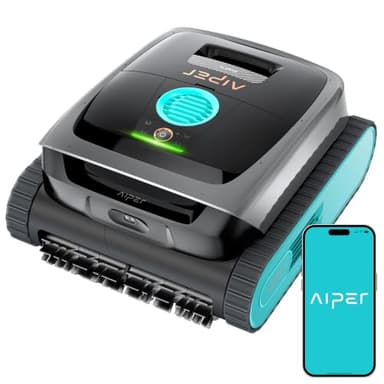
Pick 3 - In-ground pools with an app
Aiper Scuba S3 Robotic Pool Cleaner
The current flagship of the range: route planning from the pool's own contours rather than a fixed pattern, lateral waterline scrubbing, and a dual-stage filter down to 3 micron.
The published figure
Up to 240 minutes in Eco mode, a 180 micron mesh plus a replaceable 3 micron ultra-fine insert, lateral waterline scrubbing to 2 in above the water, auto-docking at the waterline with a phone alert, 18 lbs
Path planning is what separates a robot that covers a pool from one that covers a pool eventually. A machine running a fixed zig-zag in an irregular pool misses the same areas every cycle.
Auto-docking matters more than it sounds. This one ascends to the waterline when the cycle ends, waits ten minutes and sends a phone alert. A cordless robot that finishes in the middle of the deep end is a robot you retrieve with a hook.
The 2026 listing states what the earlier one did not: a 180 micron mesh with a replaceable 3 micron ultra-fine insert behind it. That is the same pair of figures Aiper states on the Scuba V3 and S1, so filtration is no longer the specification that separates them.
What it does well
- Route planning built from the pool's own contours rather than a fixed pattern
- Lateral waterline scrubbing to 2 in above the water, where the scum line forms
- Docks at the waterline and sends an alert, so retrieval is not a hunt
What it costs you
- No square-foot coverage figure, so it cannot be sized to a pool the way the Seagull SE can
- Cordless, so the battery is the wear part and eventually the limit
Skip it if you only need the floor cleaned. The waterline scrubbing and the docking behavior are what this model charges for, and the cheaper Scuba S1 states the same 3 micron filter layer.
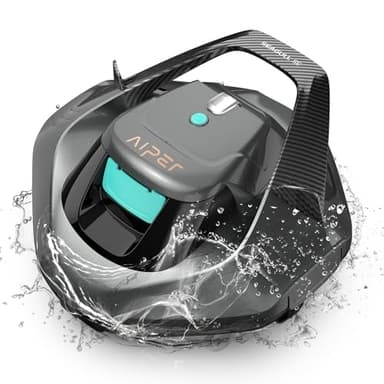
Pick 4 - Above-ground pools
Aiper Seagull SE Cordless Robotic Pool Vacuum
Publishes suction, runtime and a coverage area together, which is the full sizing check most of this category makes impossible.
The published figure
1,320 GPH suction, 100 minute runtime, rated by the maker for above-ground pools up to 860 sq ft
860 sq ft is a real number you can check. A 24 ft round above-ground pool has about 452 sq ft of floor, so this covers it with a wide margin - and that is the arithmetic a coverage figure exists to let you do.
1,320 GPH is the suction figure. It is lower than the in-ground models in the range, which is appropriate: an above-ground pool is a flat floor with no walls to climb and no deep end to work.
100 minutes is short by in-ground standards and ample for the area it is rated to.
What it does well
- Suction, runtime and coverage area all published together
- Sized and priced for the pool it is actually for
- Self-parking, so retrieval is not a chore
What it costs you
- Does not climb walls, by design
- Wrong machine for an in-ground pool of any size
Skip it if you own an in-ground pool. You would be giving up wall and waterline cleaning entirely.
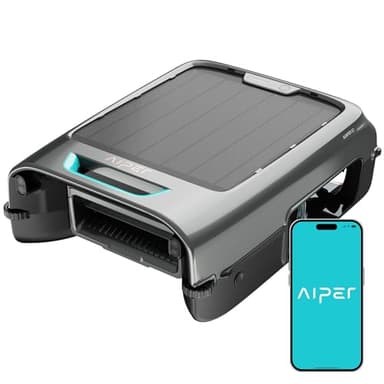
Pick 5 - Surface debris, continuously
Aiper EcoSurfer S2 Solar Pool Skimmer Robot
A different machine entirely - it works the surface, not the floor, which is where leaves are cheapest to catch.
The published figure
Solar-charged surface skimmer, 150 micron filtration, app support, obstacle avoidance
This is not a floor robot and it does not replace one. It runs on the surface collecting debris before it sinks, which is the same economics as our daily net argument: a floating leaf is trivial to remove, a sunken one is a vacuum cycle.
Solar charging means it can run continuously through daylight rather than in cycles, which is what makes the prevention argument work at all.
150 micron filtration is coarse, and correctly so - it is catching leaves and insects, not silt.
What it does well
- Catches debris before it sinks, which is where prevention is cheapest
- Solar, so continuous running costs nothing
- Complements a floor robot rather than competing with one
What it costs you
- Does nothing at all about the floor or walls
- Coarse 150 micron filtration - by design, but it is not a clarity tool
- Effectiveness depends on your pool getting real sun
Skip it if your problem is on the floor. This machine never goes there, and no amount of surface skimming clears settled debris.
How the range compares to the others here
| Brand | Publishes filtration micron | Publishes coverage area | Publishes runtime |
|---|---|---|---|
| Wybot | Yes, on several models | Yes, on several models | Yes |
| Aiper | On two of five | On one of five | On two of five |
| Dolphin | Not on the listings we read | Not on the listings we read | Corded - not applicable |
| Polaris | Not on the listings we read | Publishes pool length instead | Corded on some models |
On published specification detail, Wybot remains the most complete in this category - see Wybot pool cleaners, with Beatbot close behind on the Sora range, and Aiper vs Dolphin for the cordless-against-corded decision. Aiper's V3 beats everything on the single figure of filtration fineness. Dolphin and Polaris compete on other things: Dolphin on corded simplicity and Polaris on published length ratings and dealer support.
What we have not done
We have not run any of these machines. There is no test pool here and no fleet. Everything above is read from what Aiper publishes, cross-checked against the live listings on 6 September 2026, with the gaps named as gaps.
What we cannot tell you: whether a 3 micron filter achieves 3 micron in a real pool, how the navigation behaves on a freeform shape, or how any of these batteries hold up in year three. Those need a lab or a season, and we have neither.
Questions people actually ask
Is Aiper a good pool cleaner brand?
Which Aiper has the best filtration?
What size pool does the Aiper Seagull SE cover?
What is the difference between the Aiper Scuba S1 and S3?
Is the Aiper EcoSurfer a replacement for a floor robot?
Sources
Every figure on this page traces to one of these. Where a number could not be sourced, the page says so rather than estimating.
- WYBOT C2 - maker's product page, 180 minute runtime, up to 2,152 sq ft per cycle, 10 micron ultra-fine plus 180 micron primary filtration
- Skim & Soak methodology - the constants, formulas and worked examples behind every dose on this site
- Aiper Scuba V3 AI Vision, 3 micron MicroMesh filter - Amazon listing, read 2026-09-02
- Aiper Scuba S1, 270 min Eco runtime - Amazon listing, read 2026-10-03
- Aiper Seagull SE, 1,320 GPH, 100 min, 860 sq ft - Amazon listing, read 2026-09-02
- Aiper EcoSurfer S2 solar skimmer, 150 micron - Amazon listing, read 2026-09-02
Read next
Best robotic cleaner
Best Robotic Pool Cleaners
Corded and cordless robots compared on coverage per cycle, micron rating and runtime, with the sizing rule that decides it.
Top pick
Dolphin Nautilus CC Plus Wi-Fi Robotic Pool Vacuum
In-ground pools up to 50 ft
#ad · how this is funded · price as of October 9, 2026
Best published specs
Wybot Pool Cleaners
The A1, B1, C1, C2, S2 and S3 compared on the figures Wybot publishes and most competitors do not.
Top pick
Wybot C2 Cordless Pool Vacuum for In-ground Pools
Finest published filtration
Choosing a Robot by Pool Type
Above-ground, vinyl, fiberglass and gunite each change which robot specs matter and which are irrelevant.
Top pick
Dolphin Nautilus AG Robotic Pool Vacuum, above ground
Above-ground pools
#ad · how this is funded · price as of October 9, 2026
What a Robotic Pool Cleaner Costs to Run
Electricity per cycle and per season, computed from published power draw, plus the consumables that cost more than the power does.
Top pick
Dolphin Nautilus CC Plus Wi-Fi Robotic Pool Vacuum
In-ground pools up to 50 ft
#ad · how this is funded · price as of October 9, 2026