Green Water & Algae
Best Pool Brush
The cheapest tool you will buy for a pool, and the one that decides how well the expensive chemicals work.
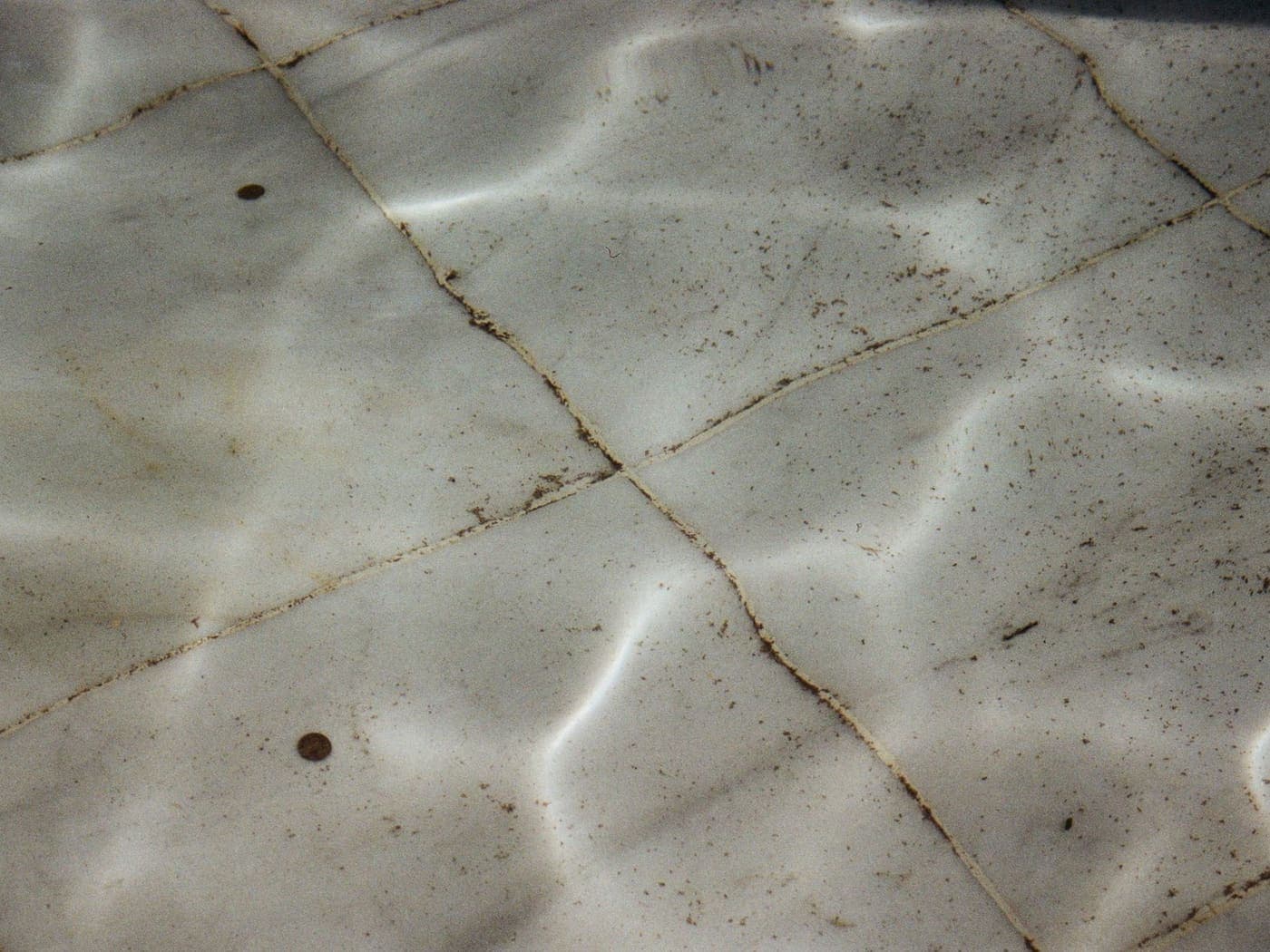
We have not handled these products and we do not pretend to have. Here is what we did instead. Links to Amazon earn us a commission at no extra cost to you, and commission never decides a pick — disclosure.
| # | Product | Best for | The spec it turns on | Price |
|---|---|---|---|---|
| 1 | 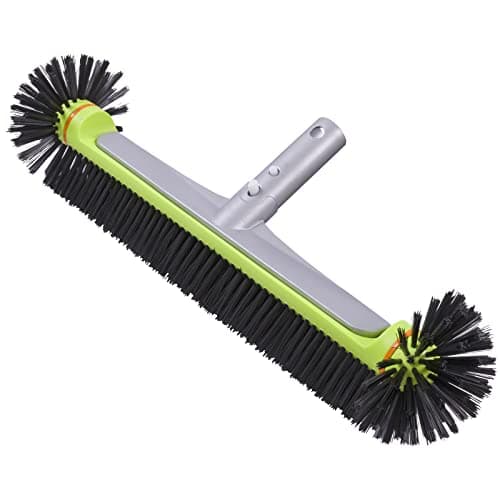 Sepetrel 17.5-Inch Hemispherical Pool Brush HeadTop pickThe one brush on this page the maker states is safe on every common pool surface, which is why it is first. | Most pools, most surfaces | 17.5 in head, 1 lb, 45-degree angled aluminum handle, stated safe for vinyl, concrete, fiberglass and tile | |
| 2 | 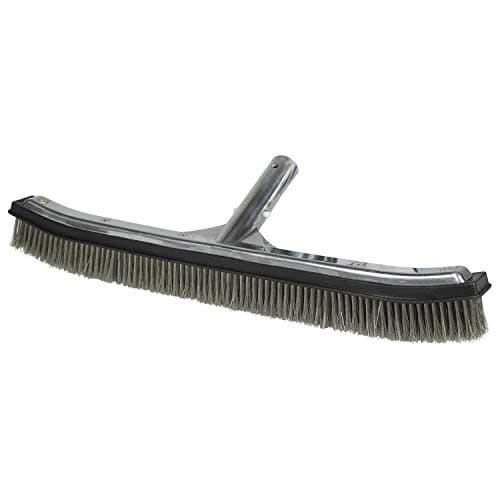 Poolmaster 18-Inch Stainless Steel Pool Algae BrushStainless bristles on a concrete pool are the step that makes the shock work, and the cheapest item in any of these roundups. | Brushing before you shock | 18 in stainless steel bristles on an aluminum back, for gunite and concrete | |
| 3 | 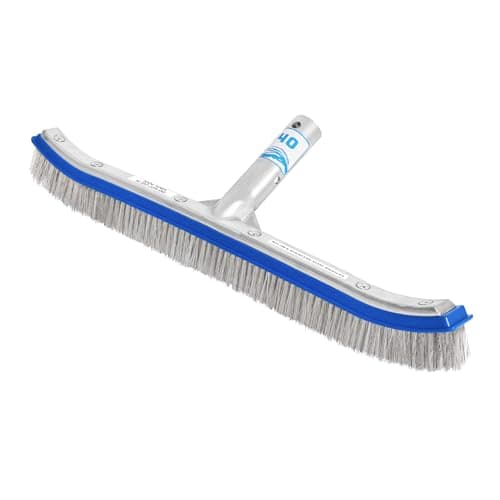 440 18-Inch Combo Stainless Steel and Nylon Pool BrushStainless bite where you need it with nylon rows carrying the routine work, so one brush covers both jobs on a hard-surface pool. | Plaster and gunite, week in week out | 18 in head mixing nylon and stainless bristles, curved edges, aluminum handle on a hardened plastic frame | |
| 4 | 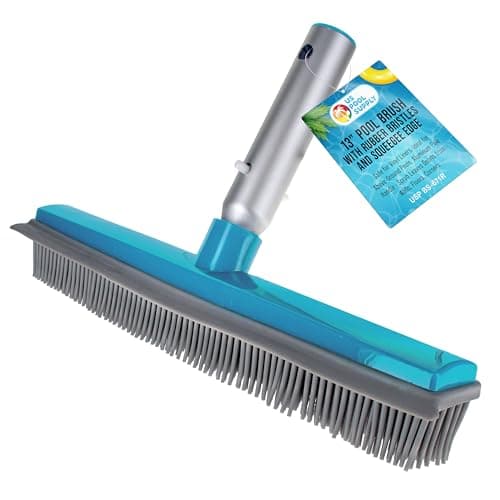 U.S. Pool Supply 13-Inch Pool Brush Head, Rubber Bristles with Squeegee EdgeRubber rather than nylon, which is the right answer on a liner you would like to keep watertight. | Above-ground vinyl liners | 13 in head, rubber bristles plus a rubber squeegee leading edge, aluminum handle for a 1-1/4 in pole | |
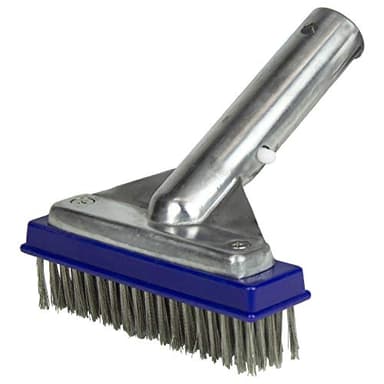
| 5 | 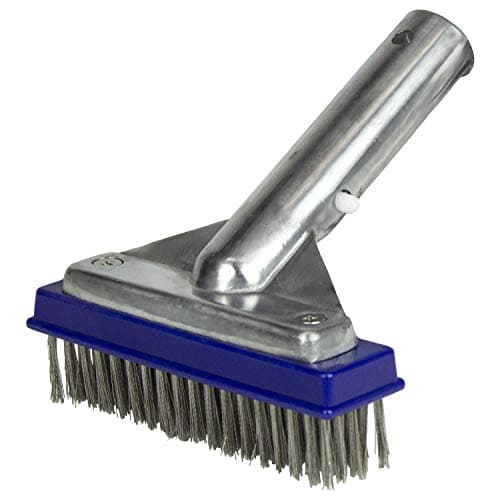 Poolmaster 5-Inch Stainless Steel Pool Algae Detail BrushThe narrow brush that reaches into the grout lines and corners where black algae actually anchors. | Spot-treating black algae | 5 in stainless steel bristles on an aluminum back, for gunite and concrete | |
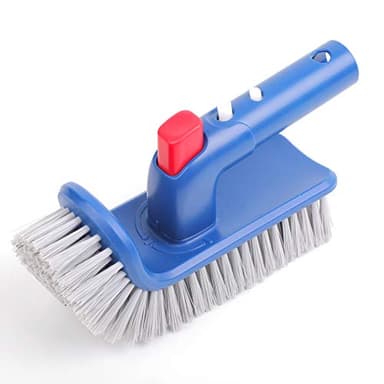
| 6 | 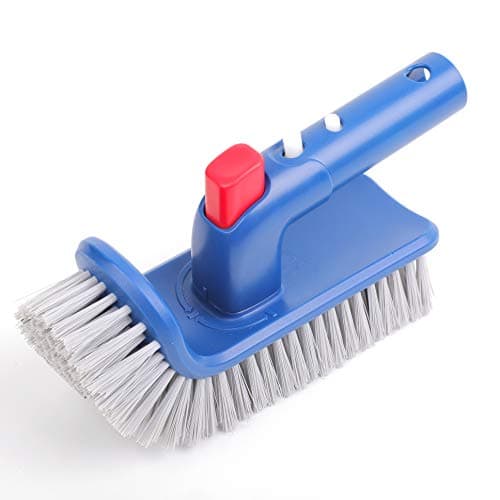 Sepetrel Rotatable Step and Corner Pool Brush HeadA wall brush cannot get into a step riser at any useful angle. This one turns to meet it. | Steps, corners and the spa | 4.3 x 2.8 x 8.3 in head, handle rotates 90 degrees left and right, 90-degree curved bristle ends | |
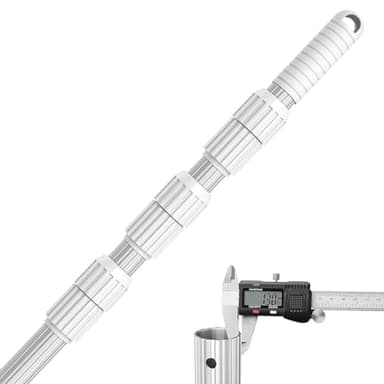
| 7 | 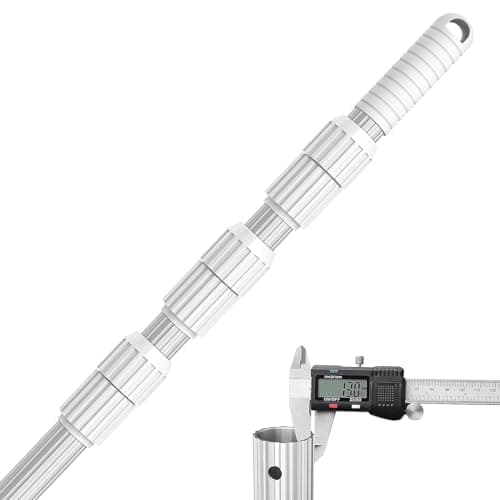 ARLBA Telescoping Pool Pole, 16.5 ft, 4-section aluminumWall thickness is the specification that decides whether a pole survives the season, and this one publishes it. | Reaching the middle of a wide pool | 16.5 ft extended, 1.30 mm anodized aluminum, four sections with three locking cams, 1-1/4 in end |
Why the cheapest tool decides the expensive outcome
Algae on a wall is not floating in the water. It is anchored to the surface underneath a film of its own making, and that film is a physical barrier between the organism and everything you dose into the pool. Chlorine cannot oxidize what it cannot touch.
Brushing removes the barrier. That is the entire mechanism, and it is why every ordered fix on this site - starting with how to clear a green pool fast - puts brushing before dosing rather than after it. HTH says the same thing on its own Green to Blue product page: brushing the pool surfaces will help speed up the process.
A brush costs less than a single bag of shock. If it makes one shock treatment work that would otherwise have needed two, it has paid for itself in the first week you own it - which is an unusual thing to be able to say about anything in pool care.
Your surface picks the brush
Everything else on this page is detail. The one decision that can go badly wrong is bristle material against pool surface, because the failure mode in one direction is a permanent hole in your liner.
| Your pool surface | Use | Never use | Why |
|---|---|---|---|
| Plaster, gunite, concrete | Stainless steel, or a nylon and stainless combination | - | Hard, porous and slightly rough. Algae anchors in the pores and nylon skates over it. |
| Vinyl liner, inground | Nylon | Stainless steel | Steel bristles cut vinyl. The maker of every stainless brush here says so on the listing. |
| Vinyl liner, above ground | Rubber or nylon | Stainless steel | Same risk, thinner liner, and the pool is the liner. A puncture is a replacement. |
| Fiberglass | Nylon or rubber | Stainless steel | The gelcoat scratches, and scratches are where the next algae bloom takes hold. |
| Tile and waterline | Nylon | Stainless steel on the grout | Steel scours grout out of the joint over a season of weekly passes. |
| Painted plaster | Nylon | Stainless steel | Steel takes the paint off, which is not a cosmetic problem - it is a bare surface for algae. |
If you inherited the pool and genuinely do not know what it is finished in, buy nylon. Nylon on plaster is slower than it should be; steel on vinyl is a repair.
The four bristle materials, honestly
Nylon
The default, and the right default. Stiff enough to lift a biofilm off any surface, soft enough that it cannot damage one. It is what you want for the weekly pass on any pool and the only thing you should put on a liner or on fiberglass.
Its limit is established algae on a rough surface. Plaster is porous, black algae roots into that porosity, and nylon simply cannot generate the pressure per bristle to break it out. That is a real limitation, not a marketing one.
Stainless steel
For plaster, gunite and concrete only. Poolmaster's own listing for the 18 inch head is unambiguous about it: designed for inground pools and spas with plaster, gunite or concrete finishes, and not safe for vinyl liners or fiberglass surfaces.
On the surface it is made for, nothing else comes close. Steel is what removes black algae from a plaster wall, and no chemical treatment for black algae works without it because the crust has to be physically broken before anything can reach the organism underneath.
Combination nylon and stainless
Alternating rows of each. The steel gives bite on the spots that need it while the nylon rows carry the routine work and stop you scouring the finish every single week. Still hard-surface only - the maker of the combination head here also excludes above-ground pools.
For a plaster pool owner who wants one brush rather than two, this is the sensible compromise. For someone actively fighting a bloom, full stainless is still the faster tool.
Rubber
The specialist. Rubber bristles flex further than nylon, which keeps the head in contact through the coving where an above-ground wall curves into the floor, and they cannot scratch a liner under any pressure you can apply through a pole.
The trade is bite. Rubber lifts film and loose debris and does very little against calcium scale or an established bloom. It is a maintenance brush, not a recovery one.
Width, and the arithmetic nobody does
Brush heads run from about 5 inches to about 22. The instinct is to buy the widest one, and for wall and floor work that instinct is right - but it is worth seeing how much difference it actually makes, because the answer is larger than most people expect.
The counter-argument is real and worth stating. A very wide head flexes in the middle under pressure, so the center rows do less work than the ends; and a wide head cannot follow a curve, which is why steps, coving and the corner between two walls end up under-brushed on almost every pool. Around 17 to 18 inches is where most owners land, with a small brush kept for the places the big one skims.
The three things worth checking on the listing
- **A stated surface.** Any brush worth buying names the finishes it is for, or the ones it is not for. A listing that says nothing about surface is telling you the seller does not know, and on a liner that silence is expensive.
- **The pole fitting.** 1-1/4 inch is the standard, and every head on this page states it. A head with a proprietary fitting locks you into one maker's pole for the life of the pool.
- **Weight, if it is published.** Most listings do not publish it. On a 16 ft pole held at arm's length, half a pound decides whether you brush the whole pool or the half you can reach before your shoulders give out.
Bristle row counts are quoted constantly and mean very little without knowing the bristle diameter and stiffness, which nobody publishes. Treat a row count as a rough proxy for coverage and nothing more.
The picks
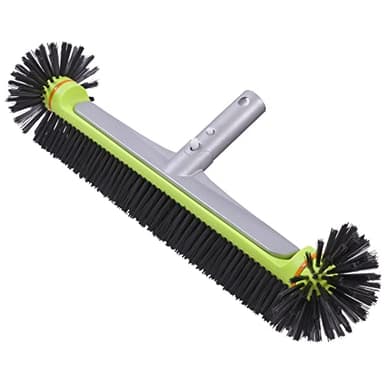
Top pick - Most pools, most surfaces
Sepetrel 17.5-Inch Hemispherical Pool Brush Head
The one brush on this page the maker states is safe on every common pool surface, which is why it is first.
The published figure
17.5 in head, 1 lb, 45-degree angled aluminum handle, stated safe for vinyl, concrete, fiberglass and tile
Sepetrel states this head is for vinyl, concrete, fiberglass and tile. That single sentence is what separates an all-surfaces brush from a stainless one, and most listings in this category never make the claim either way.
The published weight is 1 lb. On a 16 ft pole held overhead that is the difference between brushing a whole pool and brushing the half you can reach before your arms give out - a heavy head is the reason a brush stops getting used.
The hemispherical bristle profile is the maker's term for a rounded end that follows a wall into the coving and the corner instead of skipping across it. The head measures 17.5 x 4.3 x 3.7 inches and clips to any standard 1-1/4 inch pole.
What it does well
- Stated safe on vinyl, concrete, fiberglass and tile - it cannot be the wrong choice for your surface
- 1 lb published weight, which is what makes a full brush-down actually happen
- 45-degree angled handle keeps the head flat on the wall instead of rolling off it
What it costs you
- Nylon cannot match stainless on a plaster pool with established algae
- Pole is not included
- The maker does not publish a bristle row count
Skip it if your pool is plaster or gunite and you are fighting algae right now. Stainless removes in one pass what nylon will not remove in five.
#ad · how this is funded · price as of October 9, 2026
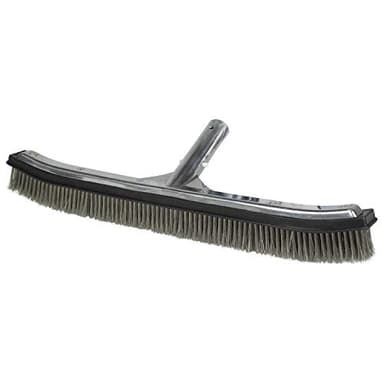
Pick 2 - Brushing before you shock
Poolmaster 18-Inch Stainless Steel Pool Algae Brush
Stainless bristles on a concrete pool are the step that makes the shock work, and the cheapest item in any of these roundups.
The published figure
18 in stainless steel bristles on an aluminum back, for gunite and concrete
Algae clinging to a wall is physically shielded from the water around it. Brushing first is what lets chlorine reach the organism rather than the film over it, which is why every ordered fix on this site puts brushing before dosing.
Stainless is for gunite, concrete and plaster only. On a vinyl liner it will cut, and you want nylon.
18 inches is the size that covers a wall in a reasonable number of passes without being unmanageable on a long pole.
What it does well
- Makes the shock dose that follows it materially more effective
- Costs a fraction of any chemical it improves
- Aluminum back resists the corrosion that kills cheap brushes
What it costs you
- Stainless bristles will damage a vinyl liner
- Pole sold separately
Skip it if your pool has a vinyl liner. Buy the nylon equivalent instead.
#ad · how this is funded · price as of October 9, 2026
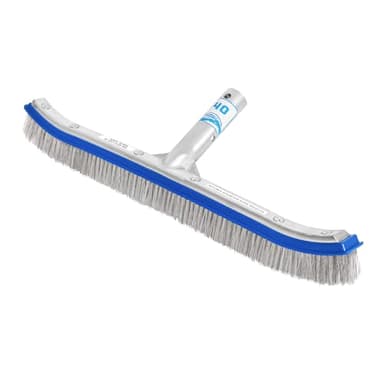
Pick 3 - Plaster and gunite, week in week out
440 18-Inch Combo Stainless Steel and Nylon Pool Brush
Stainless bite where you need it with nylon rows carrying the routine work, so one brush covers both jobs on a hard-surface pool.
The published figure
18 in head mixing nylon and stainless bristles, curved edges, aluminum handle on a hardened plastic frame
The maker states this head combines nylon and stainless steel bristles, and lists it for concrete, gunite and plaster while explicitly excluding above-ground pools. That exclusion is a liner warning, and it is the right one to publish.
A full-stainless brush is punishing on routine work and shortens the life of plaster if you lean on it every week. Mixed rows give you enough metal to break a film and enough nylon to make the weekly pass tolerable.
18 inches and curved edges is the same geometry as the Poolmaster stainless head - the difference is entirely in what the bristles are made of. It uses an EZ clip and fits any standard telescopic pole.
What it does well
- Handles both the weekly brush and an algae pass without owning two heads
- 18 in curved head covers a wall quickly and follows it into corners
- The listing states plainly which surfaces it is not for, which most do not
What it costs you
- Not for vinyl or above-ground pools, per the maker
- Less aggressive than full stainless on established black algae
- Hardened plastic frame rather than a full die-cast back
Skip it if your pool has a vinyl liner. The steel rows will cut it, and the maker says so.
#ad · how this is funded · price as of October 9, 2026
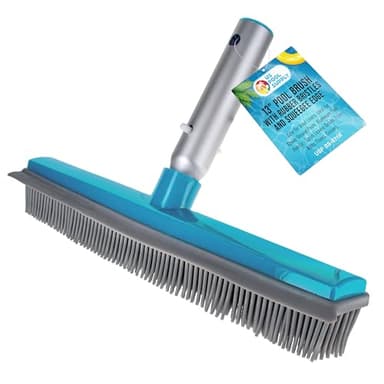
Pick 4 - Above-ground vinyl liners
U.S. Pool Supply 13-Inch Pool Brush Head, Rubber Bristles with Squeegee Edge
Rubber rather than nylon, which is the right answer on a liner you would like to keep watertight.
The published figure
13 in head, rubber bristles plus a rubber squeegee leading edge, aluminum handle for a 1-1/4 in pole
The maker states the rubber bristles and squeegee edge are for scrubbing vinyl liners without scratching or damaging them. On an above-ground pool the liner is the pool, and a puncture is not a scratch - it is a replacement.
Rubber flexes further than nylon, so the head stays in contact through the coving where an above-ground wall curves into the floor. That curve is where debris accumulates and where a stiff flat head skips.
13 inches is narrower than the 17.5 and 18 inch heads here, which is the correct trade on a small pool: less width, more pressure per inch, and less of the flex that makes a wide head wander.
What it does well
- Rubber bristles cannot cut a liner the way steel can
- Squeegee edge gives a wide soft scrape for film rather than grit
- Flexes into coving, steps and slopes instead of riding over them
What it costs you
- 13 in covers a large inground pool slowly
- Rubber has no bite on calcium scale or established algae
- Pole not included
Skip it if you own a large plaster inground pool. This is the wrong material and the wrong width for it.
#ad · how this is funded · price as of October 9, 2026
Pick 5 - Spot-treating black algae
Poolmaster 5-Inch Stainless Steel Pool Algae Detail Brush
The narrow brush that reaches into the grout lines and corners where black algae actually anchors.
The published figure
5 in stainless steel bristles on an aluminum back, for gunite and concrete
An 18 inch wall brush sweeps a wall. It cannot put meaningful pressure into a two-inch patch in a grout line, and pressure is the entire mechanism against black algae.
Black algae grows a protective layer that chlorine cannot penetrate. Breaking that crust is what lets any treatment reach the organism, and a small head concentrates your force on the spot rather than spreading it over a wall.
Stainless is for gunite, concrete and plaster only. On a vinyl liner it will cut.
What it does well
- Concentrates pressure on a small area, which is what the job needs
- Reaches grout lines, corners and steps a wide brush skims over
- Costs a fraction of the chemicals it makes work
What it costs you
- Useless for routine wall brushing
- Stainless will damage a vinyl liner
Skip it if your pool has a vinyl liner. Black algae is rare on vinyl and stainless will cut it.
#ad · how this is funded · price as of October 9, 2026
Pick 6 - Steps, corners and the spa
Sepetrel Rotatable Step and Corner Pool Brush Head
A wall brush cannot get into a step riser at any useful angle. This one turns to meet it.
The published figure
4.3 x 2.8 x 8.3 in head, handle rotates 90 degrees left and right, 90-degree curved bristle ends
Steps are where algae is found last and cleared last, because a wide flat head on a long pole meets a step tread at the wrong angle and skims it. Sepetrel's handle rotates 90 degrees each way on a button, so the head can be set to the surface you are actually on.
The 90-degree curved front is for the join between a riser and a tread - the internal corner that a straight-ended brush touches at exactly one point.
It works by hand or on a standard 1-1/4 inch pole, which also makes it the brush for a spa or hot tub where a 17 inch head does not fit at all.
What it does well
- Rotating head meets step treads, risers and corners at a usable angle
- Small enough to use by hand in a spa
- Clip has a guard that stops the pole pinching your fingers
What it costs you
- Far too small for wall or floor work
- Rubber and plastic construction, not aluminum
- The maker does not state a bristle material
Skip it if your pool has no steps, benches or spa. This is a second brush, never a first one.
#ad · how this is funded · price as of October 9, 2026
Pick 7 - Reaching the middle of a wide pool
ARLBA Telescoping Pool Pole, 16.5 ft, 4-section aluminum
Wall thickness is the specification that decides whether a pole survives the season, and this one publishes it.
The published figure
16.5 ft extended, 1.30 mm anodized aluminum, four sections with three locking cams, 1-1/4 in end
Every net, brush and vacuum head on this site attaches to a pole, and the pole is where people economize and then replace twice.
1.3 mm wall thickness is the published figure to compare against. Thin-walled poles flex at full extension, and the flex is what eventually kinks them permanently at the joint.
16.5 feet reaches the middle of most residential pools from the edge. A 12 ft pole does not, on anything wider than about 20 feet.
What it does well
- Publishes wall thickness, 1.30 mm, which most pole listings do not
- 16.5 ft reaches the center of a typical residential pool
- Standard fitting works with every net and brush on this site
What it costs you
- Four sections flex more at full extension than two
- Aluminum at this length is heavy overhead
Skip it if you own a small above-ground pool you can reach across. A 12 ft two-section pole is stiffer and lighter.
#ad · how this is funded · price as of October 9, 2026
The pole is half the tool
Every head here is sold without a pole, and the pole is where people economize and then buy twice. A thin-walled pole flexes at full extension, and that flex is what eventually kinks it permanently at a joint - after which it will not lock at the length you need.
Wall thickness is the specification to compare, and almost no listing publishes it. Length matters too: 16 feet reaches the middle of a typical residential pool from the edge, and 12 feet does not on anything wider than about 20 feet. The same pole carries your skimmer net and vacuum head, so it is bought once for the whole cleaning kit.
How to brush a pool so the shock works
- **Brush before you dose, not after.** The point is to expose the algae to chlorine that has not yet been consumed.
- **Start at the shallow end and work toward the deep end,** so you are pushing debris ahead of you rather than dragging it back over surfaces you have already done.
- **Walls first, then the floor.** Everything you knock off a wall lands on the floor, and doing it in the other order means doing the floor twice.
- **Overlap every pass by a few inches.** The gaps between passes are where a bloom restarts, and they are invisible from the deck.
- **Do the steps, the ladder and the light niche by hand or with a small head.** These are where algae is found last, because a wide head on a long pole meets them at the wrong angle.
- **Then dose,** by weight for your actual volume - see best pool shock for the dose tables.
- **Brush again the next day,** before you vacuum. What settles overnight is dead algae, and stirring it back into suspension before you vacuum makes it easier for the filter to catch.
On a bad bloom this is a daily job for several days rather than a single afternoon, and that is normal. Mustard algae in particular returns to the same shaded wall repeatedly, and the brushing is what eventually exhausts it.
What a brush cannot do
It cannot fix chemistry. If your cyanuric acid is high, brushing exposes the algae perfectly to chlorine that has been blunted before it arrives - see cyanuric acid for why the reading on your test strip stops meaning what it used to.
It cannot remove what it knocks loose. Brushing puts the bloom into suspension, which is where your filter, a clarifier or a vacuum has to take over. And it cannot substitute for circulation: a pool with a dead spot behind the ladder will grow algae there again whatever you do with a brush.
It also cannot help with green water that is not algae at all. Roughly one green pool in five is dissolved metal rather than a bloom, and there is nothing on the walls to brush.
Questions people actually ask
What is the best pool brush?
Can I use a stainless steel brush on a vinyl liner?
Should I brush before or after shocking the pool?
How often should I brush my pool?
What size pool brush do I need?
Do I need a special brush for black algae?
Does a robotic cleaner mean I do not need a brush?
Sources
Every figure on this page traces to one of these. Where a number could not be sourced, the page says so rather than estimating.
- HTH Pool Care Green to Blue Advanced - product page, the two-step cal hypo then flocculant recovery sequence
- Skim & Soak methodology - the constants, formulas and worked examples behind every dose on this site
- Sepetrel 17.5-Inch Hemispherical Pool Brush Head, stated safe for vinyl, concrete, fiberglass and tile - Amazon listing, read 2026-09-08
- Poolmaster 18-Inch Stainless Steel Pool Algae Brush, gunite and concrete only - Amazon listing, read 2026-09-08
- 440 18-Inch Combo Stainless Steel and Nylon Pool Brush, in-ground hard surfaces only - Amazon listing, read 2026-09-08
- U.S. Pool Supply 13" Pool Brush Head with Rubber Bristles and Squeegee Edge - Amazon listing, read 2026-09-08
Read next
How to Clear a Green Pool Fast
The ordered fix: test, brush, shock by weight, filter continuously, clear the dead algae, then prevent the next one.
Best for black algae
How to Get Rid of Black Algae
Black algae roots into plaster under a protective crust. Brush hard, treat the brushed spot, repeat for weeks.
Top pick
Poolmaster 5-Inch Stainless Steel Pool Algae Detail Brush
Spot-treating black algae
#ad · how this is funded · price as of October 9, 2026
Best for mustard algae
How to Get Rid of Mustard Algae
Yellow, powdery, shade-loving and chlorine-tolerant. Treating the water without treating the equipment gives you a two-week cycle.
Top pick
United Chemicals YellowTreat Mustard Algaecide, 2 lb
Mustard algae specifically
#ad · how this is funded · price as of October 9, 2026
Best starter tool set
Pool Cleaning Kit Essentials
The six-item manual set, what each one is for, and why bundled kits are judged on their pole.
Top pick
ARLBA Telescoping Pool Pole, 16.5 ft, 4-section aluminum
Reaching the middle of a wide pool
#ad · how this is funded · price as of October 9, 2026
Best for vacuuming algae
Best Pool Vacuum for Algae
Dead algae is far finer than leaves. What matters is where it ends up, not how hard the vacuum pulls.
Top pick
POOLWHALE Pool Vacuum Head and 36 ft Hose Kit
The complete manual kit
#ad · how this is funded · price as of October 9, 2026