Testing & Chemistry
Calcium Hardness Too High
The one reading on this site with no chemical answer. There is arithmetic instead, and it tells you how much water has to go.

We have not handled these products and we do not pretend to have. Here is what we did instead. Links to Amazon earn us a commission at no extra cost to you, and commission never decides a pick — disclosure.
| # | Product | Best for | The spec it turns on | Price |
|---|---|---|---|---|
| 1 |  Natural Chemistry Scale Free, 2 Liter, 2-PackTop pickA sequestrant that keeps hard water from depositing while you deal with the hardness itself. It prevents; it does not remove calcium from the pool. | Holding the line while you dilute | Listing states phosphate-free prevention of scale buildup and staining from excess calcium, iron, copper and other minerals, including on salt generator cells, and states it must not be used with biguanides | |
| 2 |  EasyCare Scaletec Plus Calcium Descaler, 64 ozThe other half of the job: this one is aimed at scale that has already formed, without draining the pool and taking acid to the plaster. | Scale that is already on the surfaces | Listing states removal of white calcium and mixed-composition scale from pool surfaces and equipment, sequestration of iron, copper and manganese stains, salt cell care, and a non-acidic formula | |
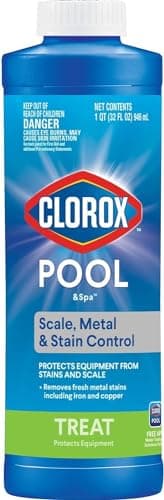
| 3 | 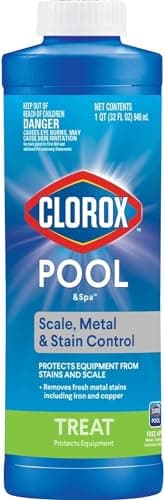 Clorox Pool&Spa Scale, Metal and Stain Control, 1 quartCovers calcium scale as well as metals, which is the right combination on hard fill water - and it limits its stain-removal claim to fresh stains, which is honest. | Hard water plus metals | 1 quart; stated to prevent metal stains and scale formation and to remove fresh metal stains | |
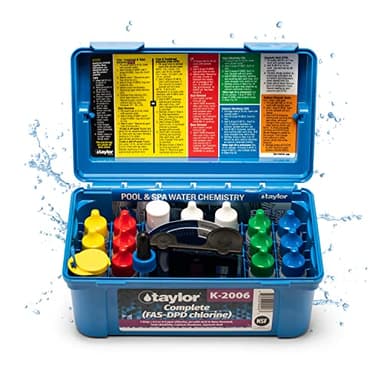
| 4 | 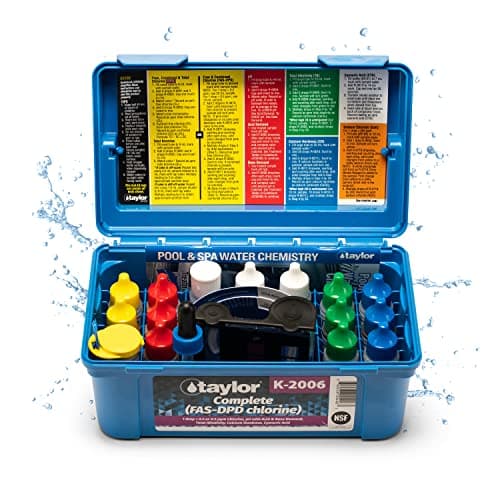 Taylor K-2006 Complete FAS-DPD Pool Test KitThe kit every pool forum names, and for once the consensus is right - because titration is the one chlorine method that does not saturate exactly when you need it. | The reference residential kit | FAS-DPD titration for free and combined chlorine, plus pH, acid and base demand, total alkalinity, calcium hardness and cyanuric acid; 3/4 oz reagents | |
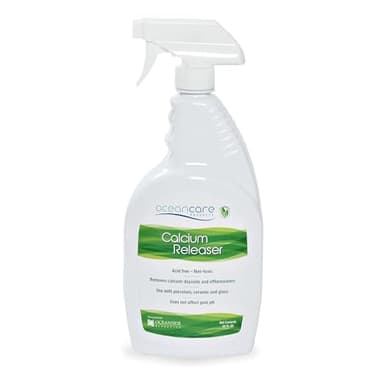
| 5 | 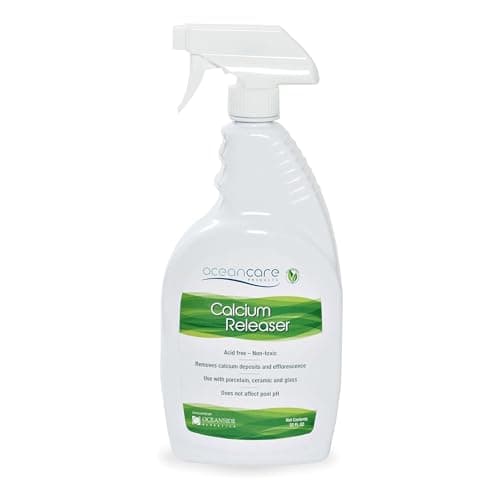 Oceancare Calcium Releaser, 32 oz trigger sprayMineral acid-free and aimed squarely at tile finishes that other products warn you about. A short listing, but the claims it makes are the relevant ones. | Delicate tile finishes | Listing states mineral acid-free, for porcelain, ceramic and glass tile, removes calcium and efflorescence | |
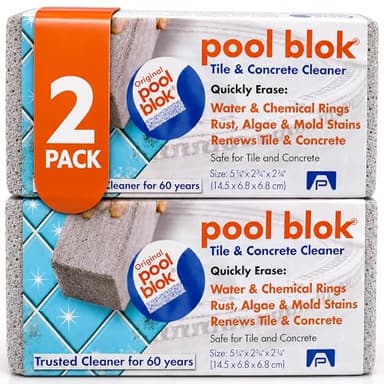
| 6 | 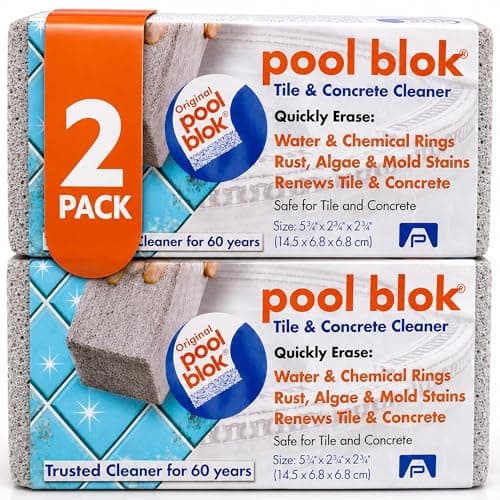 Pumie Pool Blok Pumice Stone, 2-packThe cheapest thing on this page and the one with the clearest limits. It abrades deposits off hard surfaces and will damage soft ones. | Spot-removing scale by hand | Listing states natural pumice that floats; for ceramic tile, grout, concrete and gunite; not for vinyl, fiberglass or wood |
Why there is no chemical answer
Every other reading on this site can be moved in both directions with a product. pH has acid and soda ash. Alkalinity has bicarbonate and acid. Chlorine has shock and, if you insist, thiosulfate. Calcium hardness has an increaser and nothing in the other direction.
That is not an oversight in the market. Dissolved calcium leaves water in exactly three ways: it precipitates onto a surface as scale, it goes out through a filter after being deliberately precipitated, or it leaves in the water itself. The first is the damage you are trying to avoid. The third is dilution.
Our page on how to raise calcium hardness says the same thing from the other side, and it is the reason that correction gets a warning the others do not: it is one-way.
Check these two numbers before you drain anything
A high calcium reading on its own does not scale a pool. Calcium carbonate comes out of solution when the water is already pushing in that direction - high pH, high total alkalinity, warm water - and stays dissolved when it is not.
So before you move a drop of water, bring pH into the 7.2 to 7.6 range that every label on this site agrees on, and alkalinity into 80 to 120 ppm. See pool pH too high and how to lower alkalinity. A pool at 500 ppm calcium with correct pH and alkalinity is frequently fine; a pool at 350 ppm with pH drifting over 8 will scale.
The arithmetic: how much water has to go
Dilution is a mixing problem, and it has one honest formula. You are replacing a fraction of water at your current hardness with water at your fill water's hardness.
The denominator is where the bad news lives. If your fill water is close to your target, a modest replacement does a lot of work. At 220 ppm against a 400 ppm target you can get there, but every top-up pushes back toward it - and if the hose runs harder than your target, no amount of draining reaches it at all.
| Option | Lowers calcium hardness? | What it is for |
|---|---|---|
| Partial drain and refill | Yes - the only route that does | Moving the number itself |
| Phosphate-free sequestrant | No | Keeping the calcium you have from depositing |
| Non-acidic descaler | No | Removing scale that has already formed |
| Pumice block or tile cleaner | No | Waterline deposits, by hand |
| Carbon hose pre-filter on the fill line | No | Chlorine, metals and sediment - the listings make no calcium claim |
| Water softener or hauled soft water | Yes, indirectly | Changing what the refill water is |
| Lowering pH and alkalinity | No | Stopping the calcium you have from depositing - do this first |
That fourth-from-last row is worth pausing on, because hose pre-filters are sold alongside pool chemicals and are easy to mistake for a hardness fix. They are activated carbon cartridges: the listings state chlorine, heavy metals, odor and sediment reduction, and not one of them claims to remove calcium. Buying one will not change your hardness reading.
Doing the drain without damaging the pool
- Test the fill water from the hose, not the pool. Everything below depends on it.
- Run the formula above and convert the fraction to gallons, so you are draining to a mark rather than to a feeling.
- Never drain a vinyl-lined pool below the shallow-end floor, and never empty a plaster pool with a high water table without professional advice - an empty shell can float.
- Lower in stages across a day or two on a large replacement, refilling as you go, rather than emptying and then filling.
- Retest hardness, pH, alkalinity and stabilizer after a full turnover. Dilution moves all of them, which is the one upside: a pool diluted for calcium usually comes back with its cyanuric acid down too.
- Rebalance alkalinity first, then pH, then everything else - the order on how to balance pool water.
What to use while you get there
A drain-and-refill is a weekend and a water bill, and most people do not do it the day they read the number. The products below buy you that gap honestly: they stop the calcium depositing, and they take off what has already deposited. None of them lowers the reading, and any listing suggesting otherwise is overclaiming.
Phosphate-free matters when picking a sequestrant. A good deal of this category is phosphate-based, and phosphate is algae food - HTH's own phosphate remover page states that levels above 200 to 500 ppb make algae harder to control. See are phosphates bad for your pool.
The picks

Top pick - Holding the line while you dilute
Natural Chemistry Scale Free, 2 Liter, 2-Pack
A sequestrant that keeps hard water from depositing while you deal with the hardness itself. It prevents; it does not remove calcium from the pool.
The published figure
Listing states phosphate-free prevention of scale buildup and staining from excess calcium, iron, copper and other minerals, including on salt generator cells, and states it must not be used with biguanides
Phosphate-free matters here. Many sequestrants are phosphate-based, and adding phosphate to a pool is adding algae food, which is the trade-off this one is designed to avoid.
Salt cells scale first and worst, because the plates are where calcium precipitates. A pool with a chlorinator and hard fill water is the strongest case for a product like this.
The listing's one hard warning is the biguanide incompatibility. If your pool runs on a non-chlorine biguanide sanitizer, this is not for you.
What it does well
- Phosphate free, so it does not feed algae
- Explicitly covers salt cell scaling as well as surfaces
- Two 2 L bottles, which is a season on most pools
What it costs you
- Prevents deposits, it does not lower calcium hardness
- Needs re-dosing, because sequestrants degrade
- Stated incompatible with biguanide sanitizers
Skip it if your calcium hardness reading is fine. A sequestrant in water that is not depositing anything is money for nothing.
#ad · how this is funded · price as of October 30, 2026

Pick 2 - Scale that is already on the surfaces
EasyCare Scaletec Plus Calcium Descaler, 64 oz
The other half of the job: this one is aimed at scale that has already formed, without draining the pool and taking acid to the plaster.
The published figure
Listing states removal of white calcium and mixed-composition scale from pool surfaces and equipment, sequestration of iron, copper and manganese stains, salt cell care, and a non-acidic formula
Non-acidic is the selling point. The traditional fix for waterline scale is an acid wash or a pumice stone, and both take material off the surface along with the deposit.
It also sequesters metals, so on well water it is doing two jobs. That overlaps with a metal sequestrant, and buying both is usually buying the same chemistry twice.
The listing describes salt cell output recovery, which is the measurable version of this claim: a scaled cell makes less chlorine.
What it does well
- Targets existing scale rather than only preventing new scale
- Non-acidic, so no acid wash and no scrubbing
- Covers iron, copper and manganese staining as well
What it costs you
- Does not lower calcium hardness either, so the underlying reading stays
- 64 oz at this price is not a casual purchase
- Third-party seller, so stock and price move
Skip it if the deposit is a soft greasy band rather than a hard crust. That is body oil, and a tile cleaner removes it for a fraction of the money.
#ad · how this is funded · price as of October 30, 2026
Pick 3 - Hard water plus metals
Clorox Pool&Spa Scale, Metal and Stain Control, 1 quart
Covers calcium scale as well as metals, which is the right combination on hard fill water - and it limits its stain-removal claim to fresh stains, which is honest.
The published figure
1 quart; stated to prevent metal stains and scale formation and to remove fresh metal stains
Clorox claims prevention of both metal staining and scale, and removal of fresh iron and copper stains. Fresh is the operative word: a sequestrant can pull a days-old stain back into solution and cannot touch one that has set over a season.
The scale claim is what makes it the pick for hard water. High calcium with high pH deposits scale on tile and in the heater, and the same chemistry that holds metal in solution holds calcium.
No dose per gallon appears on the listing, so the label decides it.
What it does well
- Handles scale and metals in one product
- States the limit of its own stain-removal claim
- Widely stocked, so easy to re-buy mid-season
What it costs you
- No dose per volume on the listing
- Will not remove a stain that has set
- No active ingredient stated
Skip it if your fill water is soft and metal is the only problem. A plain sequestrant with a published dose is more checkable.
#ad · how this is funded · price as of October 30, 2026
Pick 4 - The reference residential kit
Taylor K-2006 Complete FAS-DPD Pool Test Kit
The kit every pool forum names, and for once the consensus is right - because titration is the one chlorine method that does not saturate exactly when you need it.
The published figure
FAS-DPD titration for free and combined chlorine, plus pH, acid and base demand, total alkalinity, calcium hardness and cyanuric acid; 3/4 oz reagents
The chlorine test is FAS-DPD: you add reagent drop by drop until a pink sample turns clear, and count the drops. Each drop is a fixed amount of chlorine, so 20 ppm reads as more drops rather than as an impossible shade of pink. Every color-match method tops out around 5 ppm - the range you are in during a shock.
The other six tests are the same reagents as the cheaper K-2005. What you pay extra for is the chlorine method and nothing else.
The 3/4 oz reagent bottles are what separate it from the K-2006C. They run out in a season of frequent testing on one pool; the C's 2 oz bottles do not.
What it does well
- Reads chlorine accurately at shock levels, which no strip can
- Covers all seven residential parameters
- Reagents are sold individually, so the case lasts for years
What it costs you
- 3/4 oz bottles empty quickly if you test more than weekly
- A full run takes minutes rather than seconds
- Several times the price of a strip bottle
Skip it if you never shock and test once a week. A strip kit gets used, and this one might not.
#ad · how this is funded · price as of October 30, 2026
Pick 5 - Delicate tile finishes
Oceancare Calcium Releaser, 32 oz trigger spray
Mineral acid-free and aimed squarely at tile finishes that other products warn you about. A short listing, but the claims it makes are the relevant ones.
The published figure
Listing states mineral acid-free, for porcelain, ceramic and glass tile, removes calcium and efflorescence
Oceancare states the formula is mineral acid-free and safe on sensitive tile finishes, for use on porcelain, ceramic and glass tile.
It states removal of calcium and efflorescence - the white bloom that forms as water moves through grout and masonry and leaves its minerals behind.
The listing is brief and publishes no coverage area or dwell time, so plan on testing a small patch and working out your own routine.
What it does well
- Stated mineral acid-free
- Named for porcelain, ceramic and glass tile
- Trigger spray suits spot work on a scum line
What it costs you
- No coverage area or dwell time published
- 32 oz does not go far on a full waterline
- Third-party seller, so delivery varies
Skip it if you have a whole pool's waterline to do. Price the quart against the gallon before buying spray bottles.
#ad · how this is funded · price as of October 30, 2026
Pick 6 - Spot-removing scale by hand
Pumie Pool Blok Pumice Stone, 2-pack
The cheapest thing on this page and the one with the clearest limits. It abrades deposits off hard surfaces and will damage soft ones.
The published figure
Listing states natural pumice that floats; for ceramic tile, grout, concrete and gunite; not for vinyl, fiberglass or wood
Pumie states it breaks up lime, rust and mineral deposits at the waterline, that the block floats so you can work without draining, and that it adds no chemicals to the water.
The listing names the surfaces: ceramic tile, grout, concrete and gunite - and states it is not for vinyl, fiberglass or wood. That exclusion is the whole decision. On a vinyl liner this is the wrong tool.
It is hand work. A full waterline with a pumice stone is an afternoon, which is exactly what the spray products are sold to avoid.
What it does well
- Adds nothing to the water
- Floats, so it works without draining the pool
- Costs a fraction of any chemical here
What it costs you
- Stated unsuitable for vinyl, fiberglass and wood
- Slow hand work on a full waterline
- Abrasive by design, so it can dull a glazed finish if you lean on it
Skip it if your pool is vinyl-lined or fiberglass. The listing rules both out.
#ad · how this is funded · price as of October 30, 2026
What does not work
- Flocculant. It drops suspended material to the floor so you can vacuum it to waste; it does not pull dissolved calcium out of solution.
- Muriatic acid as a hardness treatment. Acid lowers pH and alkalinity, which stops calcium depositing - the hardness reading itself does not move.
- A carbon hose filter, for the reason above.
- Ignoring it on a salt pool. The cell scales, output falls, and the first symptom is usually a chlorine problem that no amount of salt fixes.
- Draining before testing the fill water. If the hose runs harder than your target, you will have spent a day and a water bill to arrive somewhere worse.
Questions people actually ask
How do you lower calcium hardness in a pool?
What happens if calcium hardness is too high?
Can you lower calcium hardness without draining?
Does a hose filter remove calcium when filling a pool?
What is a good calcium hardness level for a pool?
Is it safe to swim in a pool with high calcium hardness?
Sources
Every figure on this page traces to one of these. Where a number could not be sourced, the page says so rather than estimating.
- Pool & Hot Tub Alliance - PHTA standards program, the ANSI-accredited consensus standards for residential and public pools
- HTH Pool Care Phosphate Remover - product page, states 2 fl oz per 10,000 gallons weekly and that levels above 200-500 ppb make algae harder to control
- HTH Pool Care Alkalinity Up - product page, states the 80-120 ppm total alkalinity target and a 6-8 hour circulation wait
- HTH Pool Care pH Down - product page, sodium bisulfate, states a 7.2-7.6 target and a 4-6 hour wait after shocking
- Skim & Soak methodology - the constants, formulas and worked examples behind every dose on this site
- Natural Chemistry Scale Free, 2 L - phosphate-free scale and stain prevention, including salt cells - Amazon listing, read 2026-10-30
- EasyCare Scaletec Plus, 64 oz - non-acidic calcium descaler and metal sequestrant - Amazon listing, read 2026-10-30
- POOLPURE garden hose end pre-filter - activated carbon, states chlorine, heavy metal, odor and sediment reduction and no calcium claim - Amazon listing, read 2026-10-30
Read next

How to Raise Calcium Hardness
Why low calcium hardness attacks surfaces, the 200-400 ppm target the labels agree on, and the calcium chloride dose worked out in full.
Top pick
Pool Mate Premium Calcium Hardness Increaser, 25 lb
A real correction on a full-size pool

Pool pH Too High
High pH blunts chlorine and clouds water. Correct it with acid, then find the cause - usually alkalinity or aeration.
Top pick
HTH Pool Care pH Down, 5 lb
Lowering pH

How to Lower Your Pool's Alkalinity
Acid lowers both alkalinity and pH; aeration raises pH alone. Alternating the two is how you separate them.
Top pick
HTH Pool Care pH Down, 5 lb
Lowering pH

Best salt cell cleaner
Best Salt Cell Cleaner
Salt cell cleaners compared on published dilution, soak time and which scales they remove - plus why the acid method is the expensive one.
Top pick
BioGuard Mineral Springs Cell Cleaner, 1 quart
A fast, stated soak time
#ad · how this is funded · price as of October 30, 2026

Best pool tile cleaner
Best Pool Tile Cleaner
Calcium scale against oily scum at the waterline, the non-acid sprays and the pumice route, and the surfaces each listing rules out.
Top pick
Guardian Pool & Tile Cleaner, 1 quart
Scale above the waterline without scrubbing
#ad · how this is funded · price as of October 30, 2026